
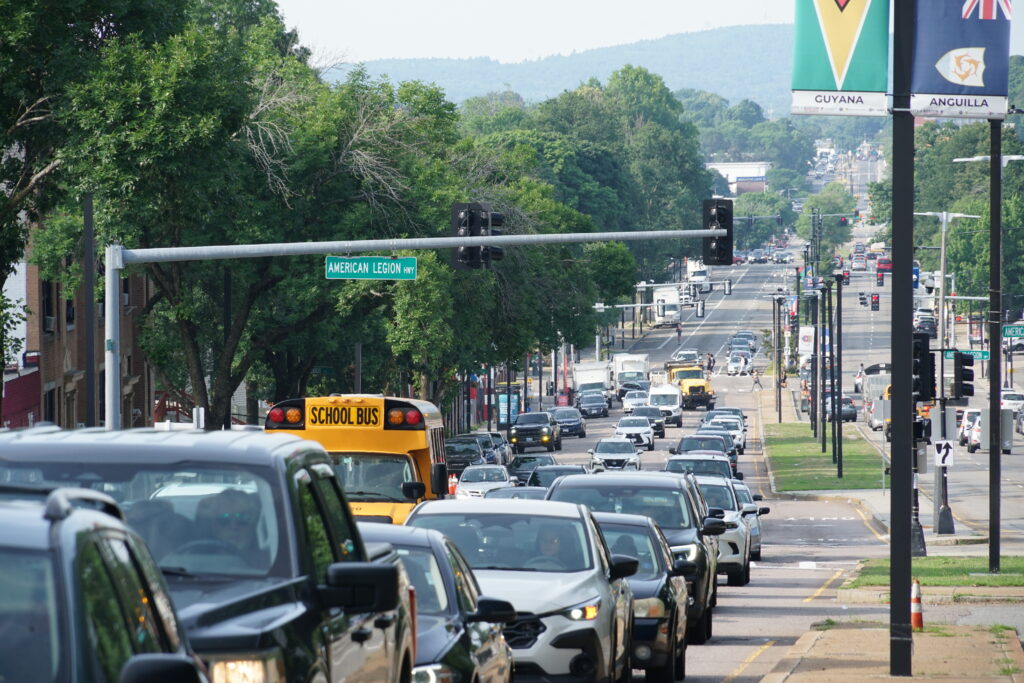
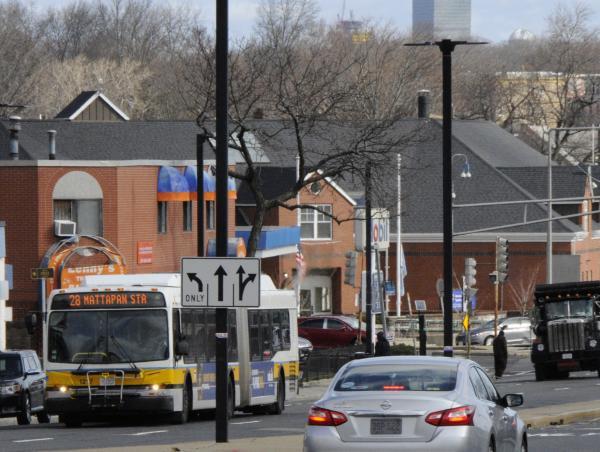
Above: Traffic on Blue Hill Avenue on a recent July morning. Yawu Miller photo
City of Boston and MBTA officials plan to convene a fresh round of community meetings in September to discuss revised plans for a transformative, $135 million plan to modernize and improve Blue Hill Avenue from Mattapan Square to Grove Hall.
The major infrastructure project, in the works for several years and the subject of dozens of meetings already, has been dogged by vocal opponents who say one of its central features— a center-running bus lane— may be disruptive to businesses and is unwanted by many who live in the community and use the roadway.
The new round of four public meetings will begin with a town hall meeting on Thurs., Sept. 10 at Morning Star Baptist Church in Mattapan. Three additional meetings are planned in both Dorchester and Mattapan through the end of September.
The renewed outreach on the project comes as Mayor Wu reshuffles the leadership and priorities of her administration’s Streets Cabinet, prompted in part by the death of city transportation planner Louisa Gag, who was fatally struck by a truck while riding her bicycle in Mission Hill on July 9.
“After years of listening and learning from residents, local businesses, elected leaders, and transit riders, we are excited to share an updated proposal reflecting detailed feedback and gather additional public input on the future of Blue Hill Avenue,” Mayor Wu said in a statement to The Reporter today. “I encourage residents to join our upcoming community meetings and help guide this transformative, generational investment in a safer, more connected Blue Hill Avenue for everyone who lives, works, worships, owns a business, or travels along this historic corridor today and for generations to come.”
In a letter last week, Wu acknowledged that her administration had fallen behind on some roadway work and that its processes for selecting, designing, and delivering street projects— including the Blue Hill Avenue re-design— needed improvement.
Her plan called for bringing Chris Osgood and Tali Robbins into full-time leadership roles and convening an advisory group to examine the Streets Cabinet’s staffing, resources, and organizational structure.
Osgood, who previously led the cabinet from 2015 to 2021, will begin serving as interim Chief of Streets on Aug. 3. Osgood told the Reporter that the Blue Hill Avenue meetings will be organized jointly by city departments and MBTA planners.
“We plan to announce with the MBTA a series of community conversations in September that reflect the significant amount of work that’s happened in the last several months between the City of Boston and the MBTA, working with and responding to feedback we’ve gotten from the community,” Osgood said.
In announcing the meetings, a city statement provided to The Reporter referred to an updated design and a willingness to “gather additional public feedback.” It also signals ongoing support for moving forward, hailing the project as “the largest investment in the Blue Hill Avenue streetscape in decades.
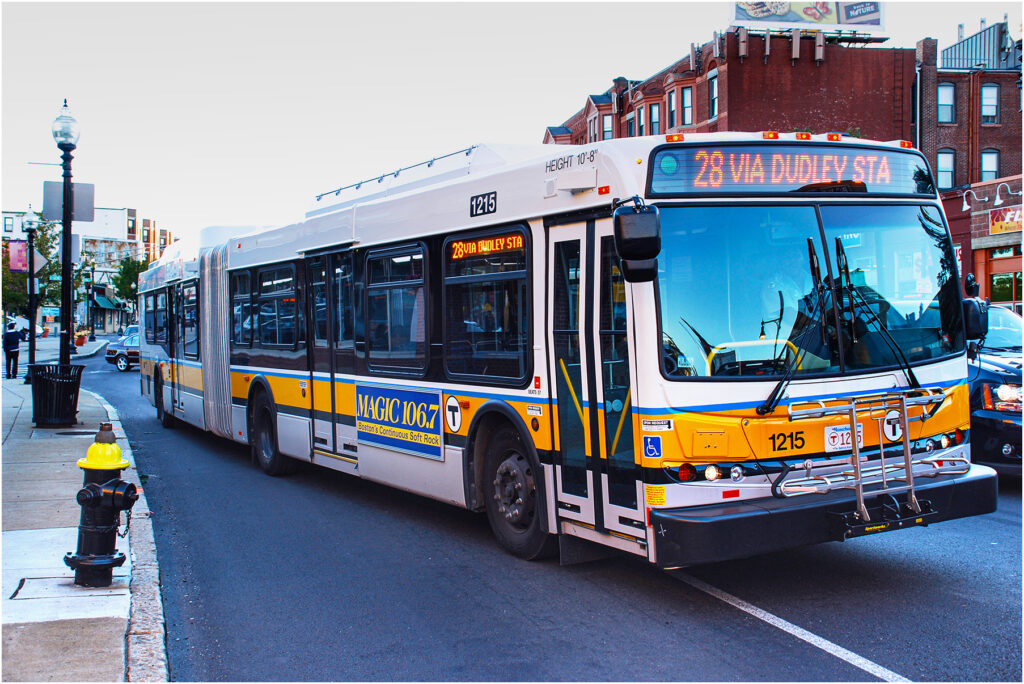
“It will fund a full reconstruction of the roadway and sidewalks along the three-mile corridor and add new streetlights, trees, street furniture, safer crossings, and additional improvements. The proposed center-running bus lanes are expected to reduce travel times for all bus routes on Blue Hill Avenue. Route 28 trips from Mattapan to Grove Hall will be shortened by approximately 10-15 minutes during rush hour––cutting trip times in half,” the city statement reads.
City and MBTA officials have not yet indicated whether revisions to the design will change the cost estimate or specific design elements. But Osgood emphasized that the revised plans would result in a net increase in parking spaces and retain at least two general traffic lanes in each direction through most of the corridor. The design also calls for signalized left turns and U-turns at selected intersections, nearly 200 new street trees, 185 pedestrian ramps, and 20 additional signalized crosswalks.
Osgood described Blue Hill Avenue as “one of the most critical transit spines in New England” and said the latest design seeks to balance improved bus reliability with the concerns of businesses, motorists, pedestrians, cyclists, and residents.
“We want to make sure that, for example, we are supporting small local businesses through a net increase in parking spaces,” Osgood said, while also “adding greenery and enhancing the public realm, responsive to the requests we’ve heard from residents.”
The September meetings fit a changing approach to public participation suggested by Wu in her July 24 letter.
“Meaningful community engagement should not delay a project until unanimous agreement is reached, nor become merely a box to check before rushing to implementation,” Wu wrote. “Community engagement is how we address tradeoffs fairly, cultivate trust through genuine dialogue, and arrive at the most effective design details.”
A recent Reporter review found that the project has already been the subject of at least 18 formal public meetings since 2022, with thousands of survey responses and less-formal outreach contacts made by MBTA and city staff. Asked why more meetings were necessary, Osgood said the earlier discussions produced design changes that residents should have a chance to review and refine.
“Public engagement is going to be really important to continue to shape and enhance the design we have,” Osgood said. “There are a number of design changes, to the credit of the MBTA team and the city team, that reflect what we’ve heard at some of those previous meetings.”
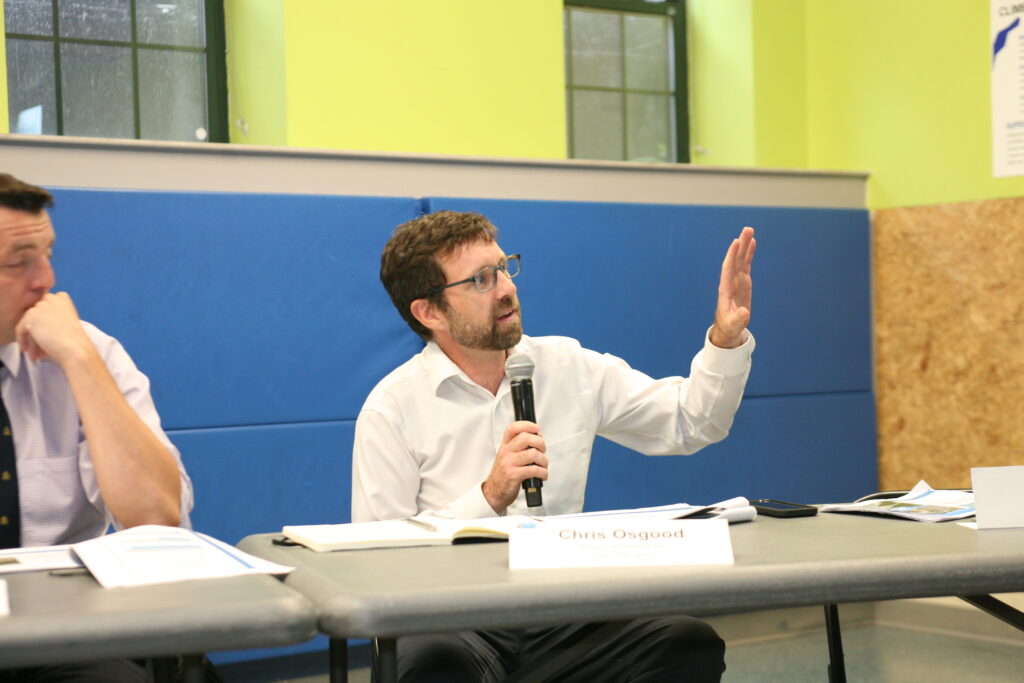
Chris Osgood is shown during a public meeting in 2024. Seth Daniel photo
While the Streets Cabinet is most directly engaged in design, Osgood called it “an all-administration collaboration with the MBTA.”
“It really is about the corridor as a whole, and how we improve and invest in the corridor in a way that works best for residents all along the corridor, businesses, the institutions and the residents who live along that corridor,” he said.
Wu and her cabinet will also be able to lean on a new eight-member Streets Advisory Group that Osgood said was assembled recently and had its second meeting this week. Members include former city and state Transportation commissioners, including several men and women who served in key roles under former Mayor Tom Menino.
They include former city Transportation chief Tom Tinlin, a close Wu ally from South Boston, who also led the state’s Department of Transportation; Joanne Massaro, who was the city’s former Public Works chief; and Dorchester’s Justin Holmes, who was a chief of staff to city councilor Maureen Feeney and served as Chief Information Officer for the city under Menino.
Other members include Jarred Johnson, a former Dorchester resident who led the advocacy group Transit Matters; former District 6 City Councillor Matt O’Malley; former BTD planning director Vineet Gupta; former LivableStreets Alliance executive director Stacy Thompson; and Brad Gerratt, who also led the city’s Transportation Department.
The group is expected to review job descriptions for key vacancies and advise Wu on how the cabinet should be organized going forward.
“The experts focused on that work are really providing some guidance to us,” said Osgood, who noted the bulk of their conversations would happen in the “early fall.”
The meetings on the Blue Hill Avenue project specifically are scheduled for Sept. 10 at 6:30 p.m. at Morning Star Baptist Church, 1257 Blue Hill Ave.; Sept. 14 at 6:30 p.m. at the BCYF Perkins Community Center, 155 Talbot Ave.; Sept. 22 at 6 p.m. at the Mattapan Branch Library, 1350 Blue Hill Ave.; and Sept. 30 at 6:30 p.m. at BCYF Holland center, 85 Olney St., Dorchester.
In announcing the new set of meetings, the Wu administration included words of support from State Rep. Russell Holmes, one of the leading political voices for the Blue Hill Ave project, and from District 5 Councillor Enrique Pepén.
Holmes said, in part: “Our communities deserve this investment into our neighborhoods. I look forward to the continued robust community engagement this fall to further refine the design and bring this long awaited project into fruition.”
Other changes to staffing in the Streets Cabinet include interim Chief of Streets Nick Gove moving into his former role on Aug. 3 as deputy chief for transportation. He will oversee all Transportation Department operations and will also oversee the Public Works divisions – which is responsible for street operations, street lighting, waste reduction, code enforcement and central fleet.
Amy Cording will continue to serve as Interim Deputy Chief for Infrastructure and Design.
