
The first votes in Boston’s preliminary election for mayor will be cast in three weeks and candidate Josh Kraft is considered a lock to earn a spot on November’s ballot to challenge incumbent Michelle Wu in a head-to-head contest for the city’s top job.
But, Kraft, who sat down with The Reporter last week for an interview, is keenly aware that his campaign will face a steep uphill climb this fall.
“I know there was a public poll that came out that had us 30 points down, and frankly, I was shocked, because the response we’re getting in the neighborhoods, every single neighborhood, regardless of socioeconomics, race, ethnicity, language, it’s always the same,” he said. “People don’t feel connected to the city, people don’t feel listened to or a part of the city, and they want change.”
He’s still “in it to win it,” Kraft emphasized during a pause between stops in Charlestown and the North End. “I feel great about our campaign. I’m going to work as hard as I can physically, mentally, and just keep looking and connecting, talking to folks, hearing folks, and so on. It’s all about people connecting to me.”
The 58-year-old Kraft, who relocated to Boston from Newton in 2023 and lives in a North End condominium with his partner, Michelle Perez Vichot, often leans into talking about his three decades of work in Boston’s neighborhoods. It’s that experience, his supporters say, that makes him a worthy prospect to lead the city, even though he has no prior government or political experience.
The candidate frames the job of mayor as the “ultimate” form of community work, something that he has spent his life doing as a non-profit leader.
“The mayor of a city is unlike any other political position because in the end, it’s not about politics,” Kraft said. “A mayor is all about getting things done for residents on the ground, being responsive, understanding the needs of the community, and helping the community meet those needs. It’s more about transparency, management, and accessibility than it is about politics.”
The third-born son of New England Patriots owner Robert Kraft, he says he chose not to join the family business full time, but to focus instead on public service and the welfare of city youth. After his graduation from Williams College in 1989, Kraft worked in South Boston for several years as an outreach coordinator at a non-profit focused on at-risk teens and children. In 1993, he founded the Boys & Girls Club of Chelsea in the basement of a public housing development and spent 15 years there as the organization’s executive director.
In 2008, he was hired as the president and CEO of the Boys & Girls Club of Boston, a role he held for twelve years. During that time, he points out, he doubled the club’s budget and membership by expanding into Jamaica Plain, Roslindale, and Mattapan, which is now home to the Josh Kraft Mattapan Teen Center on Hazelton Street.
“The people I’ve met through 35 years of working in the neighborhoods from all walks of life, they’ve taught me about their hopes, their dreams, and they’ve taught me about resilience,” Kraft said. “The number one thing they’ve taught me is the power of community. The power of people coming together to make change for the greater good.”
He added, “And all of them, and all those relationships and all those people, and what they’ve taught me, is what inspires me to run for mayor of Boston.”
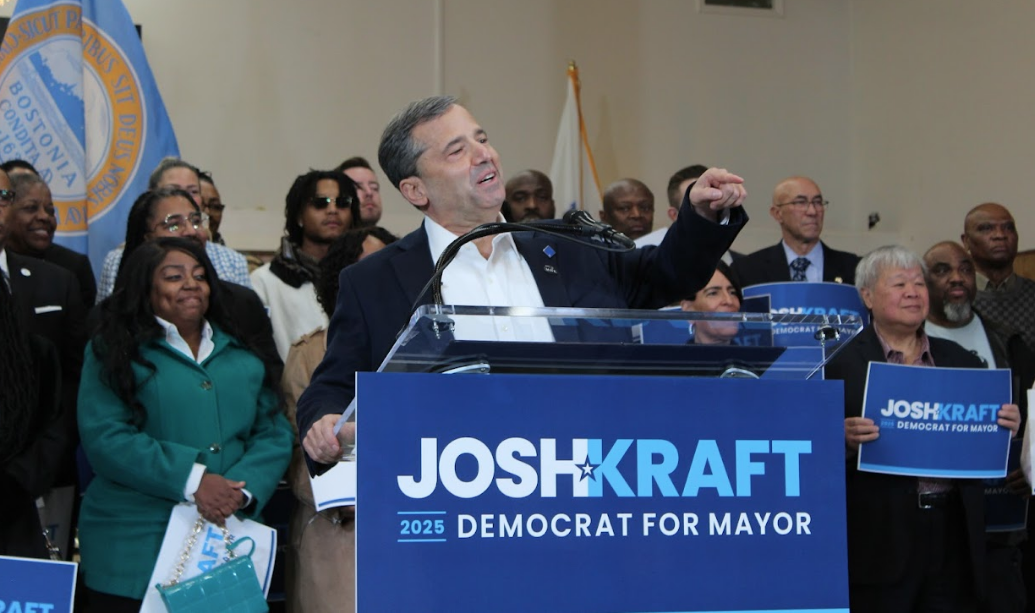
Kraft officially launched his campaign on Feb. 4 of this year in Prince Hall Grand Lodge in Dorchester’s Grove Hall neighborhood (shown above). He told The Reporter that he definitely recalls some nervousness as he stepped into the spotlight that day with a group of about 75 supporters behind him.
“Launch day was a key moment of the campaign,” he said. “I knew media would be there. When I walked out, I saw 35 years of relationship on the stage behind me, but then I turned around, and it was the media. I was like, ‘Wow, pretty intense.’”
In the past, Kraft said, he became accustomed to proving his value with his actions, not his words. “I wouldn’t try to tell people; I’d try to show people,” he said. “In this, you’ve got to show, but you’ve also got to tell. It was my first time doing that, and I’ve definitely gotten much better.”
Kraft, by most accounts, has shown improvement on the stump over the last six months. While perhaps not as smooth or quick with his words as his opponent, as a candidate, he tends to have more success away from the cameras and microphones.
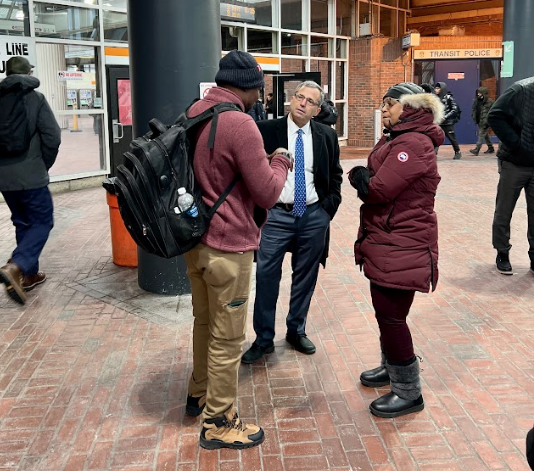
His friendly, quiet demeanor comes off as personable in smaller settings, such as when he greeted potential voters at T stations in Nubian Square and Forest Hills (above), often acknowledging people he knew from his leadership role at BGCB.
But, as he takes on a heavily favored incumbent, Kraft’s spelling out of his critique of Wu’s performance has been sharp and, at times, damning, spotlighting a host of issues, ranging from housing production and her support for expanded bike lanes to the ongoing public safety crisis centered around Massachusetts Avenue in the South End and Roxbury.
But he has reserved perhaps his toughest critique for the mayor’s expensive high-profile project: The rebuild of White Stadium at Franklin Park, which her administration has advanced as a “generational opportunity” for the city’s school population. The renovation, now underway, is part of a joint venture with a professional women’s soccer club, Boston Legacy.
Kraft argues that the project should be exclusively for Boston students and that it can be done at a far lower cost than the mayor has set out to spend. The number he cites is $20 million. If elected, he said, he will cancel the contract between the city and the sports franchise and design the facility for a different use.
“We need to know how much money is being spent,” he said of the project. “The last public number we got was $91 million. I, from someone at City Hall, have an estimate sheet that has it at $172 million. Whatever it is, it’s way too much money.
“You could have a stadium solely for the use of Boston Public school kids, and the generations of families that have used the park,” he asserted. “I am confident that we could get a lot of private philanthropy to cover at least half of that $20 million.”
Housing— and Kraft’s claim that Wu’s policies are to blame for a slowdown in new construction— has also been a constant refrain in his campaigning.
“We need a more affordable option, especially for working people,” he said. “We have a first-time home buyer program that includes working families because the current programs are great, but unfortunately, some working families make too much to qualify for them, but they don’t make enough to buy a home.” His proposal, he noted, “increases the eligibility requirements, income, salary wise, so more people can be involved and qualify for the program.”
Another key issue that Kraft often raises is the state of public education in Boston.
“Schools need to be better,” he said. “We pay taxes, some folks are worried about their kids in the schools. Others say, ‘I pay taxes, and I have to send my child to parochial or private school.’ I think we got to make the schools better. That’s what the residents and the families of the city deserve.”
Improving literacy rates, increasing vocational opportunities, and reassessing exam schools, he said, are all part of his plan. To make things work, he said, he would get parents more involved in the decision-making side of school administration.
“We want to engage parents,” he said. “Make sure they feel a part of the process. So we’re going to return elected members to the school committee. We’re also going to reopen the office for parents at City Hall.”
In April, Kraft visited the Richard J. Murphy School in Dorchester and heard parents express their concerns and frustrations about safety inside their children’s school. “Safety in schools is a huge issue, and whether it’s social workers, psychologists, or some kind of public safety force being in the school, we have to do better, because if kids don’t feel safe, they’re not going to learn,” he said, noting that if “teachers don’t feel safe, they’re not going to be at their best.”
In the larger sense, safety concerns in and around neighborhoods most impacted by homelessness and drug addiction– often oversimplifed as the “Mass. and Cass problem” – is a “human tragedy” that Kraft often cites as a priority.
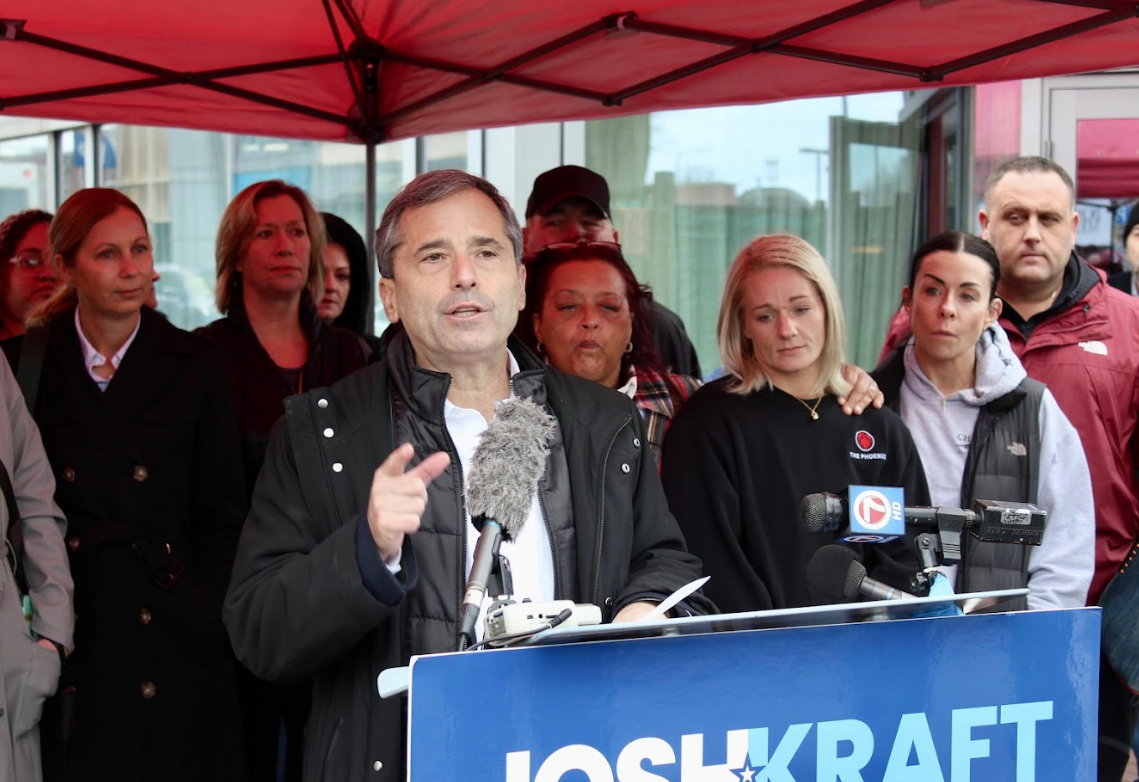
Candidate Josh Kraft spoke at a press conference near Massachusetts Avenue in April 2025. Reporter file photo
He has proposed opening a new recovery campus and in the interview he said he backs a proposal by District 3 City Councillor John FitzGerald to create a regional fund, with other communities adding money to help pay for facilities and services in Boston.
“It’s a major issue with two phases,” Kraft said. “The first is a human tragedy of a vicious cycle, of addiction, mental illness, and homelessness that needs to be addressed. The second is the impact on neighborhoods and the quality-of-life impact for residents, homeowners, and small businesses. We need to fix both, and we need to do it as soon as possible.”
With respect to a problematic situation for Dorchester and Mattapan residents – last August’s abrupt closure of Carney Hospital – Kraft has offered less-than-specific answers when he has been asked about what might now be done with the still-vacant site. “Healthcare is the cornerstone of the community,” he has said, “people need access to healthcare. We have to figure out that at least emergency services need to be at the Carney or somewhere.”
In recent days, the challenger has turned to speaking about what Boston is facing with Donald Trump in the White House for a second time.
Two mailers paid for by his campaign sent to city voters in the last week targeted the president directly, using the theme that Kraft will be a “fighter” and “stand up to Trump’s dangerous policies and make Boston a city where everyone is welcome.” And, on Sunday, in a scripted address to supporters at Iron Workers Local 7 Union Hall in South Boston, he was pointed in his rhetoric about Trump.
“Mayor Wu likes to tie me to Donald Trump because of my dad’s relationship [to him],” he told The Reporter last week. “First and foremost, my dad is not running for mayor. I’m running for mayor. I am my own person. I’ve never voted for Donald Trump. I’ve never given him a cent. I think he’s completely unequipped ethically, temperamentally, emotionally, to be the president of the United States. We see it every day.”
Kraft went a step further: “In this past election, I voted for, and financially supported, Kamala Harris. People don’t know, but I paid for a bus to go to Pennsylvania to knock on doors. I love my dad a lot. We agree on many things. [But] we have disagreed on Donald Trump since 2016.”
Kraft noted that his grandparents’ immigrant experiences drive his opposition to this president.
“My mother’s dad came here to escape the Nazis as an immigrant,” he said. “I understand what our immigrant community is going through now with Donald Trump, and many of the people in my 35 years of relationships are part of that community.
“They have taught me about hopes, dreams, and the power of resilience, and I will always stand by them and stand hard against who’s going after them unfairly, no matter who’s in the Oval Office.”
The quest by Wu and media outlets for more information on his personal finances and his ties to his family’s business interests continues to dog Kraft’s campaign. Last Friday, an accounting firm that works for him shared a summary of his tax payments, but not his full tax returns from recent years that would include more information about his holdings and sources of income.
As if on cue, Wu and her allies in state and city government on Monday once again touched up Kraft for his unwillingness to share more detailed financial information.
Kraft has continued to deny that he has a role in the project or his family’s business ventures, though a disclosure last week noted that he takes in revenue from the Patriots Foundation, a non-profit entity controlled by his family.
In the interview, Kraft seemed undaunted despite the ongoing questions about possible financial conflicts and his poor polling numbers.
“I’ve been campaigning 24/7. It’s funny, as of February 4th, I had never been in this world before. I don’t know how people, if they lose it, and then go challenge another, I don’t know how people do this,” he said. “I’m pouring everything I have into [the race] because I believe in the city and I believe, most importantly, in the people, in the residents of this city.”
This is the latest in a series of Reporter articles about the three candidates challenging Michelle Wu in the Sept. 9 preliminary election for mayor of Boston. Earlier articles in this series focused on challengers Domingos DaRosa and Robert Cappucci.
