

‘Bold’ plans, hostile feds are part of terrain
Eighteen years ago, Michelle Wu, a Chicago native and recent Harvard graduate with a degree in Economics, was working in the private sector for a consulting firm when a family crisis changed the course of her life, calling her home to Illinois, then back to Boston, this time with a new sense of mission.
By 2021, the change of direction had made Wu a historical figure in local politics: the first woman and person of color to be elected as the city’s mayor. But, when she left Boston in 2007, it was as a crisis responder, helping a mother who, she said, had suffered a “nervous breakdown” and also caring for three younger siblings.
When the help at home expanded to opening a “tea room” in Chicago, Wu took on one more new role: that of a frustrated constituent struggling with a city bureaucracy.
Getting the family business up and running took eight months of “red tape” and inspections — an ordeal that Wu credits with spurring her to come back and enroll in Harvard Law School.
“I felt like no one in government was even acknowledging real life, much less trying to help us,” Wu recalled in a video post on Harvard Law Today. “I really wanted to go back to law school and understand how I could help craft some of those ordinances and shape some of that city government bureaucracy to make it easier for families.”
In 2025, while campaigning for her second term as mayor, Wu has been adding variations to the same theme, whether in access to early education and child care or getting approvals for new housing. But, even before her first run for elective office in 2013, the family entrepreneur had gained learning experiences from two political figures: former Boston mayor Tom Menino and the state’s senior US Senator, Elizabeth Warren.
While attending law school, Wu interned with the Menino administration, where her first assignments included helping clear regulatory hurdles for food trucks and streamlining the permit process for restaurants.
“I still can hear his voice, talking about how important it is to make sure that whatever you do, whatever the experts are saying, whatever the complex policy details are, at the end of the day, the real question is, ‘What does this mean for families in our city?’” Wu said in a remote interview earlier this month.
Another part of the experience was the occasional ride back to City Hall with a mayor whose encyclopedic command of neighborhood particulars bespoke his branding as the “urban mechanic.”
“One time we were at an event at the Mildred [Avenue K-8 School], and then went back to City Hall afterwards,” Wu recalled, “so going back from Mattapan to Government Center and hearing all the stories he had, where every single block held some important meaning to him, whether it was who lived there and how they were involved in our community, or a grocery store that he had worked so hard to persuade to move in because residents needed access to fresh foods and everything that a grocery store offers, or a vacant parcel of land that he was still hoping would turn into something that would improve the community.”
Around the same time, Wu was taking a class on contracts taught by Warren. What stood out for her was a professor who began her first class by skipping the ceremonial preamble and immediately “cold calling” students on assigned reading. According to Wu, the learning went beyond the pacing and accountability for digesting material, even beyond understanding how individual cases take on the larger role of precedents.
“But she would always push us to go deeper,” Wu noted, “in that it wasn’t just about who won and who lost before the courts—that, in fact, the laws were already written through advocacy or lobbying from certain groups who had particular interests and might have had more of a platform or resources to get their interests reflected directly in the law.”
In other words: How law comes from power, and how power is flexed by political action.
For Wu’s elected predecessors, the path to power ran through networks dominated by men: politics, organized labor, and sports. Wu’s path combined legal work for tenants faced with eviction and vulnerable populations served by local health providers. She also took part in Emerge Massachusetts, a Democratic recruitment and training program aimed at increasing diversity in leadership and encourage more women to seek office.
A more direct encouragement was Professor Warren’s decision to challenge her Republican predecessor, Scott Brown, in 2012. Wu joined the campaign, coordinating outreach, even showing up late for law school graduation after a morning rush-hour standout at North Station.
“What actually made me think about politics as a possibility was seeing her transition from professor to candidate to senator without changing anything about herself,” Wu said on Harvard Law School Today. “It was incredibly inspiring to see that you don’t have to put on a politician face or have a very different public and private persona.”
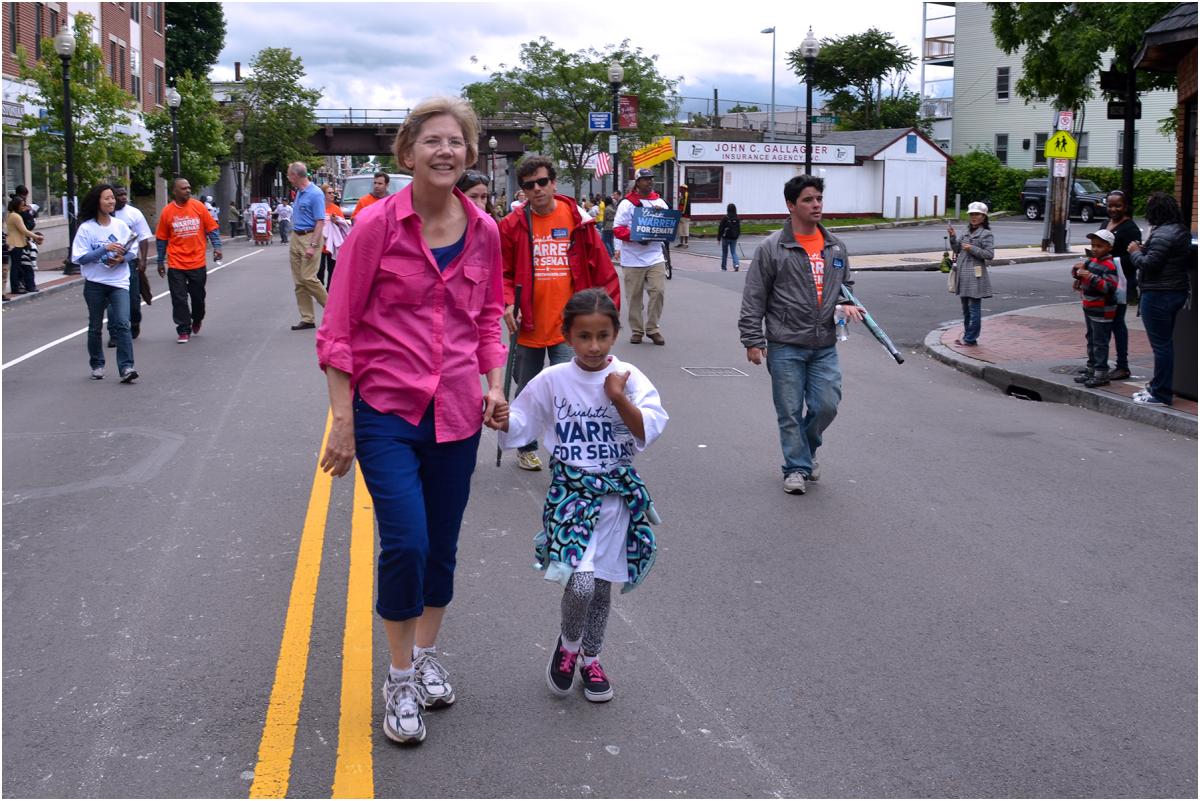
That’s how Wu ended up tailing Warren in the 2012 Dorchester Day Parade. The candidate was in the middle of the avenue, wearing sneakers and sporting a casual pink shirt with hem untucked and long sleeves partly rolled up. Off to the side of the avenue, within range of spectators, was Wu, also in sneakers, clutching campaign “lit,” wearing jeans and, over a long-sleeved shirt, a white-and-blue “Warren” T-shirt.
By the end of the parade, Wu recalls her giving the tee-shirt to a Warren enthusiast. She also remembers the avenue and the crowd.
“It’s seeing people who reflect every part of our community come together to celebrate what connects us,” she reflected, “not speaking the same language necessarily, not voting the same way or looking the same or even worshiping the same way, but all connected to a sense of place. And Dorchester Day is one of the best days of the entire year because, down that three-mile stretch of our city, we see every culture, every generation and, no matter the weather, people come out for it.”
Wu returned to the parade route the following year, in her first run for city councillor-at-large that would prove to be successful. Eight years later, as the winning finalist for mayor against a council colleague from Dorchester, Annissa Essaibi George, she carried four of the area’s five wards.
Last month, Wu was endorsed for re-election by the Democratic Ward Committee in Ward 15 (Meeting House Hill/Fields Corner). As of Monday this week, the Ward 14 (Grove Hall, Franklin Field, Mattapan) Committee had yet to endorse a candidate for mayor, but its chair, Darryl Smith, could cite accomplishments for Wu—as well as challenges. Under Menino, Smith had worked in the Inspectional Services Dept. and later became an interdepartmental troubleshooter, chairing the mayor’s Neighborhood Response Team.
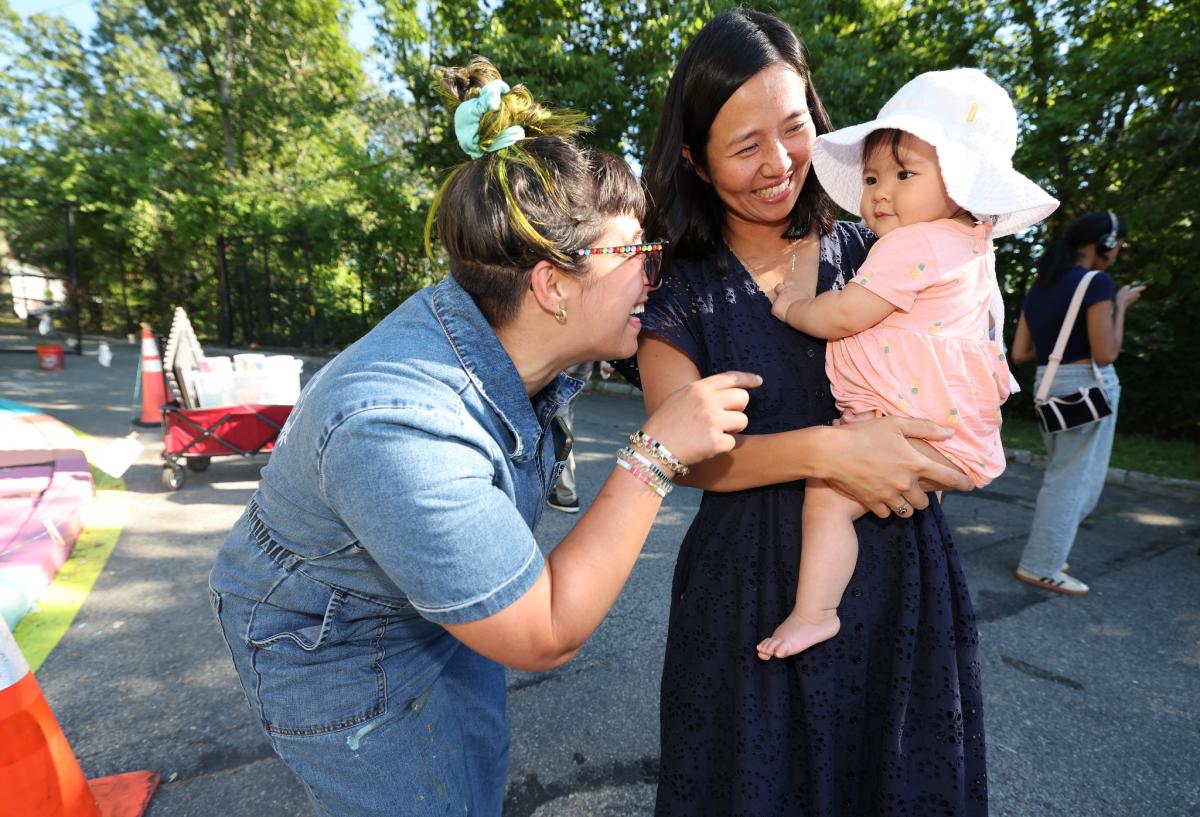
Above, Mayor Wu and her daughter Mira greeted a constituent at Mattapan’s Gallivan Community Center Unity Day on Aug. 23. John Wilcox/Mayor’s Office photo
Smith credited Wu with free bus service for riders along the Blue Hill Avenue corridor—funded initially by federal pandemic relief money— and for trying to improve service with bus lanes staunchly supported by state Rep. Russell Holmes. The lanes had been opposed by some business owners concerned about congestion and the lack of parking, and the MBTA cautioned against pursuing the free service pilot program, expressing concerns about future funding—even though ridership on the routes increased at a rate higher than systemwide.
Smith also credited Wu with boosting city contract opportunities for certified companies headed by women and people of color. In FY2024, those firms accounted for almost 12 percent of the city’s discretionary spending. A 2021 study found that “minority” contractors had accounted for only 2.5 percent of the funding over the previous five years.
“If we stayed on that same trajectory, our community would have lost out on over a hundred million dollars’ worth of contracts,” said Smith.
In an endorsement of Wu earlier this month that was posted on Instagram, Sen. Warren emphasized gains for access to early education and childcare. “Michelle Wu has delivered on childcare,” said Warren. “She’s added more than a thousand new seats for preschoolers. She’s helped 70 new facilities open their doors for our littlest learners, and she’s expanded pre-K every single year that she’s been mayor.”
At the same event, Wu reaffirmed her goal to make Boston the safest, the greenest, and “most family-friendly” city in the country. Official figures show a recent overall drop in reported crimes, with similar post-pandemic drops in other cities. And budget increases for the Police Dept. counter earlier calls by some of Wu’s fellow Progressives to “defund” the police. But other figures show a continuation of the long decline in the number of Boston’s school-aged children—even during years of steady population growth before the pandemic.
“That is one of the driving reasons that I ran for this office,” Wu said in the remote interview, going on to add, “I have said to the team that we want to be investing in our infrastructure and housing production and everything so that we can continue to be a growing city. But, even as a total number of people has been going up, the number of children living in the city has been going down, and that when you ask families, you can feel the pressure from housing costs that are way too high, and decisions that are made about the convenience of the commute or confidence in the school system or the cost of childcare.”
In May of this year, Wu announced a $64.2 million program to create and preserve income-restricted housing units. And, last November, she announced funding for a “housing accelerator” fund, including money for middle-income home ownership opportunities that were advocated by District 4 (Mattapan/Dorchester) City Councillor Brian Worrell.
Despite the city’s boasting of “accelerated” housing production in February of this year, other trackers have noted a sharp downturn in new production after 2022—just as housing production and sales were slowed down nationwide by rising interest rates. At the same time, Boston and neighboring communities were also hard hit by the downturn in life sciences, one of the region’s leading growth sectors.
Wu has been criticized for worsening the production drop by expanding affordability set-asides required for developers—which, she notes, only took effect late last year. She has also been criticized for pursuing rent stabilization, along with a real estate transfer tax intended to generate revenue for affordable units. Both measures have failed to get approval at the State House, as has another measure that would temporarily slow the shift of the property tax burden from the commercial class of owners to the residential.
Also raising concern about added costs are climate resiliency regulations put in place by Wu that also follow initiatives supported by her predecessors.
Her efforts to unsnag Boston’s process for regulating development have met with mixed results. Though intended to increase the proactive role of planning with the neighborhoods, reforms have also given rise to concerns about remedies for displacement and the regulatory clout of neighborhood groups. In Dorchester, concerns over displacement led to zoning reforms for transit-adjacent areas near Codman Square and Four Corners to be delayed.
Getting much more attention has been was the intensely divided response to Wu’s plan to have White Stadium renovated for the Boston Legacy National Women’s Soccer League team and the Boston Public Schools. The debate has ranged from the plan and its cost, as well as the ability for plans to be shaped by surrounding neighborhoods. Darryl Smith acknowledged the sharp division over what he called a “bold” plan, but he put more emphasis on an ability to deliver on promises.
“The big take-away from me on all that,” he concluded, “is can you work with people to get what you need done? That’s where I think that, if we’re looking at the current mayor and saying, ‘Have you done everything?’ the answer certainly would be there’s a lot more to be done. And then the question becomes, is she willing to work with people to get that job done? And I think that she has achieved a lot and is looking to do a whole lot more.”
Community leaders and some elected officials have been urgently pressing for more progress on controlling outdoor drug use spinning off from the former cluster at Massachusetts Avenue and Melnea Cass Boulevard. Among them was District 3 (Dorchester) City Councillor John FitzGerald—who chairs the body’s committee on public health, homelessness and recovery. In a social media statement earlier this month, he vented frustration over what he described as a pattern of administration officials being unavailable to answer questions about the problem at council hearings.
“This not only affects constituents throughout the City of Boston,” FitzGerald posted, “this is a sign of disrespect to this body, our staff and central staff who work on so many other factors besides securing a date, for games to be played.” The post even drew assent from one of Wu’s supporters, South End State Representative John Moran, who commented, “The time for a hearing on Mass. and Cass is now.”
But, according to Tom Tinlin, a South Boston consultant and a former transportation commissioner under Menino, strains with neighborhood groups don’t necessarily prove that the mayor is being high-handed or unresponsive.
“I find it amusing when people say, ‘She doesn’t listen,’” Tinlin wrote in an email response. “I believe that is code for, ‘She doesn’t do what I want.’ The mayor and I have disagreed on things, and we talk it out….I know she hears and sees me but will make or stand by a decision that I do not agree with, but I respect that she doesn’t get so dug in that she becomes unmovable. I further respect that she makes decision for the good of the whole, not some.”
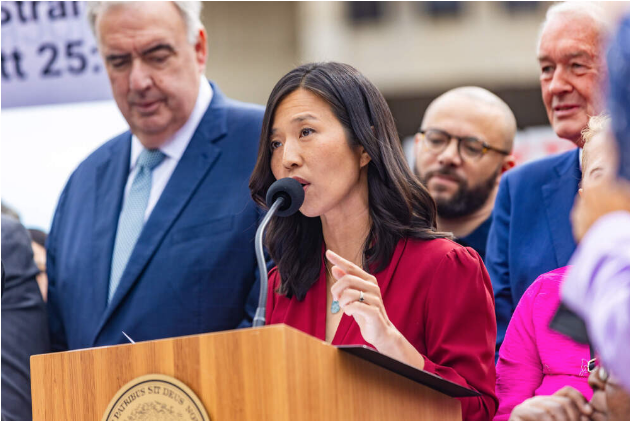
Above, Mayor Wu spoke during a press conference on Aug. 18 outside City Hall dealing with a Trump administration “demand letter.” WBUR/Jesse Costa photo
Even more contentious are relations between Wu and the administration of President Trump. His pre-election vow of mass immigrant deportations conflicts with surveyed public opinion in Boston as well as a local ordinance that limits the city’s cooperation with federal immigration enforcement. The measure, known as the “Trust Act,” was adopted and later strengthened under former mayor Marty Walsh who, like Wu, has immigrant parents.
In the remote interview, Wu stressed that immigrants charged with crimes, like other defendants, are released in accordance with pre-trial decisions by courts. Federal officials have asked for Boston Police to hold immigrants wanted on civil retainers for being in the US without authorization. But Wu argues that violent immigrants could still be held without scrapping the Trust Act if the US Immigration and Customs Enforcement (ICE) were to secure a criminal warrant from a judge.
“So we collaborate all the time with state and federal law enforcement agencies to hold people accountable for committing crimes,” Wu said. “Otherwise, we would not be the safest major city in the country with the statistics and the numbers that we have seen. But there is this piece where people are trying to suggest that it’s somehow the decision of cities or our police officers, when in fact it’s that [ICE] did not obtain the criminal warrant.”
New federal policies also affect mainstays of Boston’s post-World War II “knowledge economy,” from universities, hospitals, and start-ups generated from research, to nonprofit human services—even jobs and revenue from tourism. But, on Aug. 19, Wu faced a deadline for answering a letter from US Attorney General Pamela Bondi threatening prosecution of city officials and withholding of federal funds unless Boston complied with the Trump administration’s immigration enforcement policies.
Boston’s first mayor with a law degree since Kevin H. White, Wu signed a written response to Bondi that was couched in legal argument. The same day, she made an oral argument on City Hall Plaza, surrounded by a diverse group of allies and supporters, many from Boston’s immigrant population—or their descendants.
The assemblage on the plaza was reminiscent of turnouts Wu had seen at parades along Dorchester Avenue. This time, she cast herself as a crisis responder, even approaching the tone of legendary Red Sox slugger David Ortiz, when he came through in the clutch by uplifting fans at his team’s first home game after the 2013 Boston Marathon bombing.
“This is our country,” Wu declared. “And I’m so proud and grateful to show the world who our community is here in Boston and what we’re made of. Cities aren’t a threat to America. They fuel the American dream. They bring us together. Great cities make our country great. Boston will never back down from being a beacon of freedom and a home for everyone.”
This article is part of a series focused on the four candidates for Mayor of Boston who will appear on ballots for the preliminary election in Boston, set for Sept. 9, with early voting beginning this Saturday, Aug. 30. The articles on the other candidates— Josh Kraft, Domingos DaRosa, and Robert Cappucci, can be read at DotNews.com.
