
Total numbers from Boston’s Sept. 9 preliminary election reaffirm the time-tested advantage for an incumbent mayor, but a closer look at vote counts and campaign funding gives rise to a less familiar story: How officially non-partisan local politics can be reconfigured by the force field of a national partisan divide—even to the extent of contributing to a decision by a co-finalist to stop campaigning.
Following the pattern of her incumbent predecessors since 1979, as well as polling figures, Mayor Michelle Wu received 71.85 of the vote over runner-up Josh Kraft, who announced his decision to abandon his campaign two days after emerging as Wu’s co-finalist.
Boston’s voter turnout of 21.80 percent was below the figure for 2009, when former mayor Tom Menino was opposed for a fifth term by two at-large city councillors. But the 2025 turnout was well above the preliminary figure for 2017, when former mayor Marty Walsh was opposed by the district councillor from Roxbury, Tito Jackson.
DotLife podcast dissects the election with Yawu Miller and Bill Forry
Before September of 2017, Jackson had raised less than $100,000, and his share of the preliminary vote was 29.07 percent. By September of this year, the Kraft campaign had raised more than $6.8 million, including $3.5 million loaned by the candidate, but received only 23.07 percent of the vote. To support Kraft and oppose Wu, the independent political action committee (PAC) Your Future Your City also raised more than $3.6 million, while Bold Boston, a PAC supporting Wu, raised almost $1.1 million. In 2025, Wu’s campaign raised almost $2.9 million—less than what Kraft advanced to his own campaign.
Wu’s share of the vote was a near match for the 72 percent level of support registered in the public opinion survey numbers released early this month by Emerson College Polling. A poll by the group in February reported a slight edge for Kraft over Wu, but the later survey showed that Kraft—despite an advertising blitz on multiple platforms—had lost ground, while Wu had made dramatic gains, especially among the city’s Black, “Hispanic,” and Asian voters.
Figures from the Boston Election Dept. show that Wu carried all 22 wards, with Kraft surpassing her in only 9 of the city’s 275 precincts.
Kraft’s strongest showing was in South Boston (Ward 6 and most of Precinct 7), where he received 44.4 percent of the vote, to 49.7 percent for Wu. Though the local district city councillor, Ed Flynn, received 86.4 percent of the vote, South Boston’s turnout, at 19 percent, was below the citywide figure. In last year’s presidential election, Donald Trump and JD Vance received more than one-third of the vote in South Boston, well above their citywide figure of 19 percent.
Kraft’s next strongest showing was in Dorchester’s Ward 16 (Fields Corner/Neponset), where he tied Wu in Precinct 7 (Pope’s Hill), while carrying Precinct 9 (east of Adams Street, between Ashmont Street and Gallivan Boulevard) and the adjacent Precinct 12, between Gallivan Boulevard and the Neponset River.
Precinct 12, with its polling place at Florian Hall—the headquarters of the Boston Firefighters Union—had Boston’s second highest turnout rate, at 43.9 percent. The precinct gave 64.2 percent of the vote to Kraft, with Wu getting 27.6 percent. In last November’s presidential election, the two Ward 16 precincts carried by Kraft were the only ones carried by Trump and Vance.
The overall turnout for Ward 16 was 26.1 percent—above the citywide figure, but slightly below the figures for Ward 11 (parts of Jamaica Plain, Roxbury, and Roslindale) and well below Wards 20 (West Roxbury and part of Roslindale) and 19 (parts of Jamaica Plain and Roslindale), which had the city’s highest figure, at 35.4 percent.
At a more granular level, the highest turnout figure in the preliminary election was for Ward 20, Precinct 4, near Roslindale Village and adjacent to the location of Wu’s election-night gathering. The precinct turnout was 44.9 percent, with Wu getting 89.1 percent of the vote. Ward 20 accounted for six of the Boston precincts with turnout of at least 40 percent, with four of the others in Ward 19, a progressive stronghold.
During his campaign, Kraft drew attention to problems with open drug use and homelessness. Previously concentrated within blocks of Massachusetts Avenue and Melnea Cass Boulevard, the problems became more dispersed to other areas, especially in parts of the South End, Roxbury, and South Boston.
Flynn, whose council district also includes the South End and Chinatown, also tried to spotlight the problems in August, through an attempt to declare an emergency – a move that was stymied by fellow councillors, including allies of Wu. But the preliminary election results showed that Wu managed to finish well ahead of Kraft in precincts neighboring the “Mass. and Cass” area in the South End and Lower Roxbury.
Wu also faced strong criticism from Kraft and some neighborhood activists over her plans to replace White Stadium in Franklin Park with a facility that would be used by students of the Boston Public Schools and the Boston franchise in the National Women’s Soccer League, with part of the cost paid by the team. Despite the criticism and a legal challenge to the plan, Wu carried precincts surrounding the park in Wards 11 and 12 by ratios of at least 3:1.
The day after the election, as Wu appeared with several other elected officials backing her campaign, the local results were noted by District 6 (West Roxbury/Jamaica Plain) City Councillor Ben Weber. “Here in Jamaica Plain, we rejected a false narrative about White Stadium,” Weber declared. “The mayor is renovating a BPS facility that is going to be used by our kids in our neighborhood. It is valued, and you can see that in the numbers.”
A Wu supporter at the event from another part of the city, East Boston State Rep. Adrian Madaro, reported, “Our mayor received over 64 percent of the vote in my neighborhood. We even flipped the only few precincts that our mayor lost four years ago, which was something that we were really, really excited to see.”
The pattern of advantage for incumbents also extended to at-large candidates for City Council. Finishing first was Council President Ruthzee Louijeune, who received 45,500 votes, followed by at-large colleagues from Dorchester, Julia Mejia and Erin Murphy. More than 8,000 votes behind Murphy was the fourth-place candidate, first-term councillor Henry Santana.
Leading the other four at-large candidates who will compete in the final election, the leader was Frank Baker, who served six terms as councillor in Dorchester’s District 3. Trailing Santana by 4,430 votes, Baker finished second to Murphy in Ward 16 and in South Boston. Though he finished first in Ward 13’s high-turnout Precinct 10 (Savin Hill), he finished fourth throughout the ward, behind Mejia, Louijeune, and Murphy.
In Ward 15 (Fields Corner-Meeting House Hill), Baker came in third, behind Mejia and Louijeune, but ahead of Murphy. He finished fourth in Ward 17 (Codman Square-Lower Mills), behind Louijeune, Mejia, and Murphy. In 14 (Grove Hall, Franklin Field, Mortin Street), the top two vote-getters were Mejia and Louijeune.
In his first at-large campaign, Baker had support from several former officeholders. They included former mayor Marty Walsh, State Senator Lydia Edwards, former state representative and former Suffolk County Sheriff Richard Rouse, current state representative Brady Fluker-Reid, former city councillor Bill Linehan, and Stephen Murphy, a former at-large councillor and current Register of Deeds for Suffolk County.
Shortly before the election, Kraft received endorsements from Wu’s unsuccessful rival in the 2021 final election, former city councillor Annissa Essaibi George, as well as from former state senator Dianne Wilkerson. The day after the election, Wu was flanked on City Hall Plaza by more than a dozen supporters who were current members of the City Council or the Legislature. But their news conference was one more occasion to spotlight how much the two mayoral finalists were defined by their stance toward the administration of President Trump.
In a campaign video, Wu highlighted up her appearance before Congress earlier this year, when she defended the limits on local cooperation with federal immigration enforcement that were formulated in the city’s “Trust Act,” a measure passed by the council and signed by her elected predecessor, Marty Walsh. Last month, Wu appeared with another gathering on the plaza, firmly denouncing the threat of legal action over immigration enforcement by US Attorney General Pamela Bondi.
Though Kraft criticized spending on legal preparation for Wu’s appearance before Congress, he tried to distance himself from Trump in multiple pieces of campaign literature. One of them even showed Trump’s face, outsized and ominously shadowed, behind Kraft, with copy denouncing the president for “dividing us” and “threatening our freedoms.” In larger bold type, Kraft vowed,“ I will fight for Boston and I won’t back down.”
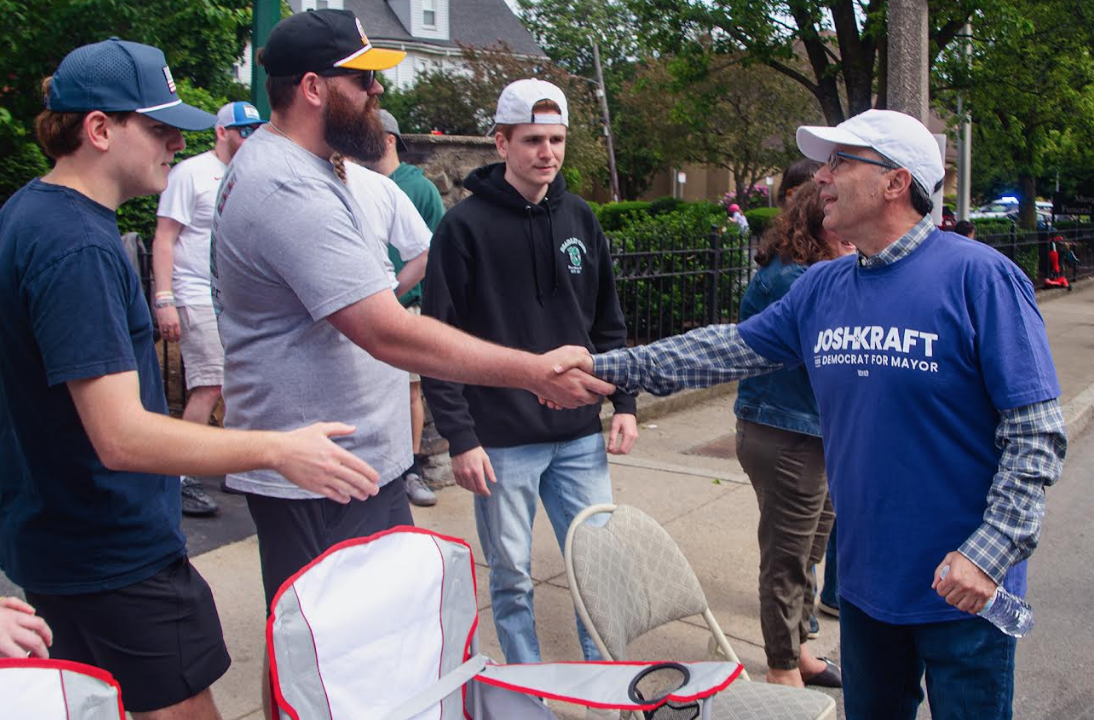
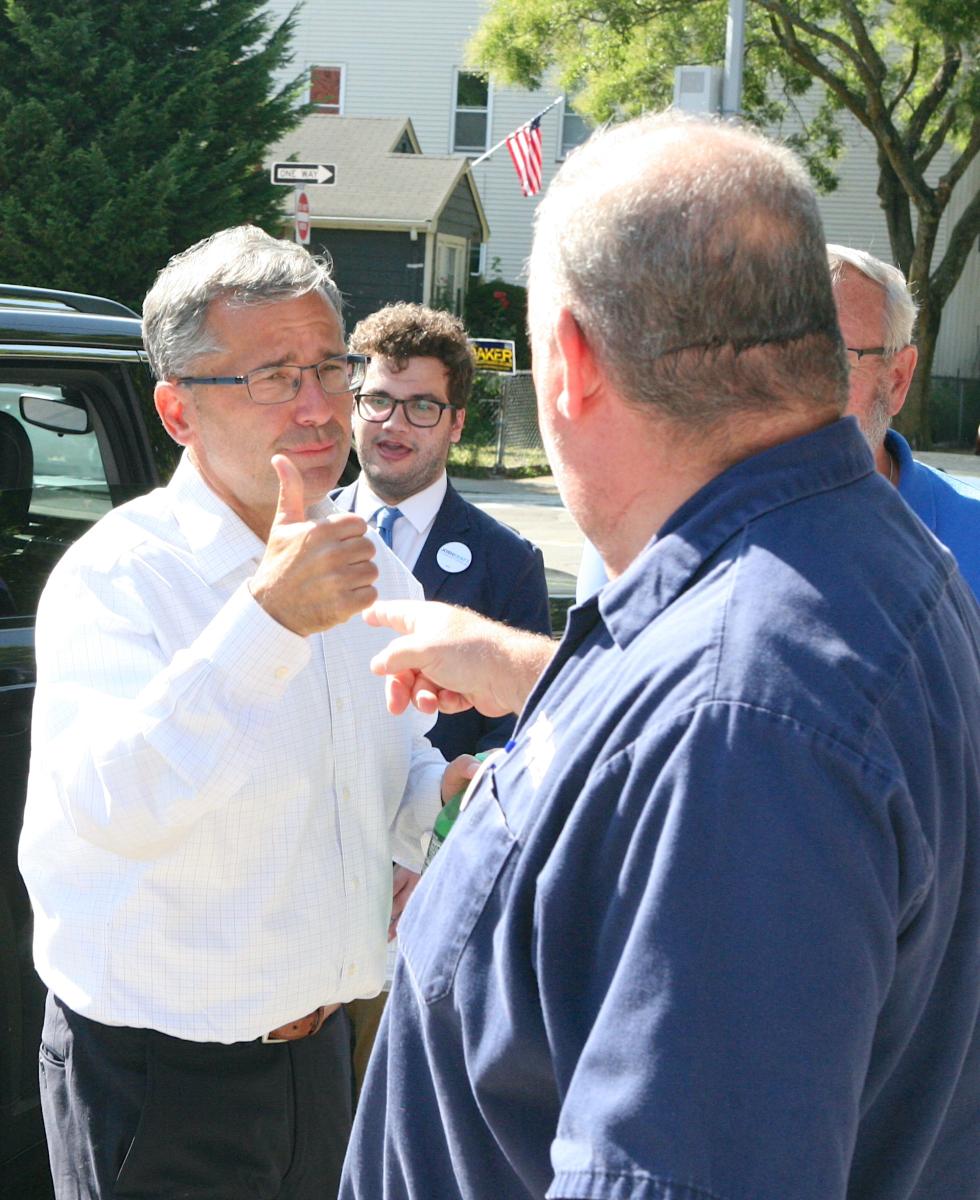
Josh Kraft on the campaign trail during the Dorchester Day Parade in June 2025. Chris Lovett photo
Though Kraft signage identified him as a Democrat, and though records show that he had made numerous campaign donations in past years to Democratic candidates, his run for mayor was also supported by past donors to Trump or other Republicans, either to the candidate’s own campaign fund or the independent PAC, “Your Future Your City.”
One of the donors to the PAC, with a $100,000 contribution, was John Alfred Paulson, a hedge fund manager who hosted a Trump fundraiser in 2024 that, according to the New York Times, brought in donations of more than $50.5 million.
Among the PAC’s largest donors, contributing $1 million, was the chairman of the New Balance shoemaking company, Jim Davis, a past contributor to Trump and supporter of his trade policies. Two years ago, Davis also contributed to a PAC opposing city council candidates aligned with Wu.
Kraft’s campaign also received a $1,000 donation from Marc Casper, CEO of Thermo Fisher Scientific. Between March and August of this year, Casper also donated $50,000 to “Your City Your Future.” In past years, according to the campaign tracking nonprofit OpenSecrets, Casper has donated mainly to Republican candidates. He gave money last year to the Republican speaker of the US House, Mike Johnson, a leadership PAC affiliated with Johnson, and the National Republican Congressional Committee.
Wu supporters have repeatedly drawn attention to the donations in campaign ads, while the mayor has echoed the same narrative in public comments. Despite his own negative statements on Trump, Kraft has accused Wu of using the president to distract from Boston’s problems with the cost of housing, “Mass. and Cass,” rising tax bills for many homeowners, and the controversy over White Stadium.
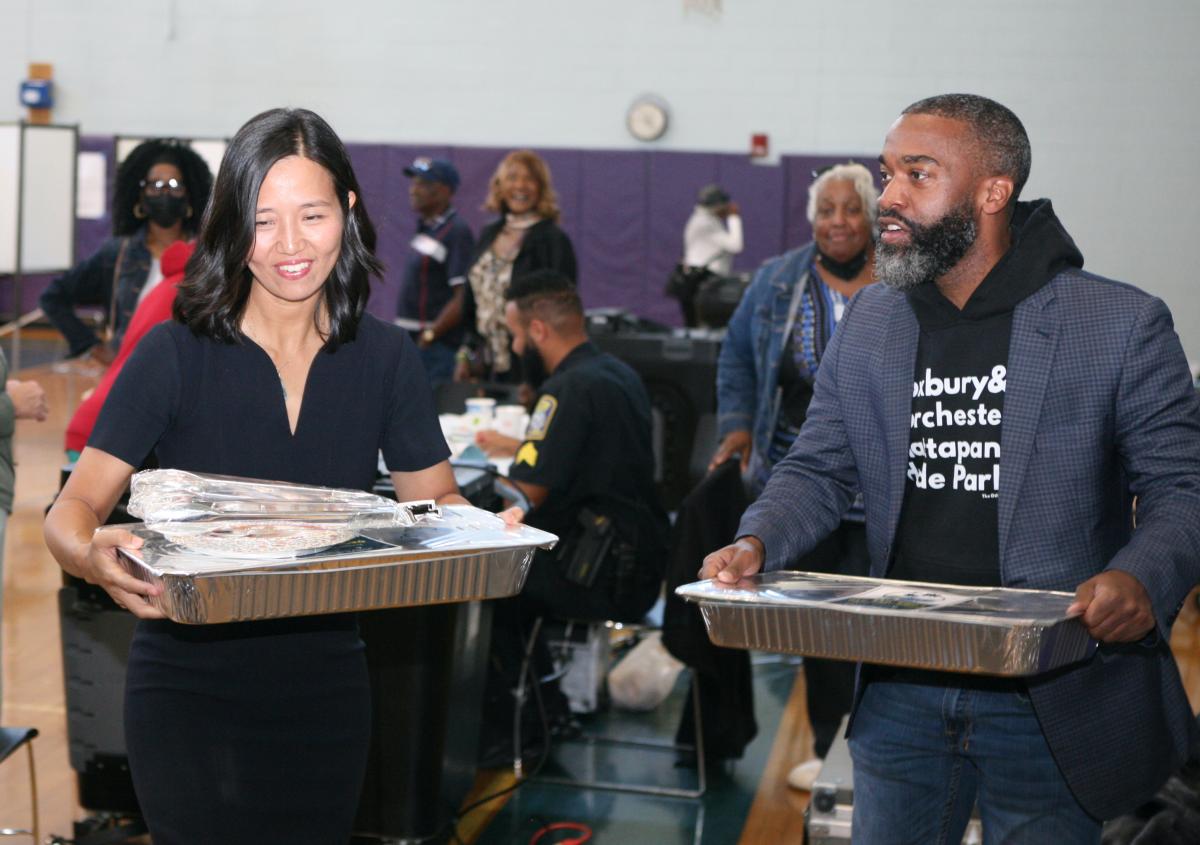
Mayor Wu and City Councillor Brian Worrell carried food trays into a polling location at the Lilla G. Frederick School on Columbia Road on Tuesday, Sept. 9, 2025. Seth Daniel photo
On two issues raised by Kraft against Wu –bike lanes and White Stadium – the Emerson poll from August showed that local sentiment was divided. But Trump’s plan to send National Guard troops into Boston was strongly opposed, by 77 percent, slightly surpassing the level of support for Wu. During the news conference the day after the election, Wu also cited the Trump effect on federal funding and the local economy—just days after the president had escalated his campaign against “blue” cities, highlighted on social media with combative imagery inspired by the Vietnam War film, “Apocalypse Now.”
“But, unfortunately, we don’t have the luxury of calling Donald Trump a distraction,” Wu contended in her news conference. “Most Bostonians do not have the privilege of thinking about this situation in this way because we don’t have millions or billions of dollars to protect against impacts when jobs are threatened, when lives are threatened, when our very identities are targeted. We don’t have the cushion to say [with] the funding that’s being cut from our schools, from improving our roadways, that’s being threatened to be cut from our public safety efforts, that we’ll find some other way to plug those gaps.”
As at her post-election celebration the night before, Wu also hailed a victory of local mobilization over money, saying:
“I think the results yesterday show [that] despite millions of dollars of negative attack ads, despite messaging that echoes this push – that everything is falling apart and we need to turn against each other and buckle down and worry and point fingers – that, in fact Bostonians want to come together.”
Before the end of the day, Boston’s election results would again be upstaged by the national political climate, with the assassination in Utah of a charismatic Trump supporter, the conservative political activist and media personality, Charlie Kirk. The killing followed shootings three months ago that targeted two Democratic state legislators in Minnesota, killing one of them and her husband. Even just a few hours before the shooting in Utah, Wu was lamenting how the climate had become more sharply polarized.
“It’s a moment,” she said, “where the example set at the federal level has unleashed hate and rhetoric that previously would’ve been unthinkable in any civil conversation, much less in the public conversation of politics and government.”
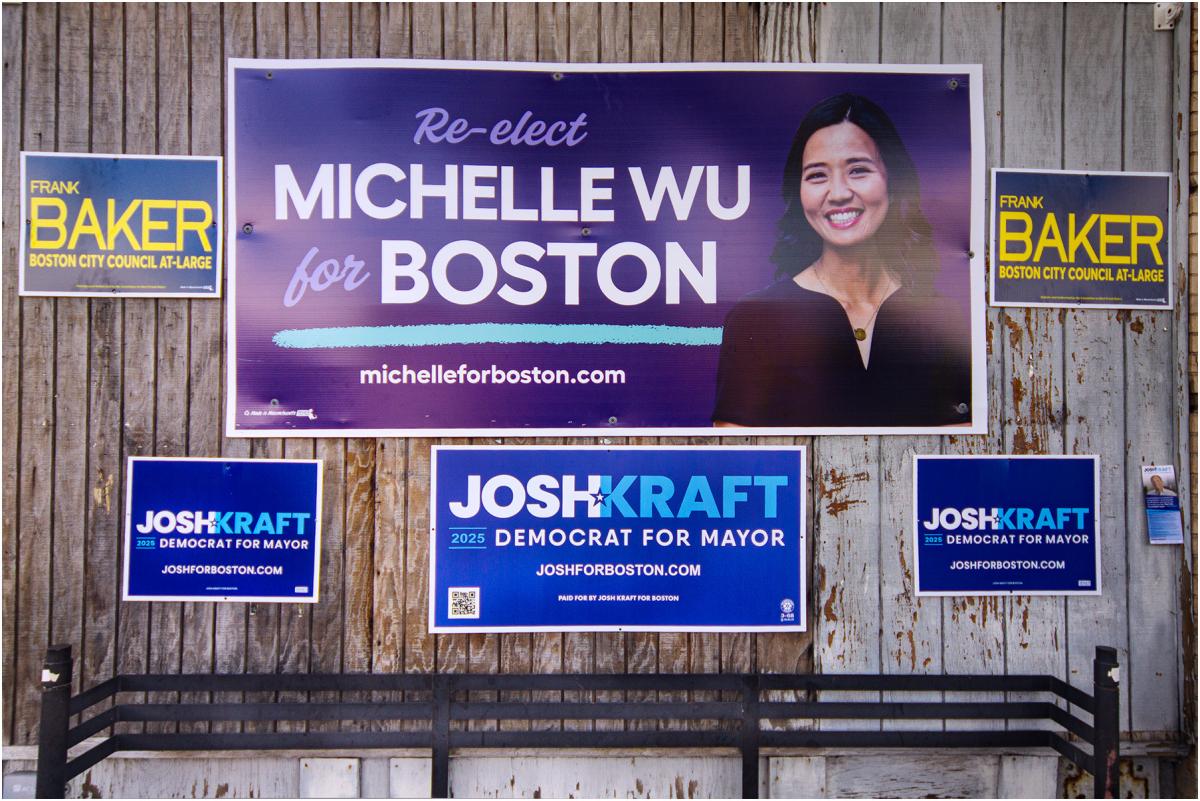
An array of campaign signs as seen on Dorchester Day, on Dot Ave, near Fields Corner. Chris Lovett photo
