
The Boston Police Patrolmen’s Association (BPPA) approved a one-year extension of its 2023 contract with the city this week, adding minor reforms to policing.
Uniformed police officers will be required to wear name tags; they’ll have access to gym facilities in BPD station houses and a 30-minute block of time in which to work out during their shifts; and they will undergo more thorough performance evaluations to bring the department into alignment with the Commission on Accreditation for Law Enforcement Agencies.
Officers will also receive a 2 percent pay raise under the new contract, which union members voted to ratify last week.
The agreement, which was announced the day before Boston voters will cast ballots for Wu, who is unopposed, and City Council candidates, underscores the mayor’s close working relationship with the police unions.
In the decades before she inked the 2023 contract, negotiations with police unions more often than not went to arbitration.
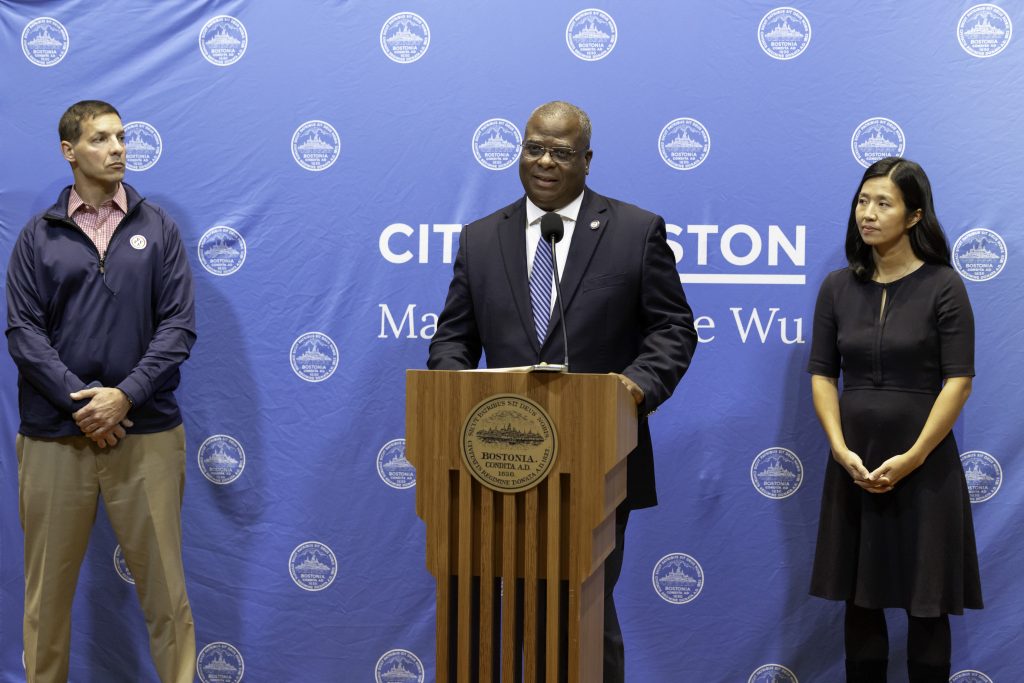
“I believe that one of the reasons why the mayor and I were so successful in coming into these negotiating contracts is because we share a similar vision,” said BPPA President Larry Calderone, “and that vision is making the department more professional, continuing to have [officers] more respected in their community and building their relationship with the people that we serve.”
Wu said the city took the unusual step of negotiating a contract extension due to the fiscal instability brought about by Trump administration funding cuts.
“We’re also in a time of tremendous need for more certainty and more predictability when it comes to public safety,” she said. ‘There’s a lot of fear in our communities, and I think we collectively decided that we could trim some of the aspirations that each side had for what would go into a multi-year contract and just focus on making sure that we would be able to have an active contract on the table, get it done, and then talk about the bigger picture of the months to come.”
Other provisions in the contract include changes to the detail system. A firm owned by former Police Commissioner Ed Davis is now under contract with the city to administer details for police and civilians, taking the responsibility for assigning contracts away from uniformed officers.
The new system will also allow the period of time for which officers are paid for details to overlap with shifts — a change Wu said would allow more officers to work details.
Speaking to reporters, Wu contrasted the department’s reforms with the conduct of federal Department of Immigration and Customs Enforcement (ICE) agents, who apprehend immigrants while masked.
“In our communities, when we have seen masked federal agents, stake out our schools, and churches, when they drag parents from their children without due process, and refuse to show a badge, or give their name or any of the details about what’s happening, the goal isn’t safety — it’s creating fear,” she said. “But here in Boston, the safest major city in the country, we do things differently. Our officers take an oath to protect our residents. They’re proud to serve the city. They call our city home, and don’t build trust with our community by hiding.”
Under the new policy, patrolmen will be required to wear name tags. BPD Commissioner Michael Cox said that officers in special units will in the near future also be required to wear either a name tag or some other form of identification.
“They don’t wear a uniform, so it might not be a badge,” he said.
With more than 1,600 members, the BPPA is the largest police union in the city. Detectives, command staff, and many members of special units are covered under other union contracts.
