

Boston Mayor Michelle Wu and thirteen city councillors began their new terms on Monday, marking a new year with a 250th anniversary bow to homegrown heroics in the War of Independence. Within a few hours, after the rituals of inauguration played out in the selection of city council president, the galvanizing spirit of ’76 would give way to parliamentary maneuvers and the equanimity of “6-7.”
Four years ago, Wu swore in Boston’s city councillors to a new term in an outdoor ceremony necessitated by the latest surge in Covid-19. Assembled in a courtyard at Boston City Hall, the councillors sported winter coats and masks, while anti-vaxx-mandate protesters on City Hall Plaza repeatedly tried to drown out the event, with a cacophony of sirens and bullhorns amplified by hollow acoustics of Government Center.
The 2026 inauguration took place in the cleaner sound space of Boston’s Symphony Hall. In her second-term inaugural address, Wu played up the difference in setting as a mark of progress, but also as a lesson about the value of technological know-how, whether for musical performance or for dislodging British rule from Boston.
In her throwback to 1776, Wu singled out Henry Knox, the Boston Public Schools alum who figured out how to get cannons from Fort Ticonderoga in New York to Dorchester Heights. A critical challenge was getting the cannons across the Hudson River when its ice was starting to melt. Thanks to his ingenuity and daring, the later positioning of the weaponry on high ground forced the British to protect their fleet by evacuating the city, a triumph saluted annually in Boston by a parade and gathering of politicians.
In her second run for mayor, Wu was outmatched by her main opponent, Josh Kraft, in combined spending from his campaign and supportive political action committees while she made sure to point out that some of the money was from donors who had also supported President Trump and Republicans in Congress. But, in last September’s preliminary election, after Kraft ended up 49 points behind the incumbent, he suspended his campaign, leaving the mayor uncontested in the November final.
Even before the start of the inaugural address, a first-term highlight video replayed Wu’s pushback against Trump policies, especially on immigration enforcement. If a national plurality in 2024 backed a presidential candidate who vowed a massive removal of immigrants, Boston’s lopsided majority in 2025 validated a staunch defender of the “Trust Act,” the local ordinance that limited local collaboration with federal immigration enforcement. The measure was signed into law by the current mayor’s predecessor, Marty Walsh, whose parents—like Wu’s—were immigrants.
“The forces we face aren’t British troops on the common or ships in our harbor, but they demand no less ingenuity,” the mayor warned in real time from the dais at Symphony Hall. “Isolation, polarization, and misinformation are fraying our connection to trust truth in each other. Core industries are losing workers to competitors overseas. And, against this backdrop, the federal government is taking aim at the ways we take care of each other.”
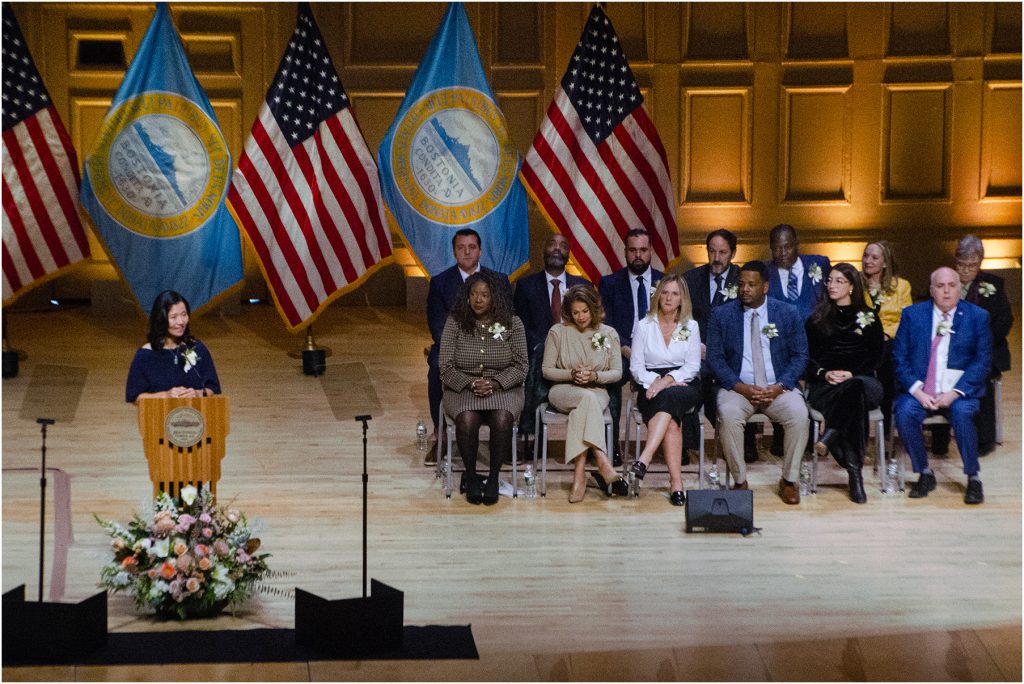
Mayor Wu addressed a Symphony Hall audience after her swearing-in ceremony. At right is the Boston City Council, class of ’26-’27. Chris Lovett photo
Not mentioned explicitly in the address was another power struggle, with the State House, over how to manage the post-pandemic shift of the property tax burden from commercial to residential owners, in line with changing valuations. Wu has been trying to get approval for a home rule measure that would temporarily slow the shift, at a time of steep decline in values for some of the city’s downtown office buildings.
Also left unmentioned were Wu’s reported backing of challengers to run against two state senators who oppose the home rule petition, Nick Collins and William N. Brownsberger. And, though the shift to remote work has contributed to commercial real estate losses in many US cities, Wu used her address to highlight signs of hope, from at least a partial rebound in retail occupancy to conversions of office buildings into housing.
The mayor cited gains for affordable housing, but there was no mention of the downturn in production after the rise of interest rates starting in 2022. The slowdown has prompted criticism of environmental mandates and inclusionary zoning requirements—supporting production of affordable units—that were increased by Wu. But researchers have also blamed factors beyond the city’s control, from interest rates and tariffs to the loss of construction workers due to immigration enforcement.
Wu did call for securing “sources of economic opportunity” and “engines that drive innovation all across America,” both grounded in a post-World War II “knowledge economy” dependent on federal funding. Rather than spell out how to surmount the dramatic shift in federal policies, Wu shifted the focus from federal threat to local potential.
“We’ll work smarter and harder to recruit the scientists and companies curing diseases like cancer and Alzheimer’s and harness clean energy and improve lives all over the world,” she said. “We’ll partner with higher education and industry to nurture and benefit from the innovation that will reshape the future from robotics to climate tech. Together we’ll prepare workers for emerging technology to expand their opportunities, rather than be replaced.”
Little more than two months after a high-profile speech on the Boston Public Schools (BPS), Wu vowed to make them “the first choice for all of our families,” with less spending on student transportation and more on advanced work, along with programs before and after class time.
“We refuse to accept that accessing high quality education means crisscrossing our children all over the city,” she said, “rather than ensuring that in every corner of Boston the best school is just down the block.”
Wu spoke of “right-sizing” the BPS, but without bringing up the recent decision by the School Committee to close three schools in June of 2027 due to declining enrollment. But the proposal was brought up later the same day, in a request for a public hearing filed by City Councillor at-Large Erin Murphy.
Shortly after the November election, a Wu ally, District 1 (East Boston, Charlestown, North End) City Councillor Gabriela Coletta Zapata, announced that she had secured at least seven votes to become the body’s next president. The declaration was soon questioned by District 4 (Dorchester/Mattapan) Councillor Brian Worrell and Councillor At-Large Julia Mejia.
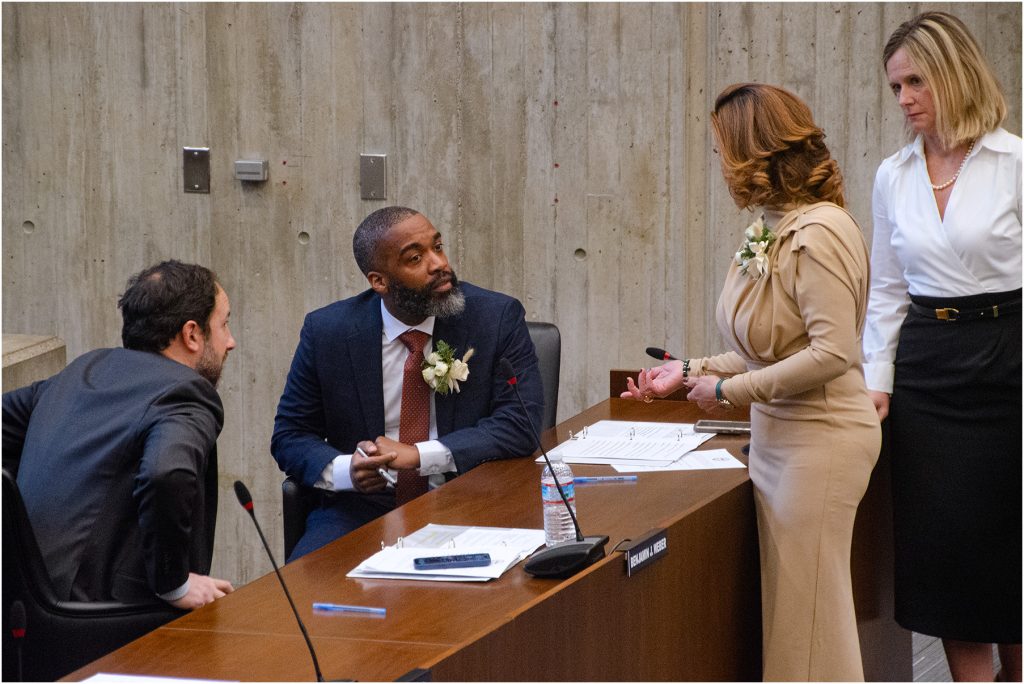
Above, Councillor Brian Worrell, center, conferred with colleagues Julia Mejia and Erin Murphy, right, and Ben Weber, left, on Jan. 5, 2026. Chris Lovett photo
On Sunday, after weeks of sometimes unfavorable news coverage, Coletta Zapata withdrew her candidacy for president, allowing the eventual election of District 9 (Allston-Brighton) Councillor Liz Breadon, who was supported by the bulk of Wu’s allies. Unlike Worrell and Mejia, Breadon acknowledged she had no intention of becoming the council president until the day before.
The last-minute development led to more outward drama in the council’s Iannella Chamber, though it’s possible that did little to change the vote count, with 7 backers for Breadon and 6 for Worrell. The most noticeable change was how openly councillors expressed their differences and tried to assert their independence from the mayor, with their two presidential contenders prompted to make a case for their leadership.
In contrast with recent contests for the presidency, this year’s process did more to highlight the skewed balance of power in Boston’s “strong-mayor” form of government — as well as the council’s abiding struggle to matter, whether through contentious independence or harmonious collaboration.
In debate leading up to the vote for president, Councillor at-Large Julia Mejia, a Worrell backer, made a plea for more open competition.
“In the last two election cycles, we have been stripped away of that process and have created a dynamic in which a small body of folks determine for an entire body who is going to oversee this body,” Mejia lamented. “And that continues to erode for trust in our ability to have good working relationships. It’s not about winners or losers. It is really all about how we choose to show up for each other and represent our constituents.”
Unlike popular votes for individual candidates, legislative bodies such as the Boston City Council choose leaders with an eye toward building power through teams and exerting leverage against a usually more powerful executive branch. That was the point made by another Worrell backer, District 3 (Dorchester) Councillor John FitzGerald.
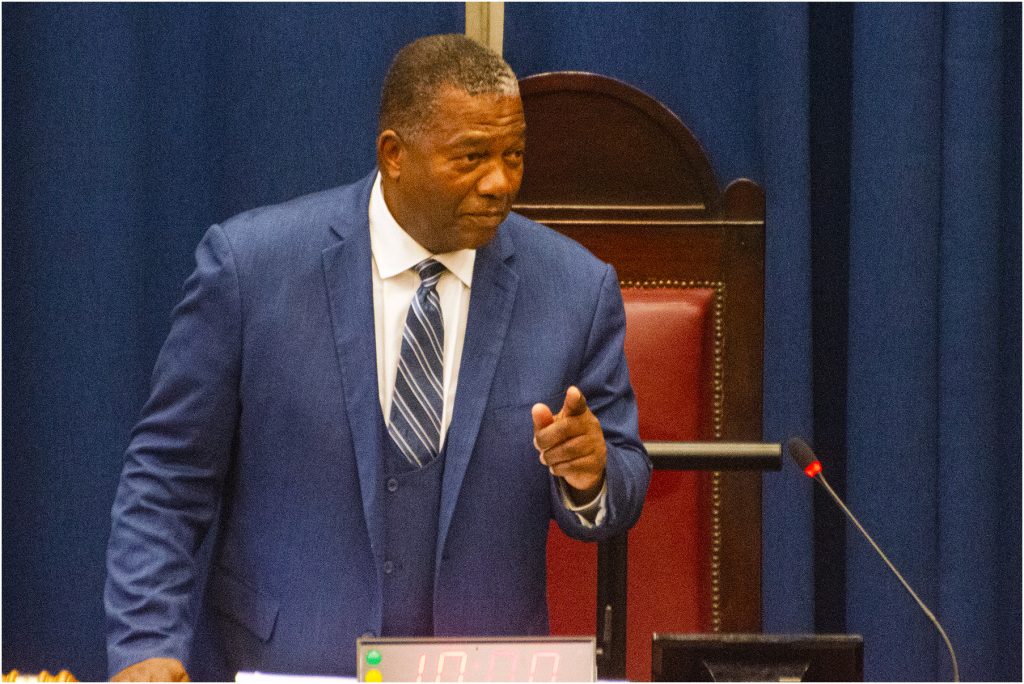
Newly-sworn-in Councillor Miniard Culpepper served as chair of the council meeting on Monday, Jan. 5, 2026 until the election of a new president. Liz Breadon took over after winning a vote of her colleagues, 7-6. Chris Lovett photo
“People have talked about back room deals and shenanigans and stuff. Guys, what do we expect? This is the job that we were assigned, elected to do. This is how it operates,” said FitzGerald. “Only once in a strong-mayor system, on this body, with us as elected councillors, do we actually have a small time to make a difference, to deliver an impact for our community. And a lot of that has to do with the committees that we get and making the administration have leverage to deal with us, right? We’re leveraging the administration to deal with us.”
Though Wu captured her second term in a landslide and verged on national prominence in her pushback against Trump policies, the bloc most laden with her council allies prevailed by only a single vote, eked out through a progression from dissonance to resolution worthy of Symphony Hall, if scaled down from orchestral splendor to half-tones of political chamber music.
“I think it speaks to the independence on the body,” Worrell reflected after the council meeting. “I think we see that there’s a split. We were split on this decision, and that just speaks to the different ideologies, perspective, the different districts that we represent… I just am encouraged that it went to that ‘six-seven.’ I’m grateful for the support that I’ve received, and I think that hopefully, other conversations, other policies, other things that come before us will have that same level of deliberation and insight–insight and thoughtfulness.”
