

Union members, activists, and elected officials gathered in the parking lot of the South Bay shopping center last Friday (Jan. 23) to demonstrate in solidarity with the people of Minneapolis and St. Paul, who were holding a citywide strike that day to protest the violent immigration crackdown there by federal agents.
The demonstration, timed to coincide with an action that drew tens of thousands of protesters to the streets of Minneapolis, included picket lines in front of the South Bay Target and Home Depot locations to highlight reports that the retailers are allowing ICE agents to use their parking lots as staging grounds for raids in local communities.
“We can build the hope and power to fight this administration and corporate greed,” said Dalida Rocha, executive director of the statewide progressive organizing group Neighbor 2 Neighbor, addressing the gathering of about 2,000 from the back of a pickup truck. “We can win.”
The South Bay assembly was one of many across the country held after ICE agents shot and killed 37-year-old Renee Nicole Good and Trump administration Vice President JD Vance asserted that federal immigration officials have immunity shielding them from criminal prosecution. On Saturday, ICE agents shot and killed Minneapolis resident Alex Pretti, an ICU nurse who was observing and filming Border Patrol agents.
Trump administration officials asserted that Pretti had approached officers brandishing a gun, but videos of the shooting showed him holding only a cell phone. He was shot after agents had pepper-sprayed him, pushed him to the ground, beat him, and removed a gun from a holster at his waist.
Pretti’s killing — and the swift statements by Trump officials casting him as responsible for his own death— have prompted national outrage and calls for the resignation of high-ranking cabinet members, including Homeland Security chief Kristi Noem, who quickly and falsely accused Pretti of being a “domestic terrorist.”
At Friday’s South Bay demonstration, speakers described the impacts ICE actions are having on Boston area communities. Chelsea Public Schools special education teacher Catherine Anderson told the gathering that ICE agents have been detaining immigrants who show up for court cases or drop off their children at child care facilities, and warned that things could get worse.
“We know that what happened in Minnesota can happen here,” she said.
Last week, attorneys for the city of Boston helped to draft a legal memo in support of a lawsuit filed by city and state leaders in Minnesota that seeks a federal court injunction to halt the ICE surge in that state.
“If the Federal Government continues to use federal immigration enforcement agencies to invade American cities, causing increased pressure and disruption, local government amici will face irreparable harm to their residents, public safety, and city services,” the filing reads.
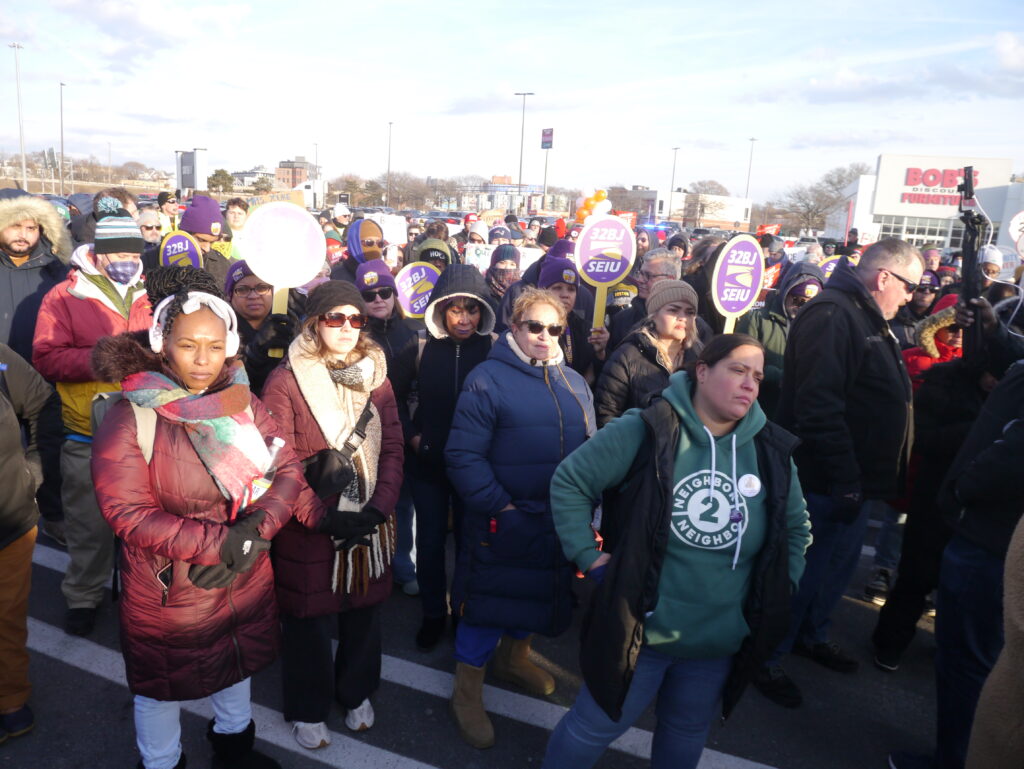
Protestors gathered in the South Bay Mall parking lot on Friday, Jan. 23 in a show of solidarity with a general strike in Minneapolis/St. Paul. Yawu Miller photo
At-large City Councilor Ruthzee Louijeune told The Reporter that Haitians in Boston fear there will be increased ICE presence in their communities if the Trump administration carries out its plan to end temporary protective status (TPS) for Haitians — a federal designation that allows people from countries affected by war, natural disasters, and other catastrophes to live and work legally in the US. There are an estimated 45,000 Haitians living in Massachusetts with TPS status— and perhaps a half-a-million nationwide.
If the current Trump order survives a pending court challenge, the effects could be devastating, not only for Haitian families, but also for many industries in Massachusetts such as health care and transportation.
“We don’t understand the scale of the potential problem that we’re going to see,” Louijeune said. “It’s a man-made disaster by a disastrous administration rooted in xenophobia and racism. The anti-immigrant combined with the anti-Blackness of this administration sadly come together when it comes to our Haitian population.”
Haitians here on TPS are questioning whether they should sell their homes, empty their bank accounts, or otherwise prepare for deportation, she said.
The Trump administration has targeted predominantly Democratic states for increasingly violent crackdowns on immigrants, regardless of whether they have documentation allowing them to live and work in this country. In Minnesota, 500,000 immigrants account for 9 percent of the state’s population. The ICE operation there has led to the shooting death of two US citizens. In Republican-controlled Texas, where an estimated 6 million immigrants account for 18 percent of the state’s population, there have been so such operations.
The administration also seems to have targeted states with large Somali populations. Last week, a large-scale operation in Maine resulted in the apprehension of more than 200 residents, according to DHS officials.
Activists expect that the Trump administration will soon launch a Minnesota-style operation in Boston.
“A loose network has been definitely preparing ourselves,” Rocha told The Reporter. “We continue to do trainings.”
Activists in Greater Boston who have already been tracking ICE actions on the ground here say the state and local governments could be doing more to protect immigrants. Police, they allege, have been sharing information with federal authorities through the Boston Regional Intelligence Center — a so-called fusion center set up to coordinate local law enforcement deployment and strategies. Information sharing through the BRIC has led to deportation proceeding of people with no criminal record in recent years.
At the state level, activists have sought passage of the Safe Communities Act, which would bar local and state law enforcement from cooperating with federal immigration officials on enforcing civil immigration offenses and end 287(g) agreements, through which local law enforcement cooperate with ICE and Intergovernmental Service Agreements, through which local jails and prisons agree to house ICE detainees. Currently, only the Plymouth House of Correction has such an agreement.
The Safe Communities Act has been stalled in the Legislature since it was filed in 2017.
“I would definitely like to see our elected leaders be more courageous,” Rocha said. “People’s lives are at risk. People are being separated from their families. There’s always things that can be done, and elected leaders need to be courageous enough to do them.”
On Sunday, Gov. Healey signaled a tougher tone in her approach: “Kristi Noem’s got to go,” she said during a press conference about a winter storm recovery.
Attorney General Andrea Joy Campbell echoed Healey’s demand minutes later in a statement.
“On Kristi Noem’s watch, Americans have been killed, children have been detained, and ICE has stoked fear and chaos in communities across the country. She must resign from her position as Secretary of Homeland Security. If she refuses to, I’m calling on Congress to impeach her,” Campbell said.
Reporter editor Bill Forry contributed to this story.
