
With families in the midst of choosing elementary schools for their children, a Cape Verdean Kriolu-English dual language option at the repurposed Lilla Frederick School on Columbia Road is a new option available for K1 students when it reopens this September.
The program is believed to be the first Kriolu-English language offered anywhere, including in Cabo Verde, where the people’s language is Kriolu, but the official language is Portuguese.
Said Joelle Gamere, chief of the Office of Multicultural and Multilingual Education at Boston Public Schools (BPS), “It will open with a K1 classroom that has a Cabo Verde dual language strand. We’re anticipating 20 students in that classroom.
“It is a two-way model, so half the students would speak Cabo Verde Kriolu, and the other half would be learning the language. They can be from Cabo Verde. They can be two or three generations here from Cabo Verde, or they can be of any other ethnicity or race.”

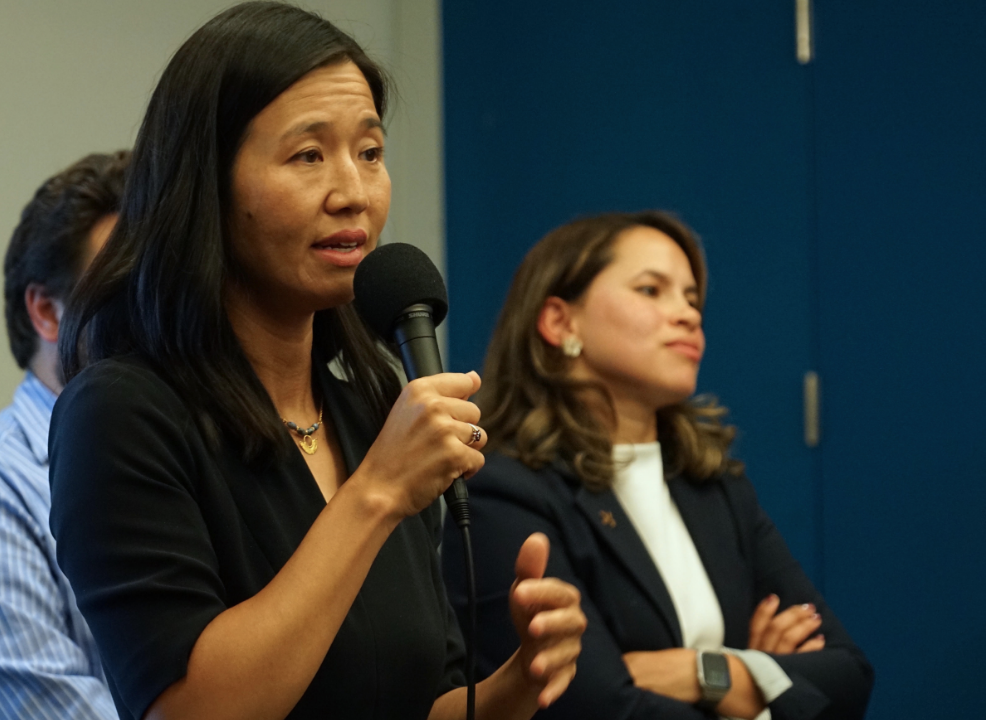
Gamere (pictured above) said the school will roll out a new grade for the next eight years to eventually include a full K1-6 dual language experience. For BPS, it’s a bilingual niche that could help retain students, who often choose other options like the nearby Conservatory Lab Charter or Roxbury Prep Charter – as well as Saint John Paul II Catholic Academy.
Charter and parochial school enrollments have increased in recent years, while BPS enrollment has decreased.
Dual language programs operate in schools that also have general education outside the dual language strand. Already there are programs in Dorchester and Mattapan for Haitian Kreyol at the Mattahunt School and for Vietnamese at the Mather School.
Most dual language classrooms include similar instruction to a regular classroom, but in two languages, adding cultural celebrations for the entire school.
Delavern Stanislaus, the chief of Capital Planning for BPS, said that the Cape Verdean community has been requesting such a program longer than any other BPS language group. The opportunity to launch one now comes as two schools— the Roger Clap and the John Winthrop — are merging and relocating into the Frederick building.
“There are conversations that have happened across the district many years,” Stanislaus said. “The Cape Verdean community has had a conversation for many years about a dual language program…We are looking for opportunities across the district to add different programmatic opportunities when possible. This is one that is in the community, and the community is asking for it.”
Students from the Clap and Winthrop will co-exist with the dual language program, much like at the Mather or Mattahunt, but the school will be devoted overall to the Cape Verdean culture and celebrations.
Gamere said conversations that restarted in June 2024 led to an active community-based working group for planning and the approval of the model by the state Department of Elementary and Secondary Education (DESE).
A consultant group led by Dr. Dr. Ambrizeth Lima is working on “transadapting” the dual language curriculum to align it with BPS processes.
“It’s pretty much the same blueprint as the Mattahunt dual language program,” said Gamere, who was instrumental in implementing that program in 2017-18.
For the Cape Verdean community in Dorchester, the renewal of talks in 2024 came with mixed results. Numerous efforts have failed or not been implemented by BPS, while other language cohorts have moved forward.
Paulo Debarros, director of the Cape Verdean Association of Boston (CVAB) and a former bi-lingual BPS educator, illustrated that history, using the life of former School Committeewoman Chantal Barbosa, who had been an advocate as a youth.
“She spoke about it with us as a youth, then graduated high school, went to college, worked at City Hall, left City Hall to be on the School Committee – served a few terms and left the School Committee,” he said. “Most of her life we have been asking for this and only now has it reached implementation.”

Debarros (above) and other groups, including the St. Peter’s Teen Center and the Cape Verdean Providers Network, participated in the working group that also included retired BPS teacher and dual language author Djofa Tavares – who wrote the first Kriolu and English children’s book, with a second ready to be published soon.
“We’ve had committees before…and we didn’t want to go a certain way and be duped again,” Tavares said. “Last year when we met with [BPS] Supt. [Mary] Skipper we talked to her about whether there was really the energy to do it, but she guaranteed it would be different and it will move forward.”
So far that has been the case, but the outreach into the community has become a critical concern. A parent meeting last month drew only a few families, and there is worry that the engagement isn’t strong enough for a successful start.
“The advocacy didn’t start yesterday,” said Debarros. “They need to understand that and CVAB has always been in front of the movement with Dr. Lima. We really appreciate Mary Skipper and her leadership in planning and Joelle bringing to us her experience and expertise with the Haitian Dual Language program. I see us getting implemented finally, but I’m concerned about family supports and cultural competency at the school – including at the school site and in school leadership.”
Debarros said he prefers a K-12 Kriolu strand that would give parents “real choices” and bring their kids back to Dorchester, as many students now go to Orchard Gardens K-8 in Roxbury. He credits BPS for getting this done and said there will be a lot of “pride” in the community, but stressed reaching the community is paramount right now.
“We want to help BPS engage these families, and we’re available,” he said. “The engagement of parents and community in that school is what will or will not lead it to success. I think it could really be a hub for Cape Verdeans if done right.”
Tavares also feels it needs to be publicized more in the community, and that they should make a bigger splash.
“It’s historic and it’s the first of its kind,” she said. “For us as a community to have it be part of the City of Boston’s education and for it to be an example to show Cabo Verde that these people are teaching the children the language and that also includes the cultural aspect, too.
“It will really strengthen the community with the legitimacy of the language, which has been a struggle. We can show Cabo Verde it can be done and maybe change things there too.”
Families with students heading to K1 can choose the Cape Verdean dual language program right now, Stanislaus said, by going online and registering their student or visiting a Parent Engagement Center.
