
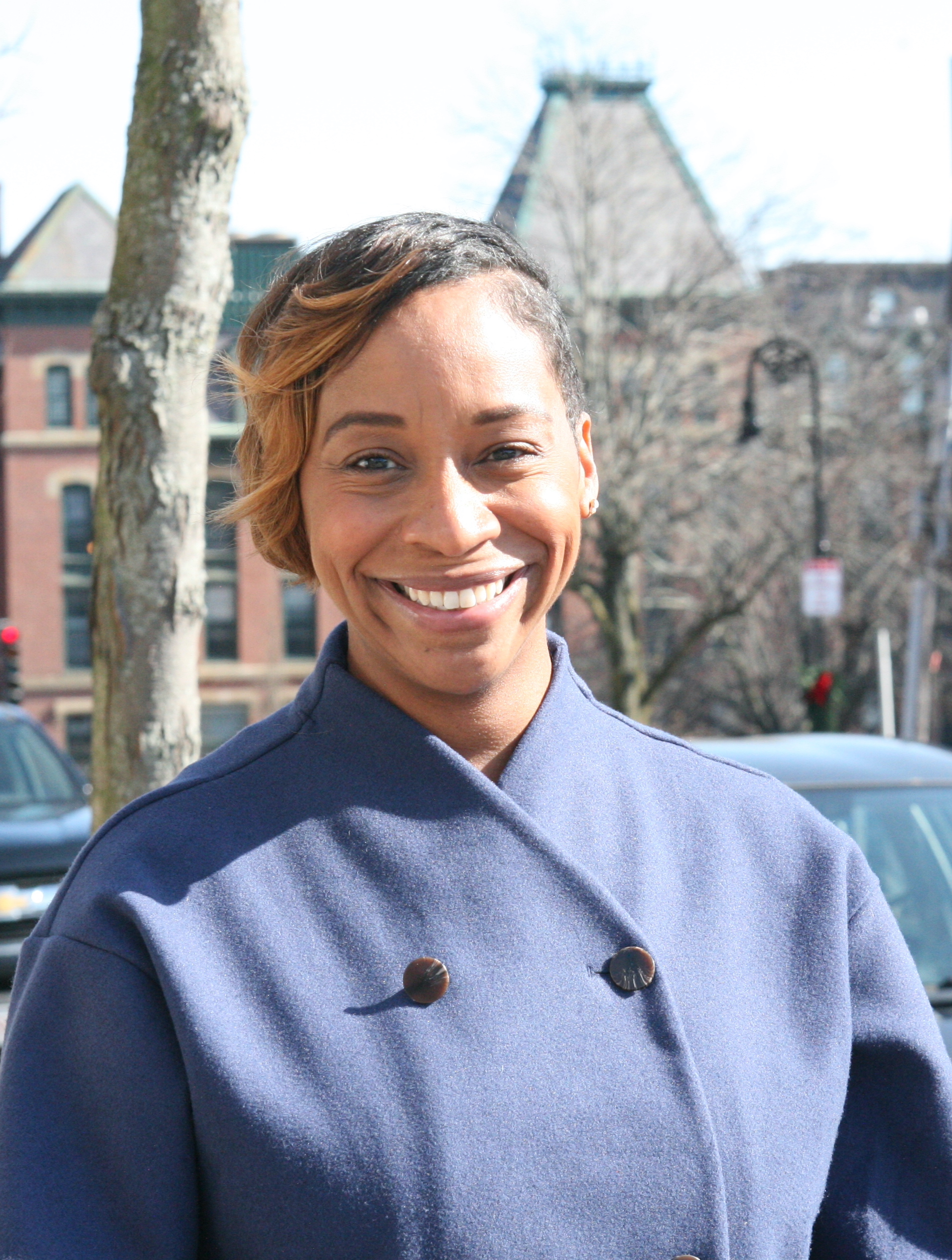

Photo: Mayor Michelle Wu addressed educators, students and reporters gathered at the Dearborn STEM school to discuss Boston Public Schools graduation rates on Monday, March 9. Yawu Miller photo
A higher percentage of Boston Public Schools students are graduating now than at any other time in the 20 years since the district began keeping track in 2006, Mayor Michelle Wu announced Monday.
Speaking to a gathering at the Dearborn STEM academy with school officials, students, and nonprofits that provide services to BPS students, Wu said that 81.3 percent of students graduated within four years, up from 59 percent in 2006.
“I want to give a huge congratulations to every single BPS student and graduate and their families and community for this incredible achievement,” Wu said. “Thank you for putting in the time and effort, investing in your future, pushing yourselves to reach your highest potential.”
Last year, 3,377 students graduated — a spike of 400 over the previous year.
“We saw an increase in graduation rates across every single student demographic group, with the biggest gains by multilingual learners, who jumped by 5 percentage points,” Wu said.
She and others at the Dearborn cited partnerships with local nonprofit groups for helping students at risk of not graduating as well as special undertakings by the district aimed at helping struggling students get back on track.
BPS Superintendent Mary Skipper cited the district’s Reengagement Center, which helps students who aren’t on track to graduate identify a BPS school or nonprofit credit recovery program that helps students finish the coursework they need to graduate.
“That means going out and knocking on doors or going into schools that have the highest drop-out rates and sitting with students and having those real conversations,” Skipper said.
She said the district also prioritized student populations most likely to drop out — multi-lingual learners, students experiencing homelessness, and special education students — and designed programs specifically for those groups.
BPS officials have also invested in programs to help prepare students for college and careers. Skipper said expanding access to Advanced Placement courses and early college courses helps keep students engaged.
While four years ago, just 180 students were enrolled in the district’s early college program — which allows students to take college-level courses at local community colleges and universities free of charge — now there are 1,100, Skipper noted.
Similarly, enrollment in the career connections program, which enables students to get credentials for certain trades while still in high school, has risen from 1,000 four years ago to 4,000 now, she said.
Additionally, Wu said, five times as many students are taking Advanced Placement courses as there were four years ago.
“What we’re really celebrating today is that our students are engaged and invested in their education and that the opportunities that we’re creating, the investments that we’re making have directly made that possible,” she said.
“We’ve been working to equip every single BPS high school with resources and opportunities that students need to feel inspired by the material, to connect with the curriculum, to be pushed to meet and exceed the grade level expectations and to come to school ready to engage and apply those lessons in the larger world.”
There are currently 44,000 students enrolled in Boston Public Schools, according to data on the Massachusetts Department of Elementary and Secondary Education (DESE) website, with 80.9 percent of students in the system classified as “high needs.”
The statewide graduation rate, according to DESE, is 89.3 percent, and the statewide percentage of students listed as “high needs” is 55 percent.
As to other data points, English language learners make up 33.6 percent of the BPS population, as compared to 13.4 percent statewide. Latinos, at 44 percent, are the largest ethnic group in BPS. Blacks are at 28 percent, whites at 14 percent, and Asians at 8 percent. Students with disabilities make up 24 percent of the student population.
