

In 1977, when city planners declared the Blue Hill Avenue corridor a “distressed area,” one of their key remedies was better transportation. After another half-century, all it took was 17 inches of snow – and a deepening political chill – to give the label a new meaning for District 7 (Roxbury/Dorchester) City Councillor Miniard Culpepper.
At the beginning of the 20th century, neighborhoods surrounding the avenue were transformed by the arrival of trolley service along a dedicated median and again, in 1955, by the service’s removal. Seventy years later, the city and the MBTA are pursuing a new remedy, which includes a center-running lane for buses, and Culpepper has filed a council hearing order to size up the idea as a setback for civil rights.
RELATED: MBTA secures $80.3M for Blue Hill Avenue improvements, bus lane project
At the City Council meeting on Feb. 25, two days after a snowy northeaster and one month after a storm that dropped two feet of snow, Culpepper rose to address the body’s president, Liz Breadon: “Can you imagine, Madam President and my colleagues,” he asked, “a center bus lane running down Blue Hill Ave during a snow emergency like the one we are in now?”

Councillor Miniard Culpepper. Chris Lovett photo
Even before the epochal “Blizzard of ’78,” city planners had summed up the Blue Hill Avenue corridor as a casualty of disinvestment, partly caused by federal policies and lending discrimination that paved the way for a mostly white migration to the suburbs. As “one of the highest priorities,” the “Boston Plan” compiled under former mayor Kevin White recommended the establishment of light rail service that would go from Dudley Station to Grove Hall, then along Blue Hill Avenue to Mattapan Square.
White’s initiative was prompted by a new pool of federal money, Urban Development Action Grants (UDAG), under President Jimmy Carter. At the time, the city and state were already planning to use other federal money for relocating the elevated Orange Line to the Southwest Corridor. They were also exploring ways to offset the reduced transportation access in areas left farther behind, especially in Roxbury.
Through the mid-20th century, Blue Hill Avenue was thriving artery for travel and neighborhood commerce. After the removal of median tracks increased capacity for motor vehicles, the avenue became more dominated by commuter traffic. Rather than being a feeder for local businesses and shoppers, the avenue became more of a barrier and a safety hazard.
“The demise of the trolley and decontinuance (sic) of commuter rail service on the nearby Midlands Branch were major factors contributing to the deterioration of the Blue Hill Avenue community,” the Boston Plan concluded. “Any effort at upgrading the area must seriously consider public transportation needs.”
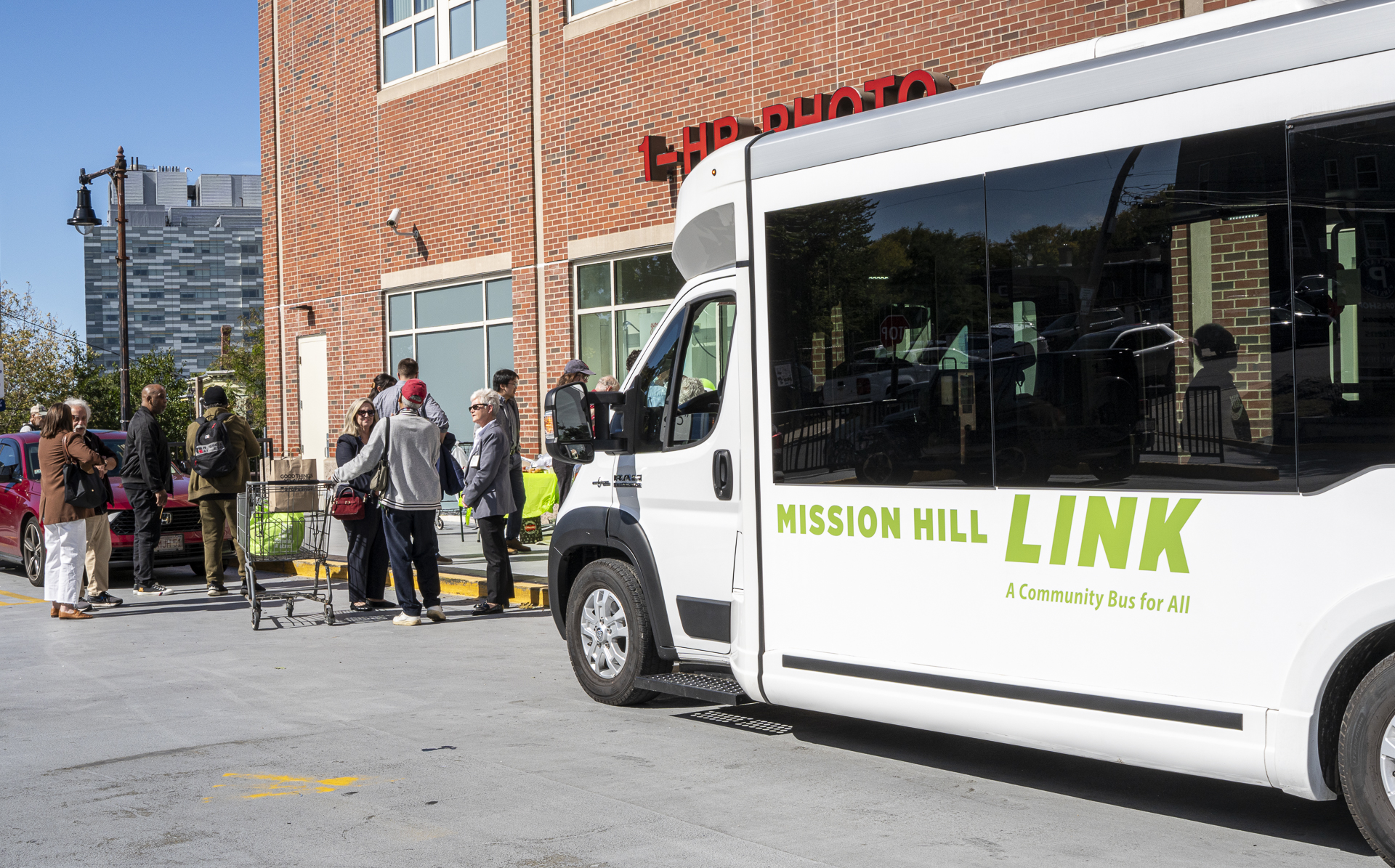
Some of those needs would be met when the Midlands Branch between South Station and Readville was revived for commuter rail, eventually with more stops and more frequent service in Mattapan and Dorchester. But, even when fare-free buses were introduced along Blue Hill Avenue in 2021, riders continued to struggle with delays caused by traffic and illegal parking.

A view of Blue Hill Avenue looking south near Franklin Field last week. Seth Daniel photo
In its 2017 “state of equity” report, the Metropolitan Area Planning Council (MAPC) calculated that Black passengers spent 64 more hours per year on buses than white passengers. In its 2018 report, MAPC called for expanding transportation options, “especially for underserved populations and communities of color,” and making them more affordable for cost-burdened households.
According to a 2019 report from the LivableStreets Alliance, the No. 28 bus (Mattapan Square-Ruggles Street) ranked first for the percentage of ridership that was underserved. Ranking fifth was the No. 23 bus, from Ashmont Station to Ruggles Station. Both routes currently have fare-free service, and both were among 15 routes that LivableStreets advocated for more frequent service and “bus priority surface improvements” that could benefit more than 110,000 people who were low-income, people of color, and limited English proficiency.
“Failing bus service is one of the greatest disparities threatening the region,” the alliance declared, “and the scope of the crisis requires the full attention of state and local policymakers in order to end transit inequities once and for all in Metro Boston.”
In a foreword to the same report, US Rep. Ayanna Pressley lamented, “For too long, our transit system has accepted and perpetuated the disparities of our region – many of our low-income neighbors have had to pay more for bus service through cash pay differentials, longer commute times, and lost pay and family time.”
As described by Culpepper while presenting his hearing order last month, the potential remedy for the “bus equity gap” could have a disparate impact on people of color, with center-running bus lanes reducing flexibility and mobility for other traffic.
“While improving transit access is a shared goal,” he told councillors, “many residents, workers, and small business owners along Blue Hill Avenue have raised concerns about the lack of thorough community consultation on the proposed center-running bus lanes. For a project that will significantly affect traffic, parking, and daily mobility, engagement must reflect the realities of those who rely on this corridor. Without it, the design risks deepening inequities.”
The hearing order also advocated possible reallocation of money for bus service to beautification of the avenue. That option was supported at the meeting by District 4 (Dorchester/Mattapan) Councillor Brian Worrell, who represents the segment of the corridor between Seaver Street and Mattapan Square.
“We’ve listened carefully to the feedback and have consistently supported the beautification proposal because that’s what I’ve heard people asking for,” Worrell said. “There are over 2,000 signatures from residents who have expressed opposition to a center-running bus lane down Blue Hill Ave. During the process, I advocated for side-running bus lanes if bus priority was to move forward. But, with where we are today, I believe we should solely focus on what is called the beautification plan for Blue Hill Ave., which was also presented by the Boston Transportation Department.”

The bus-priority option met with heavy opposition at a City Council hearing that took place last June in Mattapan, at the William E. Carter American Legion Post. There was more criticism of the “Transportation Action Plan” (TAP) three weeks later, in a statement from the Greater Mattapan Neighborhood Council (GMNC) published by the Dorchester Reporter.
“As currently designed, the TAP appears to prioritize external goals – specifically, the mobility needs of the Longwood Medical Area and attendees of events at White Stadium,” the GMNC contended. “These plans, while strategic for some, do not adequately reflect the lived realities or future aspirations of Greater Mattapan residents.”
The group also questioned whether the plan would have adequate funding, and whether enough suburban commuters could be diverted to avoid increased congestion in the avenue’s general traffic lanes.
Community opposition was also a factor in 2009, when an earlier plan for dedicated bus lanes along the avenue, funded by federal stimulus money under President Barack Obama, was withdrawn. The initiative was also criticized for a lack of outreach to the community. Two years later, the city and the MBTA started planning for the avenue again, with a new round of community engagement in 2019 that was sidelined by the Covid-19 pandemic.
In 2021, the federal government awarded $15 million for overhauling Blue Hill Avenue, with support expressed by Boston’s two US representatives–Pressley and Stephen Lynch. After Michelle Wu was elected mayor, yet another round of planning and community engagement began, with officials vowing to avoid the pitfalls of the past.
Under Wu, the approach to engagement and examination of transportation needs was more open-ended and granular. Planners included one option for the avenue, with dedicated bus lanes, and another, without a major restructuring of the roadway.
By the time the latest planning process was underway, buses were already traveling in newly built center-running lanes on Columbus Avenue, a project that the MBTA and the city plan to extend from Jackson Square to Ruggles Station.
According to a 2023 survey of the service by the Boston Transportation Dept. (BTD), 75 percent of its riders reported satisfaction, with 25 percent using the service more often. The change saved 3-4 minutes per trip during peak travel time, which the BTD said could allow more trips per day on the route with the same number of bus drivers.
The BTD also reported that traffic on some streets surrounding Columbus Avenue had rebounded to levels before the pandemic. Concerns that dedicated lanes could divert traffic to side streets have been raised in the planning process for Blue Hill Avenue.
At the Feb. 25 meeting, councillors passed, by a 12-1 vote, a resolution calling for fare-free service to continue beyond the end of June 2026 for bus routes 23, 28, and 29. Five days before the meeting, Wu announced that the fare-free service would continue through June 30, when federal money for the pilot program would be used up. Still unclear is whether the service could be supported afterward by other funding.

Above, Mayor Wu is shown in Grove Hall while promoting fare-free bus service in 2022. Chris Lovett photo
In her announcement of the decision, Wu credited the pilot with making service “faster and more reliable,” with ridership gains surpassing the rebound for bus routes overall. In the same media release, Interim Transportation Secretary and MBTA General Manager Phillip Eng hailed efforts to make service “more equitable and affordable.” He cited a system-wide MBTA program offering “significantly reduced” fares, but there was no commitment to expanding or further extending the pilot.
In a report last April, the MBTA and Mass. Dept. of Transportation acknowledged some benefits from fare-free service, but they concluded that fare-free pilot programs were “unsustainable” and not recommended as an initiative to pursue.
Under successive administrations, the city has tried to engage with communities along the Blue Hill Avenue corridor in different ways. A 2023 report for the city details a process more tightly focused on transportation, infrastructure, and safety, with an abundance of individual feedback –in contrast with the dynamic of neighborhood groups, more geared to collective action behind a larger agenda. In its statement on the bus project last year, the GMNC called for more attention to traffic beyond Blue Hill Avenue, as well as construction jobs for residents, and designation of the corridor as a “cultural economic zone.”
One community leader along the corridor maintained that the more recent engagement strategy was more likely to generate positive responses. But the city’s engagement team reported a mix of responses, sometimes conflicting, and sometimes expressing negative feelings about earlier planning, as well as projects whose benefits came with drawbacks.
“In some conversations,” the engagement report acknowledged, “it was evident that a subset of folks had a lack of trust in public agencies, negative past experiences with planning and development, or a general sense of engagement fatigue.”
In early 2026, more than two years after the report, the tenor of engagement was marked by increasing strains between the mayor and several leaders of the Black community. Among the points of conflict: continuing concerns about the renovation of White Stadium and indignation over the city’s decision not to extend the development partnership for “Parcel P-3” in Lower Roxbury. In January, Wu announced plans to use the long-vacant land as the site of a new Madison Park Technical and Vocational High School.
Another source of strain was the contentious vote for council president on Jan. 5, when the ostensible frontrunner, Brian Worrell, was sidelined in last-ditch maneuvers by his colleagues. By the time Culpepper filed his hearing order, an agenda formality became a proxy for one of the long-running tug-of-wars between disparate branches of Boston’s “strong mayor” government.
As he presented the order, Culpepper asked that it be assigned to a committee he chairs, on civil rights, racial equity, and immigrant advancement. Breadon, though, assigned the order to the committee on planning, development, and transportation, chaired by District 8 Councillor Sharon Durkan. The two committees have four members in common, but Durkan’s committee does not include Culpepper, though it does include Worrell and District 3 (Dorchester) Councillor John FitzGerald.
Durkan’s district includes the Back Bay, where the mayor had decided to eliminate a dedicated bus lane in response to local complaints. In the ensuing debate over committee assignment, Culpepper cited the different approaches to bus lanes as an instance of racial disparity. “I say for this community in District 7,” he argued, “the way they have voiced their opposition to this, to not pull it down, and pull it down in a white area, that’s exactly what disparate impact is under the Constitution.”
Durkan suggested a “nuanced conversation” that could address transportation as well as civil rights, but she supported her committee as a more accurate fit.

Several city councillors attended a June 2025 meeting in the Carter Post at Mattapan Square on the subject of the Blue Hill Avenue project. Seth Daniel photo
“There’s a civil rights angle to almost every hearing order,” observed Councilor At-Large Ruthzee Louijeune, who added that a hearing on the bus plan would include planning officials. “They are the ones who are going to be most interactive with what the intent of this hearing order is,” she said, “which is why planning, development, transportation is the right committee.”
Culpepper’s motion on committee assignment lost by a count of 7-6. The breakdown matched the Jan. 5 vote for council president that split members into blocs distinguishable overall by how much they aligned or differed with the mayor.
In later comments, by email on March 2, Culpepper drew a connection between Blue Hill Avenue, “the whole process around White Stadium,” and Parcel P-3: “The common denominator being a reaction to a plan or circumstances, but making a decision without allowing the community to advance another option.”
In the same statement, he added, “The pattern is clear: years of neglect, followed by decisions made without genuine community partnership. Community input is not a box to check after the fact; it must shape the process from the beginning. The people of District 7 are not opposed to progress. They are opposed to being sidelined. When investment comes, we have to ask who it is truly serving.”
