

More than 100 people gathered in the cafeteria of the Richard J. Murphy School on Wednesday evening to listen and respond to a developer’s plan to add two new buildings and 24 additional units of housing to what is presently a 24,670 square foot lot with a two-family house on Minot Street in Dorchester.
The two-hour meeting included a visual presentation by the developer’s attorney and comment from residents, who presented a united front in opposition to the proposal for 39 Minot St.
The property owner, Jim Paskell, Jr.— who was present at the meeting but did not speak— wants to keep the existing two-family “Hammond” house intact and build two new four-story buildings on either side. There would be 20 parking spots included, according to his plans.
Paskell’s team filed a Small Project Review Application (SPRA) with city officials in February and a city-sponsored review meeting is set for April 9.

This week’s meeting was organized by two nearby civic associations and abutters who insist the density of the project is far too big for Minot Street.
Paskell’s attorney George Morancy and architect Tim Johnson spoke on behalf of the development team.
“These plans have already been shown to some of the people here. Some people here, it might be there first time seeing the plans,” said Morancy. “We fully understand that many people in the neighborhood have formulated an opinion about the project. We understand there is opposition. Our purpose here tonight is to present the plans for those who haven’t seen them, to answer any questions anyone may have, whether you’ve seen the plans or not, and to listen to your comments.”
Johnson then walked through a presentation of the current plans.
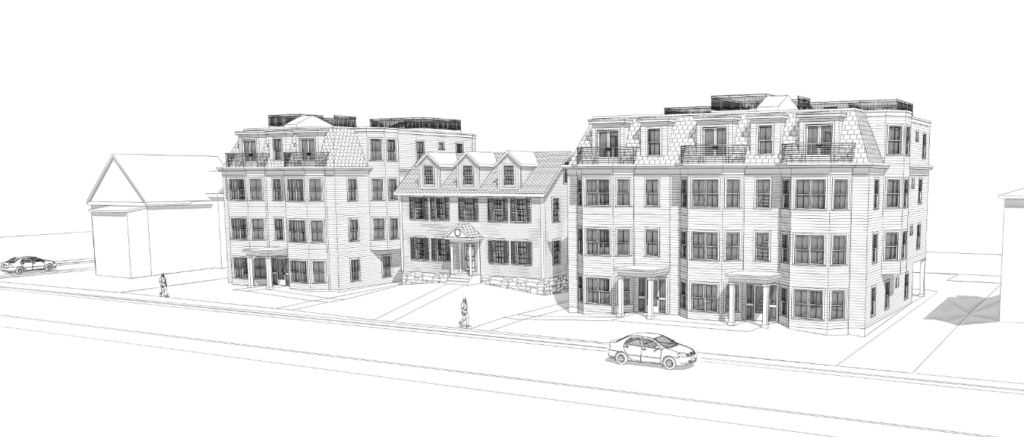
“The existing building is in the center of the property,” Johnson explained. “This is an older building from the 1800s, and the city does not want us to tear it down. We are renovating the existing building in the center and adding 3 units to the back to create a 6-unit building. On either side of this building are our new buildings.”
The two new buildings would be four stories high and include a total of 20 units. Neither will have an elevator, meaning that only the first floor will be accessible. The basements would be used entirely for utility purposes only.
“In the rear, we have 20 parking spaces. We have 26 units, that’s (about) 0.76 parking spaces per unit,” said Johnson. “Besides parking for cars, we also have parking for bikes, which was required under Article 80.”
Article 80— the city’s review process for project’s this size— was a constant theme of Wednesday night’s conversation.
“There was the perception that there was too much initial work done with the planning department before coming out into the community,” explained Morancy. “The fact is that the planning department has changed the Article 80 process based really on those concerns. The new process is that the city is requiring engagement with the community as part of an early outreach plan before filing anything with the city.”
He continued: “I want to acknowledge the fact that we understand there was unhappiness about the initial stages of this project and how we proceeded by meeting with the city. That was the process at the time; it’s no longer the process.”
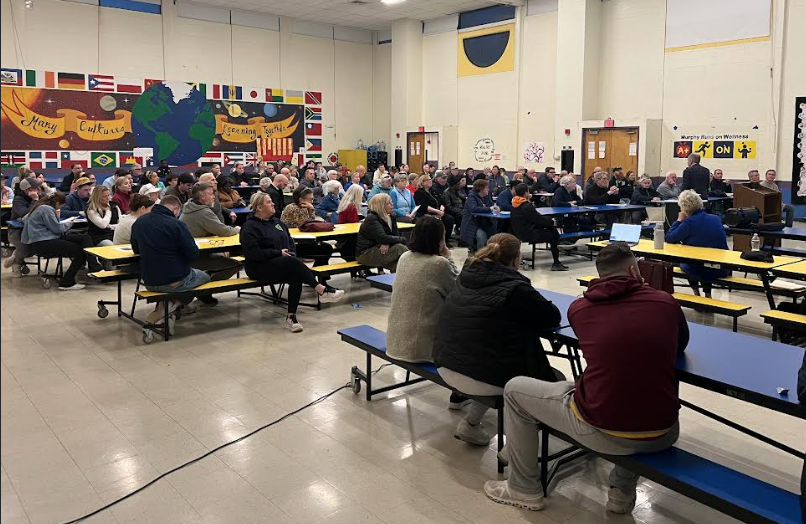
The scene inside the Murphy School cafeteria on Wednesday evening, March 25, 2026. Cassidy McNeeley photo
Boston City Councillor John FitzGerald, who represents Minot Street and has publicly opposed the project in the past, was quick to share his frustrations regarding the lack of community involvement.
“I worked at the BPDA for 17 years prior to becoming a city councillor. I’m very familiar with how this process works,” said FitzGerald, whose said his first time meeting the Paskells was at Wednesday’s meeting. “I do remember a day when it was a sign of respect to come to a city councillor and say this is what we’re proposing in your area, so I think honestly, off the bat, we’re off to a rough start.”
FitzGerald shared that he is against the project because it will “change the character of the neighborhood.” That is, he said, “one of the last areas we have for families to have their little slice of the American Dream. You got your house, your front yard, your backyard, you got neighbors borrowing sugar, everyone knows each other, looks out for each other. It’s a beautiful thing, and it’s something the city is losing.”
He continued: “What this [project] does is bring in people that I don’t think want to be part of the neighborhood. I don’t think they will want to lay roots down here. They won’t care if the sidewalks crack, they won’t care if our Boston Public Schools are good because they know they’re not going to be sticking around here.”
FitzGerald closed his remarks saying: “I’m for development, however this specific project in this specific location is not the right thing to do.” His comments were met with a sustained round of applause.
Anthony Gentile, who lives across from the project on Dunn Terrace, said family has owned their home for more than a century.
“That’s 106 years, that’s how far back our roots go,” said Gentile.
“What bothers me the most about this is that the people who are developing this don’t live in our neighborhood. They have no conception of what Neponset is about, even though they have been building in our neighborhood for years,” Gentile said. “This is a neighborhood killer. This has no place at all in our neighborhood. It will destroy what Neponset is, and it will destroy what Neponset has always been. I speak for almost everyone in this room; we are steadfastly against this proposal.”
Gentile’s neighbor John O’Toole described the project as “obscene for the neighborhood in which it sits.”
Having lived in the neighborhood for decades, O’Toole said he’s seen many changes, but that this proposal just doesn’t make sense. Instead, he suggests the developers look at past projects in the neighborhood that have worked and take inspiration from them.
“We have a couple of good examples of what does work. There is a great example on Chickatawbut Street. A historical home, it’s still the centerpiece of the development,” said O’Toole about the development at 23 Chickatawbut Street that preserved a historical home with “tasteful townhouses built behind.”
He also pointed to 608 Gallivan Blvd.
“Right across from St. Brendan’s Church, very similar size and square footage, we got that to go from 28 units to 12 units and bring it down from four stories with roof decks to three stories, and ample parking for the whole development. That’s what we hope to achieve with this.”
Cedar Grove Civic executive-board member Lauren Woods and direct abutter Ray Hanley worry that developers are not willing to take any suggestions at all.
When Woods asked what changes had been made since the meeting in the fall, Morancy said “nothing,” but clarified that many changes had been made since the original project proposal. “This project was conceptualized a couple of years ago, quite frankly,” Morancy said. “We originally approached the planning department with a much different-looking project. The original proposal was one single building, 32 units, demolishing the existing building. We had at least a one-to-one parking ratio; the entire back of the site was parking.”
He added: “We’re still very much in that community engagement process. We’re still getting feedback, we’re still listening, this meeting is still informing the planning process.”
Hanley said that among everything discussed at the abutters meeting, including concerns regarding traffic, parking, pedestrian safety, shadow and sunlight, sidewalks, and loss of neighborhood character, just about nothing has changed.
“The fact that you made no changes whatsoever just hearing from the direct abutters, never mind all the other people opposed to it, shame on you,” said Eileen Walsh of Flavia Street, whose comment drew applause and cheers.
Morancy said that the Paskells were listening to people’s concerns and would make some decisions before the Planning Department sponsored Public Meeting on April 9.
The meeting is currently scheduled for a 6 p.m. start on Zoom, but several neighbors asked that it be moved in person.
State Senator Nick Collins, who is opposed to the project, was present at the meeting and said that he is also in favor of an in-person public meeting with a hybrid option and is happy to request this. Representative Dan Hunt was not at the meeting but sent a statement opposing the plan as well.
Karen McNutt, an attorney who lives on Minot Street, reminded everyone at the meeting that they can take action.
“This is a bad idea. You’re going to go through everything, and go to the zoning board of appeals, and you know what they are going to say, ‘you’re fine,’ because they’ll approve just about anything,” she said. “But I’ll tell you something, you folks out there don’t have to accept that. You can take that to superior court.
She added, “This is a neighborhood destroyer. It destroys the quality of life in our little corner of Dorchester. You don’t have to sit and take it.”
To keep up with the project updates and meeting information, visit https://www.bostonplans.org/projects/development-projects/39-minot-street
