
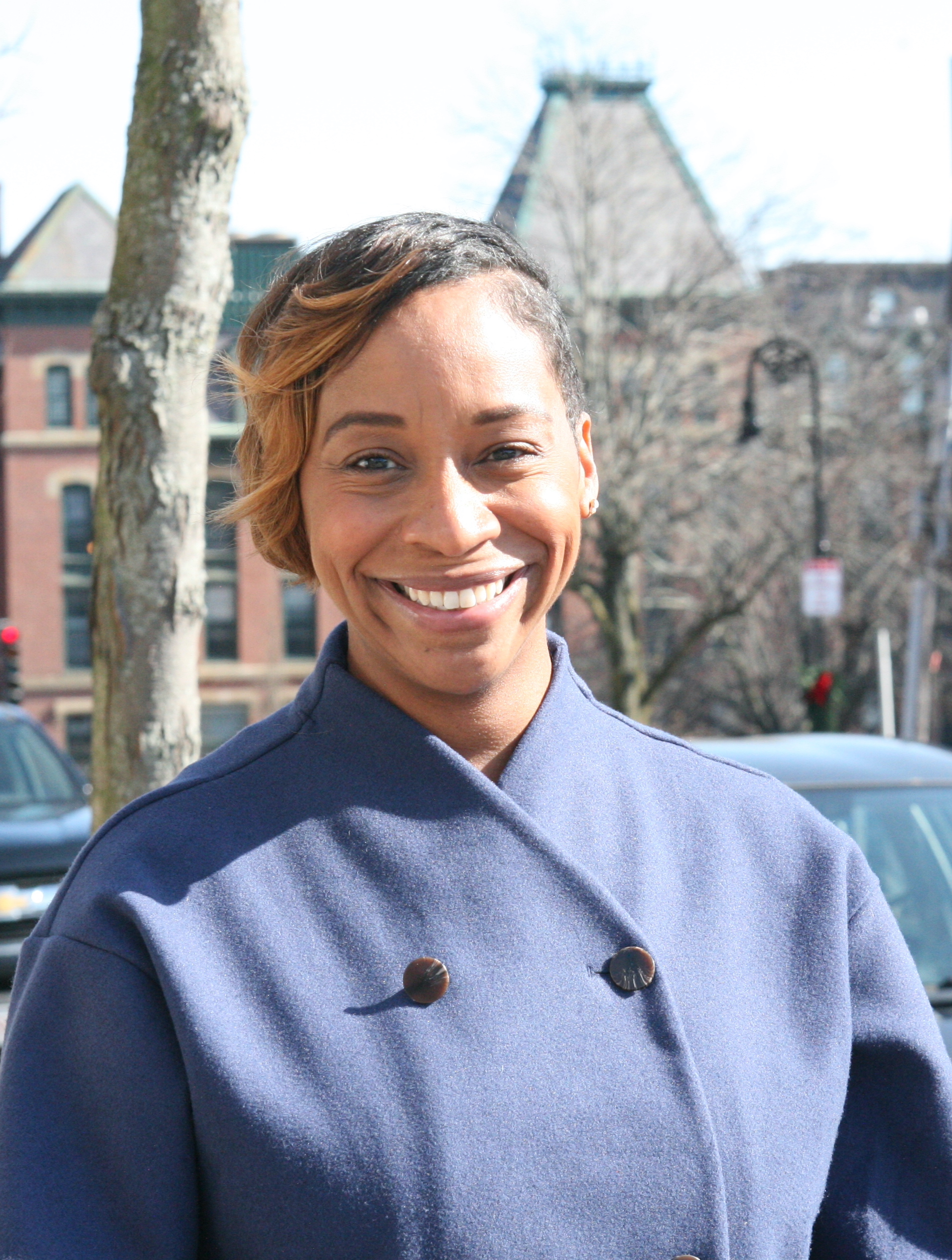

Above: TechBoston Academy student Laila Nyima Andrade, left, who is part of this year’s Aspen Challenge team, with QHH members Mykaeyla Cuello and Aaron Curry. Mitchell Heisler photo
A group of students at TechBoston Academy has formed a non-profit organization aimed at creating “a sense of belonging” for young adults in Boston. It’s part of a larger mission that began after their school community was traumatized by gunfire on its campus in 2022.
The organization— dubbed Quality Homes for Humankind (QHH) —focuses on what its founders call “the Lost Middle”— young people aged 18-32.
“Everyone we talked to was too old for youth services and not stable enough for adult systems. That’s when we started calling it ‘the Lost Middle,’” said Dorchester’s Aaron Curry, 17, one of the student leaders, who explained: “Around that time, especially 18, that’s when a lot of government assistance falls through. Because of that, they don’t have anything else to rely on.”
The non-profit has its roots in TechBoston’s participation in the Aspen Challenge, a competition for schools sponsored by the Bezos Family Foundation. “They gave us issues to choose from to promote a solution,” said Bruce Pontbriand, a longtime TechBoston Academy social studies teacher who advises the teens.
“We chose gun violence; we had a shooting at the school a couple of years ago, unfortunately, and because we had experienced it, we focused on more of an intervention approach.”
The shooting in question happened on March 15, 2022. At least ten shots were fired in the Dorchester school’s parking lot as students were loading onto a bus heading to an off-campus basketball game. Two people— a 17-year-old student and a 31-year-old teacher— were hit and wounded. Two teens— one 17 and another 16— were later arrested and charged with the assault.
The students who are leading QHH were in middle school that day. But the eruption of violence on that fateful Tuesday afternoon has continued to impact the balance of their time at TechBoston.

Above: Ten seniors and their teachers Bruce Pontbriand and Robert Driscoll sat down with The Reporter’s Cassidy McNeeley to discuss the mission of Quality Homes for Humankind. Cassidy McNeeley photo
Last year, eight students and two teachers formed Team U.N.I.T.Y, which set out its goal as uplifting neighborhoods and inspiring youth. Over ten weeks, they researched gun violence and worked at building a sustainable solution. In April, they presented their findings to a panel of judges at the Aspen Challenge’s Solution Showcase.
“We didn’t win,” Pontbriand said. “The kids came back, and they said, ‘We think we approached this from the wrong direction. It’s not an issue about guns; it’s an issue about belonging. It’s an issue about our graduates and young people in this community, not feeling like they belong, grabbing onto false senses of belonging, not having a purposeful career track.’
He added: “We have to find a way to create a situation where people feel and live in a safe situation where they belong, help them build assets, credentials, licensing tools, and then support them into careers, especially the trades, which in fact, promote a sense of belonging, and then move them into permanent housing.”
Since last year’s competition, the group of eight students has collaborated with younger peers to create a new course at TechBoston Academy. It’s called Boston Youth Power, Rights, and Community Change.
“We started to focus more on why people feel so out of place that they have to resort to violence, and then we ended up pinpointing the fact that some people feel like they don’t belong,” said MyKayela Cuello, a senior.
Said her classmate, Donte Robinson, “It’s not only that people don’t have a sense of belonging, but people are falling into false senses of belonging… They join gangs and things like that, and that causes lots of gun violence.”
The mission, senior Brian Hodge said, is to create “a sense of community, a sense of I belong here, and I am right where I should be.
“When people don’t feel that, then they have to find that in other places and with groups who are not the safest or doing the right thing, and then they turn to gun violence or whatever they need to because they are in survival mode. Once they find that safe sense of belonging, then they can focus on developing trades and careers and so on.”
This year’s Aspen Challenge group at TechBoston has also launched “We Give a Future,” which hosted its first-ever “Connector” event last month at the school, when 74 seniors were matched with more than 30 partners from local trade unions, businesses, and nonprofits who came to TechBoston for a day-long program.

Above, a scene at the We Give a Future event at TechBoston Academy last month. Mitchell Heisler photo
“We had a lot of trades and a lot of partners gathered in this room to bring awareness of their support to a lot of our seniors,” said Rachel Fuentes-Palacios, a Dorchester resident who is helping the effort. “A lot of kids that have been speaking with us don’t necessarily believe college is the right path for them.
“It’s our job to provide different trades and organizations within our community and give them an extra nudge to be able to connect with these people, have genuine conversations, and make relationships.”
Said Elijah Bernardo, one of the TechBoston students: “I have friends who just lack opportunity “They are not able to be in spaces like the Connector event, where they see different trades, because they fell through the gap so early in life. If they had held on a little longer, and they were able to be in school or see these opportunities, they would be in a different situation now.”
Since the career fair, the TechBoston group has shifted its focus to raising funds for an ambitious goal: securing a “pilot home” in Dorchester’s 02124 zip code that they hope might someday serve as a bridge to permanent housing with resources like case management and life-skills coaching.
“This summer, we’re seeking grant support to fund a small group of our graduates to go deeper into program design,” Pontbriand told The Reporter. “The partnerships are already in place—we’re now building out exactly how the model operates day to day.”
He said the group is looking to form city partnerships to help unlock an underused building, foundation support, and a local donor or partner willing to help secure a property. The students have met with City Councillor Brian Worrell to explore possible sites, he said.
Aaron Curry says the response, so far, has been positive.
“It would be different if it were from people who aren’t that age or who don’t live around here,” he said. “It wouldn’t feel impactful, but it’s people who are going to school here, who work here, live here, and do sports here. It makes everything much more intentional when it comes from the source.
“The work [other organizatiions] do is important,” he said, “but it’s different when it’s people from the community because we know what to target.”
Visit qualityhomesforhumankind.org for more information.
