
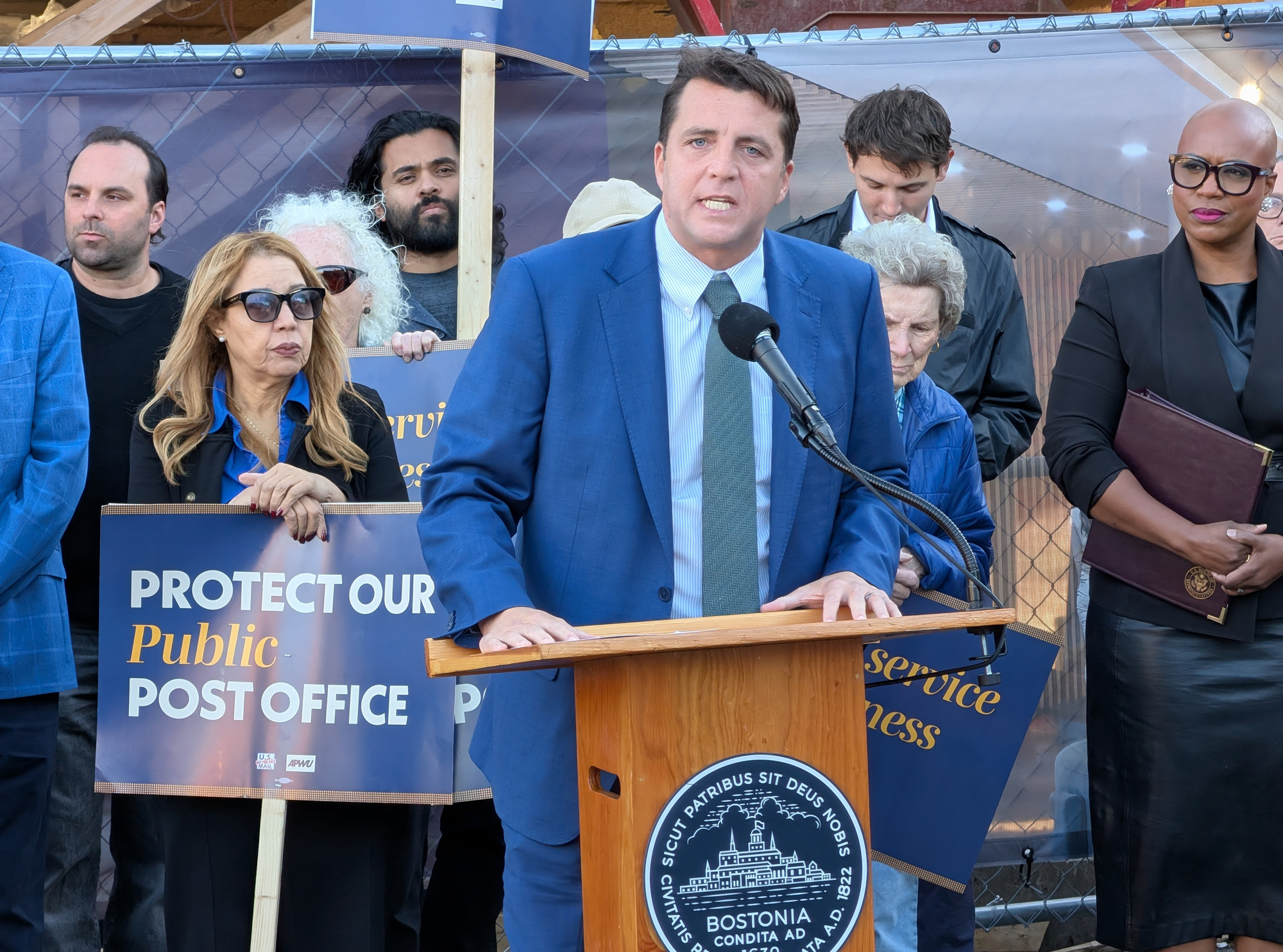


Above, Mayor Wu during a BPS event on March 26. Jeremiah Robinson/City of Boston photo
City officials planning a tighter budget for FY27 are pointing to multiple factors, from “economic headwinds” and faltering growth in the tax base to a bulge in healthcare spending, partly due to the cost of medications for weight control.
The spending proposal being filed with the City Council by Mayor Michelle Wu calls for an operating budget of $4.9 billion, Boston’s smallest increase since the depths of the “Great Recession” in 2009.
“The economic uncertainty that we are all experiencing, along with rising fixed costs slowing revenue growth, and inflationary pressures are really creating a perfect storm for local governments everywhere,” Wu said at a budget briefing on Monday. “And, in Boston, that is especially true with the local constraints that we operate under, including Proposition 2½.”
The FY27 budget increased from the previous total by 2 percent, following an increase of 4.8 percent in FY26 and 8 percent in FY25. In 2009, then-Mayor Thomas Menino filed a budget that decreased from the previous year’s total by 1.1 percent, resulting in the layoffs of 496 city employees. The FY27 operating budget letter to city councillors makes no mention of layoffs, though it does acknowledge that the smaller spending increase “has required tough choices, including targeted reductions.”
Thanks to city investments and federal pandemic relief money, Wu’s four previous budgets had boosted support for small businesses and nonprofit partners, including expanded cultural programming.
“However, due to tighter fiscal conditions and rising fixed costs, and guided by our goal to protect the core services our residents rely on most, the FY27 recommended operating budget reduces or removes funding for many of these discretionary grant programs,” Wu’s letter explained to councillors.
“Wherever possible,” she said, “we have preserved other City programs that provide similar services or leveraged public-private partnerships to help bridge potential gaps in services.”
Along with a $4.4 billion five-year capital spending plan, Wu also filed a Boston Public Schools (BPS) budget totaling $1.7 billion, an increase of 5.4 percent over FY26. This follows disclosure of a current BPS deficit of $53 million, along with a vote to close three schools by 2027, and a drop in student enrollment–down by 3,000 since 2024-25.
At a presentation last month, BPS Superintendent Mary Skipper estimated that the spending plan would result in 300-400 staff positions being eliminated. A recent report by the Boston Teachers Union warned that the cuts would “fall hardest” on schools with the highest concentration of “high-need” students, special education paraprofessionals and support staff that is more than 70 percent Black and Latino.
Despite efficiencies and alignment with declining student enrollment, Wu’s letter on the BPS budget detailed “significant cost increases,” including those for health insurance, collective bargaining agreements, student transportation, and special education.
Employee health insurance was also cast as a “major challenge” in the operating budget, with a projected increase this year of $97.3 million, partly due to the cost of non-Medicare plans rising by 20.3 percent, up sharply from increases over the previous eight years.
In a letter to the City Council on March 16, Wu’s chief financial officer and the city’s collector-treasurer, Ashley Groffenberger, attributed the spike to the general increase in the cost of healthcare, “a series of unusually high-cost claims, and the growing use of GLP-1 medications for weight loss.” A move by the administration to control the cost of the medication by “utilization management” met with resistance from a committee representing city employee unions, though an agreement was reached later that month.
According to Steve Poftak, CEO and president of the Boston Municipal Research Bureau (BMRB), the steep increase in healthcare spending also results from the city’s reserve fund for catastrophic coverage having been “exhausted.” He called the healthcare increase a “huge factor” in the budget that, he said, “is really crowding out a lot of spending.”
Among other budget factors, Poftak emphasized the decrease in revenue from outside sources, and the fall-off in local revenue from new development, which would allow the city’s tax levy to increase in excess of the cap imposed by Proposition 2½. A January BMRB report showed that revenue from new growth last year had the “slowest increase in over a decade,” and, Poftak said in an interview on Monday, that fall-off “is one of the issues that’s really that’s forced this level of cuts and has really constrained the budget.”
In its report, the BMRB concluded that “the decline in business assessed values and new growth was driven particularly by a slowdown in commercial new growth. These declines raise concerns for FY27 and beyond, given the significance of business property taxes in funding Boston’s budget.”
At a City Council hearing last week, Wu’s current requirements for climate change and creation of affordable housing were criticized as an obstacle to new development but also defended. In a statement after Wu’s budget letters were released, Greg Maynard, executive director of the Boston Policy Institute, argued that “there is significant and growing evidence that Mayor Wu’s own decisions, like increasing inclusionary zoning requirements, hiking linkage fees, and dragging her feet on comprehensive up-zoning, are responsible for the lack of new development and subsequent slow revenue growth in Boston.”
In an email statement on Monday, District 4 (Dorchester/Mattapan) Councillor Brian Worrell commented, “We’ve heard a lot about increased spending and skyrocketing residential property tax increases, which is why I’m focused on diving deeper into the slow revenue growth forecast for the city. Revenue growth is vital for the long-term health of the city, which is why this week, I filed two hearing orders, one on the creation of a public-private lending agency and the other on commercial-to-anything tax incentive programs and additional pro-growth policies.”

Mayor Tom Menino is shown announcing his 2009 budget. Chris Lovett photo
In 2009, even three months before his FY10 budget was filed, Menino used the high-profile setting of his “State of the City” address to call for city employees to accept a wage freeze. By then, it was already apparent that the national economic downturn would cause a sharp decrease in state aid.
In 2026, city budgets face other pressures, including continued inflation and relatively high interest rates, changes in federal spending and policies, as well as declining values for downtown commercial property.
The declines have been linked with everything from the recent slump in Greater Boston’s life science sector to the increased use of remote work.
In its economic survey for New England on March 3—just after the beginning of the new war in the Middle East, the Federal Reserve Bank of Boston itemized drops in inflation and unemployment. But the survey also showed a decrease in consumer confidence and found that Boston’s office markets “remained weak, with vacancies rising and rents remaining flat.”
Two commercial real estate service firms recently reported that vacancy rates for Boston’s office space were beginning to stabilize, with potential improvement in 2026 for life science. But they also noted that new office construction in Greater Boston had fallen to historic lows. In a March 4 post, the real estate blog Commercial Café reported that Boston’s office space production was less than one-quarter of its peak in 2024. The drop was also related to a national trend of developers “slowing production to drive down vacancy rates and allow demand to catch up.”
At Monday’s briefing, Wu also connected the current “fiscal moment” to a “very competitive global landscape,” with more fluidity for investments and more options on where employees can choose to live. Other factors she mentioned were market volatility and geopolitical conflicts quickly driving up energy.
“And so,” she said, “at least for the next three years, there is a particular moment of greater uncertainty that we are living out day by day and headline by headline. There is a larger underlying shift to commercial office markets everywhere as well.
“And,” she noted, “we’re starting to see some of the resets in values and hearing from property owners and those connected to real estate investment trusts that they are now starting to see the writing down of some of those values, which, in fact, is actually unlocking projects beginning to move as those resets are being absorbed with the reality that we will not get back down to a near-zero interest rate environment, at least for the foreseeable future.”
At the briefing, the executive director and CEO of the Massachusetts Municipal Association (MMA), Adam Chapdelaine, reinforced Wu’s highlighting of the limited options for local tax revenues. He also attributed budget strains to a long-term drop in unrestricted state aid, as detailed by an MMA report last October.
“Our key findings were, first, costs are rising faster than municipal revenues can keep up with. In particular, expenditures on health insurance, energy and utilities, and contractual obligations, are increasing at unsustainable rates,” said Chapdelaine. “Second, flexible state aid or unrestricted general government aid still hasn’t recovered from the Great Recession nearly 18 years ago.”
Capdelaine maintained that spending growth in the state’s local communities was below the national average, while even the additional revenue allowed from new growth was too unpredictable.
“Municipal budgets require stable recurring revenue that is not subject to economic volatility,” he argued, adding that “even with the most valiant efforts to operate efficiently, city and town leaders simply can’t overcome the larger trends that are forcing them to make very difficult decisions, and these are decisions that are felt by both local residents and businesses.”
Editor’s note: This article was amended on April 20, 2026 to correct a figure related to the percentage increase in the BPS budget for FY27 over FY26.
