


An updated proposal to build a large condominum complex on Washington Street in Lower Mills was one of two development projects reviewed and debated at a civic association meeting last Tuesday evening (April 21) at St. Gregory’s auditorium, where about 60 people participated in a sometimes chaotic two-hour session.
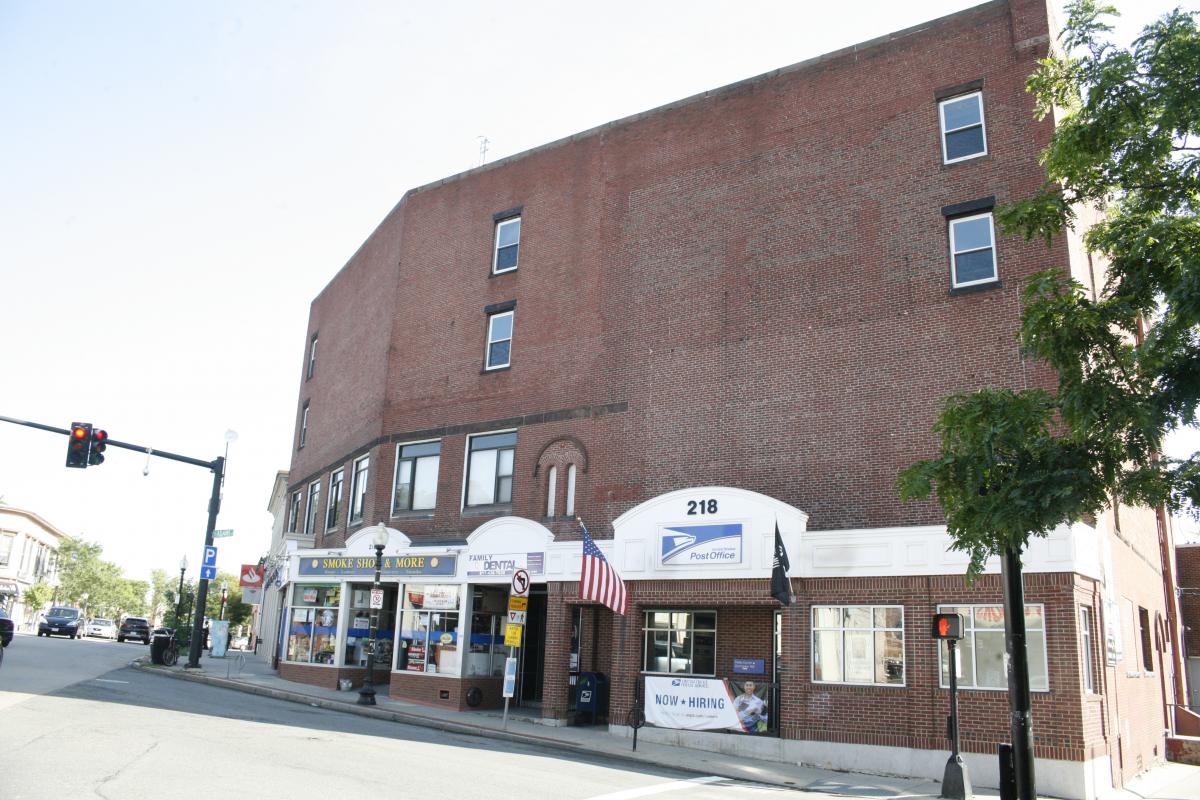
The Washington Street project— which has not yet been filed with city planning officials— is the second iteration of a plan that first surfaced in 2016 from City Point Development, a Newton-based company that hopes to build 59 condo units at 1120-1128 Washington St. The site includes two existing buildings, including the former Molloy’s funeral home, which has been closed for more than a decade.
The new plan calls for those existing buildings to be preserved and relocated on the site to make room for a 4-story building that would include a mix of 57 three, two, and one-bedroom units.
While no vote was taken on this project at Tuesday’s meeting, the discussion made clear that the project continues to face stiff resistance from abutters and other neighbors, many of whom raised concerns about existing traffic congestion in the Lower Mills village. The project includes an underground parking structure for up to 53 vehicles and 8 surface spaces, according to a plan reviewed last week by The Reporter.
Members of the Lower Mills Civic Association’s executive board, including Richard O’Mara,noted that the new plan has some positive changes from the earlier plan, particularly in preserving the existing structures on the site.
But several members of the group protested the size of the project, arguing that the introduction of what could be 150 or more new residents — and their vehicles— to the block would exacerbate already traffic-choked conditions in the village. Other speakers raised concerns about rodents, sight-views, trash collection, and other quality-of-life issues that would particularly impact direct abutters.
LMCA executive board member Tom Maistros noted that the project— when filed— would be subject to a large project Article 80 review by the city’s Planning Department.
John Rogers, an attorney who represents City Point Development and who appeared on behalf of the project’s team at the meeting, said that the group intentionally appeared before the civic group first to solicit input before filing any plans with the city of Boston.

Members of the Lower Mills Civic Association raised their hands during a vote taken during a meeting in St. Gregory’s Auditorium on April 21, 2026. Bill Forry photo
The discussion about the Washington Street plan followed an occasionally contentious discussion about a smaller, 12-unit proposal for an existing two-family house at 2038 Washington St., a property that was damaged by a fire last October. The property owner, the attorney Ernst Guerrier, appeared before the group and answered questions posed by civic members about affordability, parking concerns (three spots for a 12-unit proposal), and density.
Guerrier, who owns and manages an existing law firm from a nearby office on Gallivan Boulevard, said he and his wife — who own other properties in the neighborhood— would pledge to rent units for “below-market-rate” prices. He also indicated flexibility on the size and height of the building, but without making a specific commitment.
It was not discussed at Tuesday’s meeting, but Guerrier’s proposal was the subject of an abutters’ meeting organized by the City of Boston last December. A review of that meeting’s record indicated broad support for the proposal, with one abutter —Mike Skillin— raising objections due to the height, density, and lack of parking — all deficiencies that require Guerrier to secure zoning variances from the city’s Zoning Board of Appeal (ZBA).
The civic group voted to request that Guerrier defer a planned appearance before the ZBA — set for May— and asked that he return to the civic association with requested revisions to the existing plan. It’s not clear whether that will happen or if Guerrier will proceed with his proposal as is.
Meanwhile, the composition of the civic group’s leadership is currently in a state of limbo. Tuesday’s meeting began with the unexpected resignation of Skillin, the longtime civic president who typically runs its meetings. Skillin passed the gavel to Richard O’Mara, the group’s vice-president, who said he will serve as an interim leader until a new president is chosen.
Nominations for officers for the group were on the agenda at Tuesday’s meeting and ended with one person—O’Mara— suggesting that Skillin should serve a final year as the group’s president. He has served in that role for 49 years.
