


I’m a grandfather. I know I’m time limited. But such is not the case for billboards.
When the Outdoor Advertising Board (OAB) created billboard regulations, it allowed those erected before Aug. 25, 1920, to be “grandfathered,” meaning they could stay where they were, so long as the owners continued to get permits for them.
That grandfather status is now almost 106 years old, but unlike the rest of us grandfathers, these billboards apparently can live forever, even when they are in places where they would be illegal today.
Take one example: the historic Dorchester North Burial Ground in Uphams Corner (above) that was established in 1634 and is on the National Register of Historic Places. The remains of forty Revolutionary War soldiers, three enslaved African Americans, and two colonial governors, including William Stoughton, Chief Justice of the Salem witch trials, are interred there.
State regulations stipulate that “no permit shall be granted for a sign within 300 feet of a public park, playground, cemetery, forest, reservation and or any other scenic or recreational area, regardless of ownership…” The rules further state that “no permit shall be granted for a sign which the [Outdoor Advertising] Board, in its discretion, determines would not be in harmony with or suitable for the surrounding area or would do significant damage to the visual environment.
“In making this determination, the Board may consider, among other factors, the health, safety and general welfare of the public; the scenic beauty of the area; the physical, environmental, cultural, historical or architectural characteristics of the location and area…”
It’s clear that the regulations forbid the four large billboards that are within 300 feet of the burial ground and its ancient graves, but presumably they were there before Aug. 25, 1920.
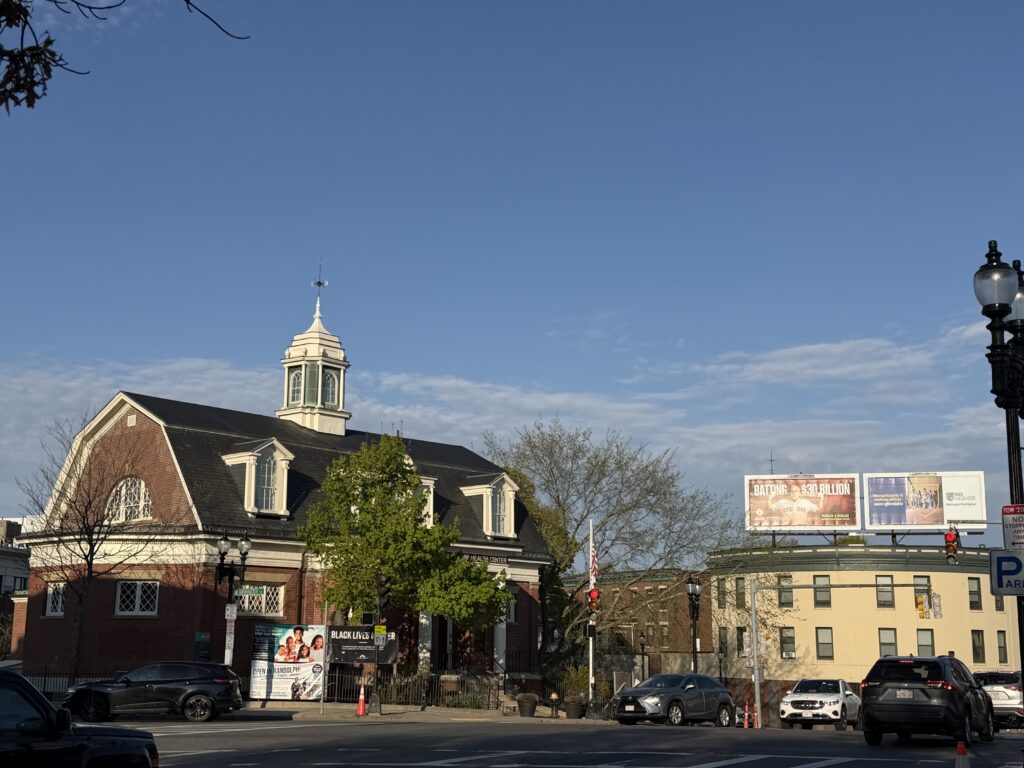
Another historic site with billboards within 300 feet of it is the Codman Square Historic District at the intersection of Washington Street and Talbot Avenue, where two huge billboards loom over four historic buildings – the Second Church (1806), the Great Hall (1904), the former Girls’ Latin School (1901) and the Lithgow Building (1899).
Billboards are also forbidden in residential areas: “No permit shall be granted or renewed for a sign that is not located in an area of business character,” which is defined further as “the area in which the sign is to be located in not predominately residential, agricultural or open space or natural area.”
One of the worst examples of this violation is the gigantic Clear Channel billboard advertising liquor on the ground at the intersection of Bowdoin Street and Geneva Avenue, which abuts three-deckers on all sides.
There are dozens of billboards in Dorchester that would not be permitted today except for “grandfathering.” But OAB “grandfathering” is a regulation, and regulations can be changed.
The OAB currently defines “grandfathering” as “a sign that was lawfully erected, but which does not comply with the provisions of Mass. General Law… Only off-premise signs which have been continuously permitted by the Department and utilized since their erection may be eligible for … Grandfathered status.” The erection must have occurred before August 25, 1920. “These signs may not be altered in any way other than ordinary/customary maintenance. If any … Grandfathered sign is modified in any way or removed, it shall lose its … Grandfathered status.”
There are four states where billboards are banned outright – Alaska, Hawaii, Maine, and Vermont. The state of Vermont had many billboards but in 1967 the legislature formed a committee to study outdoor advertising due to concerns that billboards were detrimental to the scenic resources of the state and, therefore, its economy. The result was a law passed in 1968 that banned new billboards and provided an amortization period of five years to remove existing billboards.
There were court challenges regarding the law being a public taking of property, but the amortization period for removal worked, and by the end of 1976, all billboards in Vermont had been removed.
The useful life of the Massachusetts billboards that would currently violate regulations but were grandfathered ended years ago. The regulation should be changed to read that grandfathered billboards in locations that would be unlawful today need to be removed by June 30, 2031.
Another vehicle for the removal of these billboards would be to change the regulation that forbids billboards in certain areas. Although billboards are banned on Martha’s Vineyard and Nantucket, the OAB has “specifically designated Sign Free Areas for which no permits shall be issued” in the towns of Lexington, Lincoln, Concord, and sections of Charlestown. Why not add a provision to forbid billboards within 1,000 feet of designated historic districts, along with a delimited five-year sunset for grandfathering?
Dorchester is blighted with billboards. Call your legislators today to ask them to change the regulations. Time limits are not just for grandfathers.
