Today’s media environment, taken as a whole, makes some mindful of the story in Genesis when God, angered by the arrogance of city dwellers planning a tower aimed at the heavens, set the once-common tongues of the builders into confusion and scattered them to the ends of the world, leaving the tower unfinished in an empty place called Babel. They note that these are bewildering times for those who seek news they can count on delivered with a commonly understood discourse of language and argumentation, factual information, and reliable media.
In particular, people who aim to define the terms of issues under debate find themselves on the defensive against headline-only online readers, quick, unmediated hits on social media sites, and rudely intrusive and questionable advertising.
Much of this back-and-forth plays out on national and international media stages, often uproariously;the closer news seekers get to home, though, the more likely it is that the information that residents receive from local media will be accepted generally as factual.
While news delivered on a package of paper and ink is an enterprise akin to the horse carriage travel of the early 20th century, news delivered in print – words, that is, – is still a coin in the mix on computer screens, and newspaper companies are competing in that realm, increasingly relying on websites that use visual adaptations to enhance their presentations.
Here in Massachusetts, the proliferation of community-focused news sites, both for-profit and non-profit, is an encouraging trend that needs constant monitoring and nourishing. As The Globe keeps to its renewal of centering its large-scale attention to regional news along an extended home front that runs through Boston, eastern Massachusetts, Rhode Island, and southern New Hampshire, it has, it seems, rediscovered the value of local news in discrete sections like Sports, where it once again is allocating substantial space for increased and intensive coverage of school sports and their personalities.
As to what is going on in the trenches here in Dorchester as the city, the state, and the residents of Mattapan grapple daily with how best to use the millions in funding available for the rehabilitation of Blue Hill Avenue, and as residents in Adams Village and Cedar Grove are dealing with a proposal for a housing complex on the site of a former veterans’ post, they find that big-paper coverage is a sometime thing. They expect instead that The Reporter will be on hand to record what is happening.
This scenario has become commonplace in our state, but one big question needs addressing with little delay if distinctly local news coverage by a multitude of small and energetic newsrooms is to be sustainable in the long term: Where does the money come from? At the smallest scale, staffing for reporting and sales (for some) and production is expensive, and the costs rise with success.
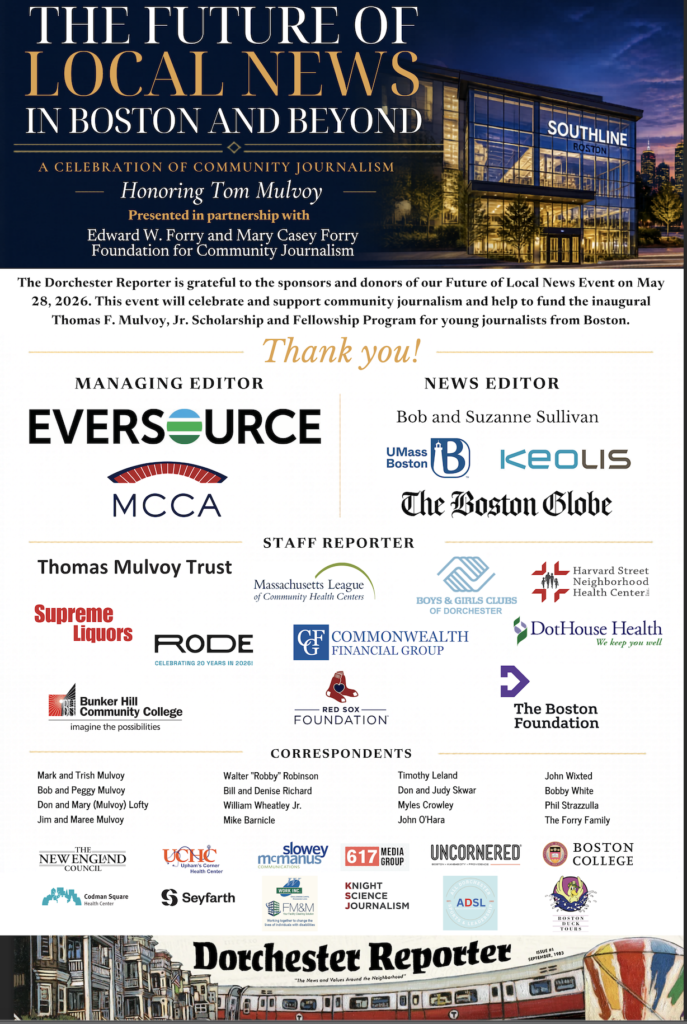
On Thursday night this week, at Southline Boston, the rehabbed former Boston Globe building, The Reporter, which has long provided internships to students, will celebrate community journalism by centering on its need for continuing financial support not only here at home, but also in towns and villages across our Commonwealth.
As part of the event, the paper will show its commitment to neighborhood news coverage with the awarding of a scholarship purse and a summer-long reporting position to a young Dorchester resident and journalist eager to bolster that commitment. The beat must go on.
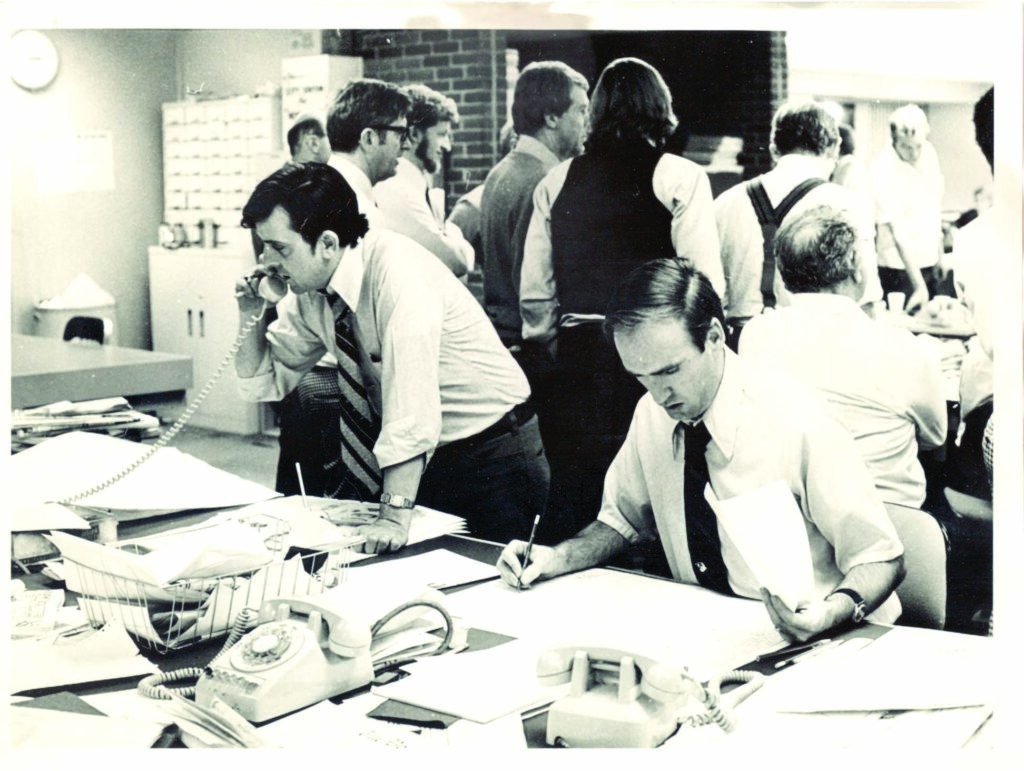
Above: Night Editor Tom Mulvoy, at right, and Assistant Managing Editor Frank Grundstrom are shown
at the Boston Globe news desk early in the morning of Nov. 3, 1976, updating the edition reporting the
election of Jimmy Carter as president. Boston Globe photo
•••
I was born during World War II, on Feb. 4, 1943, at St. Margaret’s Hospital on Jones Hill in Dorchester. I learned locally – kindergarten at the Elbridge Smith School on Dot Ave. at Centre Street, St. Mark’s Grammar School, Boston College High School – before going off the Dot grid for the first time, to Boston College in Chestnut Hill.
While living in Dorchester, my mind turned to journalism as a profession – at Radio Station WPLM in Pilgrim-rich Plymouth, Mass., where during 1965 and 1966, I was the news director (directing himself), and at The Boston Globe, where I worked as a staff editor in sports and then news from Nov. 23, 1966, to Dec. 31, 2000. In late 1976, unanticipated and unwelcomed circumstances saw me move out of the neighborhood.
But even then, I came back to work on Morrissey Boulevard for five days (often more) every week until I retired from The Globe and went off to teach at Boston College, where my old friend Ed Forry found me and lured him back “home” to his Dorchester Reporter, where I have been helping out a few days a week from mid-2002 through this evening.
You could put this headline over the paragraphs of resume above: “Dot-born editor, 83, stayed local during seven decades in newsrooms.” The augmenting headline would add: “and he loved every minute of it.”
•••
Newspapers intrigued me early on, and in my youth, they were readily available for small change, with seven of them circulating daily in Boston, two of which, the Boston Post and the Boston (Evening) Traveler, circulated right into my house. By modern standards, the placement of stories and photographs on their pages was riotous, as in disorderly, but the editions as a whole offered plenty of news, business, opinion, and sports to keep people, even young ones like me, busy reading all the way through.
At one point in the mid-1950s, I had what I later learned to call an epiphany. It occurred a day after my mother had driven us over the Neponset Bridge to Newcomb’s Bakery in North Quincy, where I heard the man behind the counter tell her that he was worried about his business “after they put that highway over the circle.”
I walked down to the Adams Street branch of the Boston Public Library the next afternoon and asked the sometimes-grumpy lady at the big desk how I could read about what was going to happen at Neponset Circle. To my relief, she answered warmly: “If you come back tomorrow, I’ll have a batch of newspaper clippings for you to look at, but you can’t take them home. So come as early as you can so you’ll have time to look them over.”
I arrived early and she handed me a folder containing cutouts of parts of pages from all the local papers, including one from Dorchester (the Argus? The Citizen?). As I read the stories about plans for the Southeast Expressway to be built over Neponset Circle and on into Boston filled with words of approval by the mayor and other politicians and of unsuccessful objections by residents and businesses, I remember thinking, “How can the government just demolish a busy neighborhood to make it easier for people from elsewhere to drive past us?” Well, they could, and they did, leaving local residents with a dark and gloomy junkyard-like space to traverse underneath a highway to elsewhere.
From that time on, I was sure that I was meant to be a newspaperman on a team with a mission to tell stories about my city and my neighborhood that readers would day after day find useful and informative. As things turned out over the next 65 years, I found my niche at two dedicated journalistic organizations, The Globe and The Reporter, where I received, and shared, a working education in news coverage by a big-city newspaper and community affairs coverage by a neighborhood (albeit the city’s largest and most diverse neighborhood) weekly and, lately, its website.
Now, I hope that the event’s scholarship recipient will have the same enriching experience as he chases the news across a landscape where everything, it seems, is variable.