
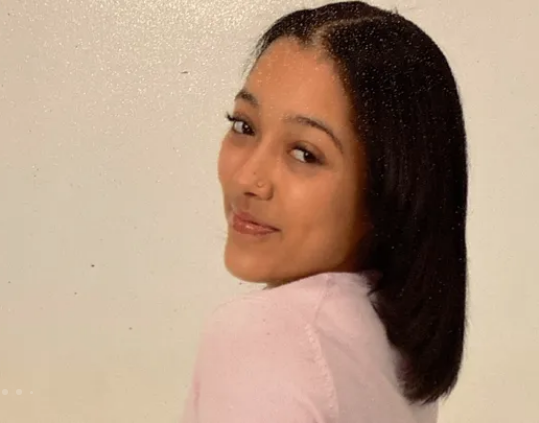
Above, Djofa Tavares celebrated the Cabo Verde World Cup team while walking in the Dorchester Day Parade on Sunday, June 7 in Fields Corner. Seth Daniel photo
By Djofa Tavares
Special to the Reporter
For many years and many generations, the Kriolu language has slowly been slipping away in the Cape Verdean community. But recently, with the growing popularity of Cabo Verde and increased visibility thanks to this year’s World Cup soccer team (Go Tubaron Azul Blue Sharks!), it is now cool to be bilingual in our community.
But we still have to do the work to preserve the language and culture.
My company, Mili Mila, secured a contract last year for the city of Boston’s Cabo Verdean Language and Culture Preservation Program. Our team created a new curriculum for participants to engage not only with the language, but also with the Cabo Verde culture.
This was the first step to realizing a dream for myself and so many families looking to continue the language with their children. So much came together perfectly to make it happen. The eagerness of parents was incredible as they looked for support to practice Kriolu with their children. English became a timesaver in directing and redirecting their children.
Mili Mila’s primary mission is to make the language and culture of Cabo Verde accessible. In 2015, we published the first-ever Cape Verdean ‘Kriolu to English’ dictionary by Manuel Da Luz Gonçalves, a former Boston Public Schools (BPS) educator. Using this grand resource, I was able to create Kriolu Basics (2020) online classes. In 2021, the Kriolu Collectibles alphabet flashcards became available to learn letter sounds.
All of that led to my book, ‘Tiagu and Vovo’ (2022), a dual language children’s book in Kriolu and English to help children not only learn Kriolu, but also to understand its importance.
In 2024, we launched the Speak Kriolu App, which includes audio and visuals, and in 2025, Mili Mila published Goncalves’ ‘English to Kriolu’ dictionary. With so many new resources, along with my 20-plus years as a BPS teacher, I was able to create a brand-new curriculum for ages 5 to 18.
Thanks to the support of Mayor Wu’s office and Eliseu Depina, the city’ former Cape Verdean community liaison, the program was free and housed in the former location of the Cape Verdean Community Center, now the Vine Street Community Center on Dudley Street. It was a full circle moment when I entered the same building, where, as a child, I had once learned from so many in the community about my culture and heritage.
I was so grateful for everyone at the center who welcomed and supported us with a space each Saturday morning.
Split into three age groups, kids learned the language and culture of Cabo Verde. The themes included basic greetings and frequently used words, pronunciation and letter sounds in the Cape Verdean alphabet, and many themes from numbers and colors, food, clothing, and favorites. There was also a map of Cabo Verde, information about each of the 10 islands, and history lessons about Amilcar Cabral, Cesaria Evora and Eugenio Tavares.
They also learned traditions like Panu Terra fabrics, and music/dance styles of Batuku and Morna. We created it all from scratch, including worksheets, games and activities, songs and poetry.
A field trip to the Cape Verdean Museum in Pawtucket helped participants learn first-hand about Immigration and Cape Verdean American stories of military service, whaling, and the cranberry bogs. We even had a session in the music studio with Music Program Director Kim Alves.
To close out our program, I had Cape Verdean artist Ivandro Carvalho join us as a guest instructor for a lesson in portraiture using the Kriolu language.
Best of all, each Saturday the participants joined me with excitement, especially the younger kids, who were so intrigued by this language that they heard from grandparents and others around them. Although the older kids hid their enthusiasm, once they were able to read and write Kriolu, I knew I had them. I was so excited to see them take notes and ask questions.
We wrapped up the Cabo Verdean Language and Culture Preservation Program in May with a great celebration that included students presenting their Identity portraits and describing themselves and their favorite things in Kriolu. As I looked around, full of emotions and trying not to cry, I saw so many smiling and proud faces, as each child received their Certificate of Completion.
I love teaching the language of Kriolu, but to have the kids and families react to the work has been a gift. Some of the words they shared in person and in emails after the close made me certain we are on the right path.
As for the future of the program, we are still unclear. We are hoping to meet with the Mayor’s Cultural Affairs Office in the coming weeks and talk about next steps. We would love to open the program up to more families and continue the work of preserving our language and culture. We encourage families to contact the Cultural Affairs office to express their interest in and support of the program.
Djofa Tavares is a former Boston Public Schools science teacher in Dorchester who teaches Kriolu Basics online for adults. She is also an author and advocate for Cape Verdean language and culture. She can be reached at djofa@mili-mila.com or via the web at www.mili-mila.com.
