

City public health officials announced a major milestone in the decrease of drug overdose deaths in 2025, as well as a decrease in new illicit drug users and the number of people congregating and openly using drugs on the Mass and Cass corridor.
Citing local efforts and national trends, Dr. Bisola Ojikutu, commissioner of the Boston Public Health Commission (BPHC), reported that the number of illicit drug overdose deaths has dropped in the last year and has declined even more over the last two years.
“I want to emphasize that this is a major public health achievement, and our 2025 data represent a significant milestone for our city,” she said in a media briefing on Wednesday.
“In 2025, there were 120 opioid overdose deaths among Boston residents, and this is the fewest number of opioid overdose deaths in our city in a decade. Comparing 2024 to 2025, there’s been a 29 percent decrease in opioid overdose deaths. And comparing 2023 to 2025…there’s been a 56 percent decrease in overdose deaths.”
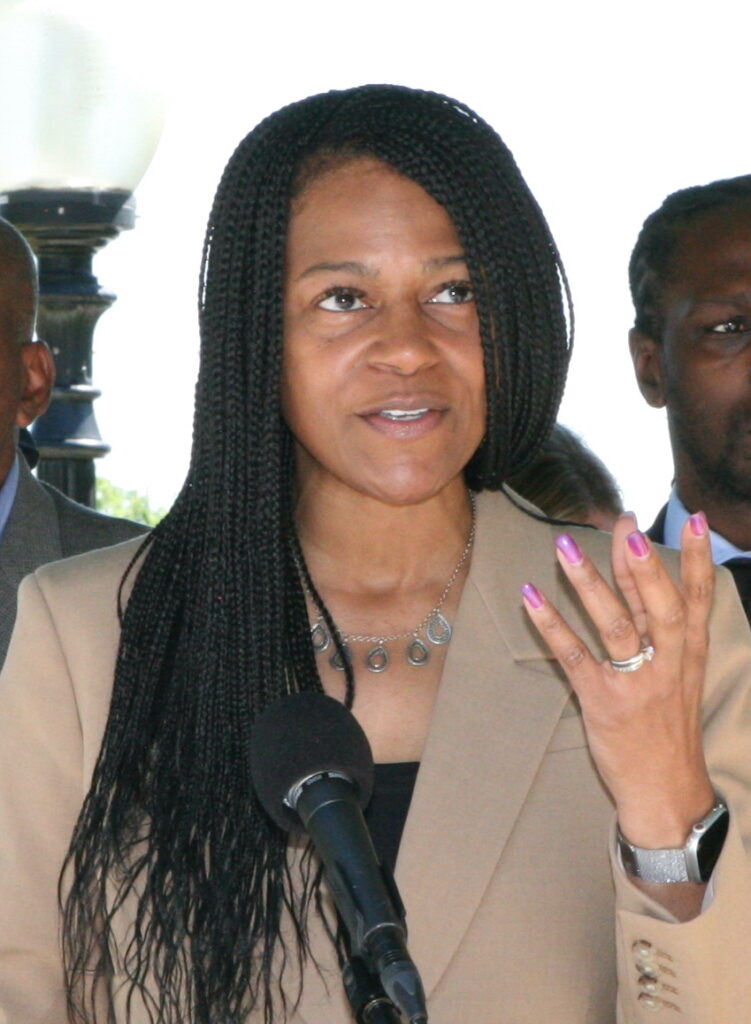
BPHC Commissioner Dr. Bisola Ojikutu said drug overdose deaths were down significantly in 2025.
For racial subgroups, there were still concerns, but also improvement. While Black and Latino residents make up 37 percent of the population, they accounted for 48 percent of overdose deaths in 2025. That said, for drug overdose deaths, there was a 34 percent decline in mortality among Black residents and a 15 percent decline for Latino residents year over year. Over the past two years, opioid overdose mortality has decreased 71 percent among Black men.
“I also want to highlight that unintentional drug overdose is the number one cause of premature death among Black men in Boston, who also have the lowest life expectancy of all male residents in Boston,” she cautioned.
The reasons for improvement are numerous and seem to point to several good things moving in the right direction at the same time to lessen drug overdose deaths, new users getting hooked, and encampments with open drug use forming at Mass and Cass.
Ojikutu first pointed to the investments into city harm reduction and recovery programs, as well as $1 million in grants that went to community organizations for substance use disorder interventions. Two of those organizations were Harvard Street Neighborhood Health Center on Blue Hill Avenue and Torchlight Recovery in Grove Hall.
“We’ve also increased our ability to navigate individuals to treatment, and that includes increased access to medications for opioid use disorder like methadone and Suboxone, as well as withdrawal management services and detox,” she said.
“And what we believe is that these findings are a result of sustained targeted investment in the entire continuum of services for people living with substance use disorder from harm reduction to treatment to recovery services.”
One of the strategies is making Naloxone, also known as the overdose withdrawal drug NARCAN, more readily available in all neighborhoods and to individuals. The city distributed nearly 35,000 doses of NARCAN last year, which is the most in the city’s history. The community organizations tapped for grants trained residents in using NARCAN and distributed more than 5,000 doses.
And while NARCAN can prevent death from happening when someone is using illicit drugs, there is an overall trend of reduced drug use among young people – lowering the risk of residents becoming addicted in the first place, she said. That, combined with those heavy users who have died in previous years, has resulted in the reversal of deaths.
“The pool of people who use drugs and who are susceptible to overdose may actually be shrinking,” she said. “Primary prevention efforts in our schools seem to be working, and fewer young people are initiating drug use. We know this from Boston’s Youth Risk Behavior Survey, which is conducted among high school students in Boston Public Schools. Essentially, the percentage of youth reporting ever using drugs has decreased significantly over time.
“So, there are few newer users and many higher-risk users have already passed away,” she noted.
The data also follows the national trend of drug supplies being pinched at the southern border, and therefore, fewer people being exposed to more dangerous drugs like fentanyl due to more vigorous prosecution and law enforcement actions. Ojikutu said the drug supply has changed in Boston, too, with lower concentrations of fentanyl found in annual drug supply testing. However, she said it was hard to know if there was a connection here to the national efforts.
“It’s difficult to make those connections,” she said. “I can basically provide what we know locally, which is we are seeing lower concentrations of fentanyl within the drugs that we have tested, and we do test samples yearly. These are preliminary, and that is probably due to drug enforcement, but I cannot provide any more detailed information as to an association.”
The other piece of good news was a reported reduction in people on the streets engaging in open drug use – whether at Mass and Cass or in the neighborhoods.
“Along with these numbers, less people are out there, and we have seen fewer people who are openly engaging in drug use,” she said. “And we’ve certainly implemented strategies to move people off of the street, one of which is to get more people housed through our low threshold housing program.”
She said that while that does not necessarily mean fewer drug overdose deaths, it does lessen the chances when someone has housing and is on a path to treatment.
Harm reduction and walk-in treatment referrals are available through BPHC’s AHOPE and PAATHS programs. AHOPE offers lifesaving harm reduction services, including syringe exchange, drug checking to identify the presence of fentanyl and xylazine, naloxone distribution, and screening for HIV, hepatitis, and other bloodborne illnesses that can be spread through intravenous drug use. The PAATHS program connects people to a variety of treatment services, including detox, medication for opioid use disorder, and outpatient treatment programs. Individuals can visit both programs at 774 Albany St. in the South End during business hours, and walk-ins are welcome. For support with substance use disorders, contact the PAATHS program at 1-855-494-4057 or 3-1-1. For more information, visit boston.gov/recovery.
