
Make way for the penguins! The neighborhood’s newest residents have found a permanent home at Franklin Park Zoo.
The Penguin Coast, a state-of-the-art habitat for critically endangered African penguins, officially opened last Thursday (June 11) as a part of the park’s African Experience.
“What’s so exciting about the Penguin Coast is that it is right here at the entrance of the zoo,” said Stephanie Brinley, president and CEO of Zoo New England. “It introduces visitors that are coming to the zoo to our conservation story, the story of saving critically endangered African penguins.”
Zoo New England has partnered with the Southern African Foundation for the Conservation of Coastal Birds (SANCCOB) to protect Africa’s penguins. Formerly found in large colonies along the continent’s southwest coast, the population of the species has declined nearly 90 percent since the start of the 20th century.
As climate change continues, African penguins from Namibia to Port Elizabeth continue to lose their habitats and their prey. But on the other side of the Atlantic, right here in Dorchester, a group of 14 (soon to be 18) penguins have found a safe and reliable home.
“We don’t have the full complement yet,” Brinley said in an interview with The Reporter. “They come from a number of different zoos, so they’ve been coming in over the last couple of weeks, and they all have been acclimating to each other and to the exhibit.”
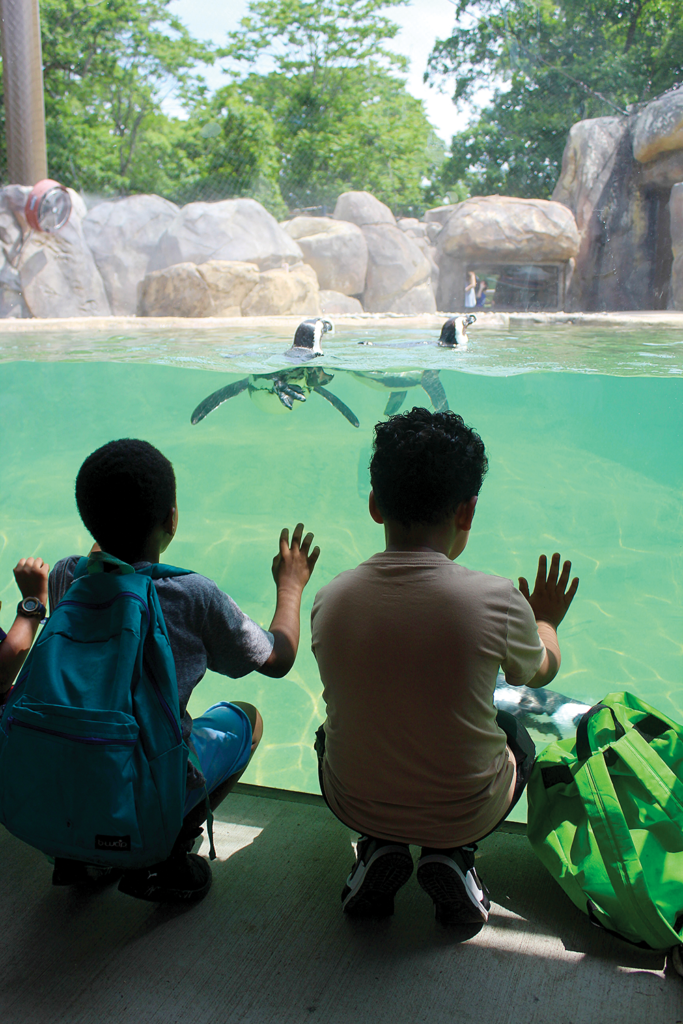
Wearing a set of silver penguin earrings and a necklace with a penguin pendant, Brinley said the experience is like no other. Park-goers can watch the penguins swim or sneak a peek at them lounging on land through the different lookout nooks. Meanwhile, children can learn about the work scientists do to help penguins survive and thrive on the replica penguin rescue boat.
Just a waddle away is the Serengeti Crossing, a habitat featuring Hartmann’s mountain zebras, white-bearded wildebeests, and ostriches. Thanks to recent renovations, guests can enjoy unparalleled views of the animals and their social interactions.
“When most kids hear that they’re going to the zoo, they’re not thinking about conservation, science, or educational outcomes. They’re thinking about, ‘I’m getting a day to leave school,’” said state Rep. Christopher Worrell.” But what makes this place so special is that while they’re having fun, they’re learning, growing, and seeing a world bigger than the one that they know, and that is what today is really about.”
He continued, “It’s about creating opportunities. It’s about making sure every child, regardless of their zip code, has a chance to explore, discover, and dream.”
Worrell said that for some young people, like his own daughter that morning, a trip to the zoo may be their first time seeing wildlife.
“For others, it may be the moment that sparks a passion for science, their environment, and their future careers that they never knew existed.”
The $21 million project was made possible through the generous support of Mathworks, the Commonwealth of Massachusetts, Grace and Ted Fey, the Welsh-Loveman Family, Lorenda Layne, Matt Niblack, Doug Lober, Barbara and Peter Roberts, Peter Wilson, and The Robert Lloyd Corkin Foundation.
“Thanks to the incredible support from the state and private support from so many donors, over the past decade, Zoo New England has completed over $65 million in capital improvements at both of our parks,” said Grace Fey, chair of the capital campaign. “With this tremendous momentum and your help, our zoos have a very bright future ahead.”
