

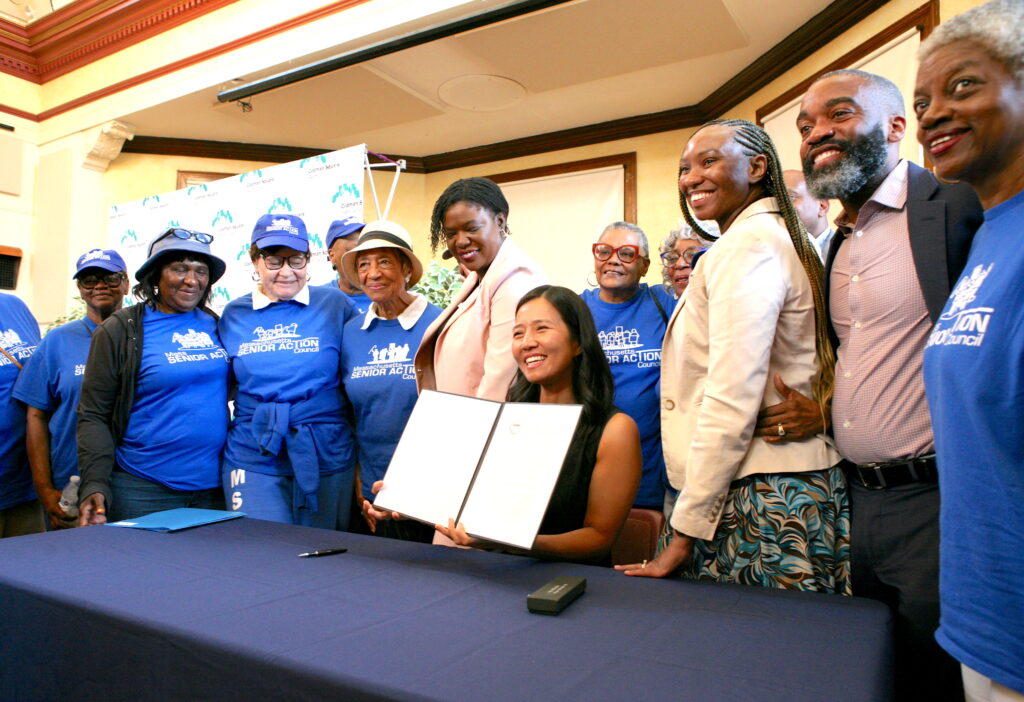
Mayor Michelle Wu was surrounded by elected officials and Mass Senior Action Council members on Monday in Codman Square’s Great Hall, where she signed an ordinance updating the city’s senior property tax relief requirements. Seth Daniel photo
Mayor Michelle Wu visited the Great Hall in Codman Square on Monday morning to sign a city ordinance that automatically ties the city’s senior citizen property tax exemption to annual cost of living adjustments, a move hailed by advocates who say it will likely save seniors significant dollars moving forward.
The local option ordinance – known as Clause 41D – was adopted unanimously last week by the City Council. It had beenavailable but not utilized for decades and elected officials said they aren’t sure why it was never adopted.
Senior advocates noted that the lack of updates to program thresholds over the last 20 years have made it difficult to qualify for tax relief.
The city’s tax relief program is worth between $1,000 and $2,000 annually. The new measure increases the fixed income with Social Security amounts from $25,980 to $26,687 if single and from $38,970 to $40,031 if married. It also increases total assets from $40,000 to $41,080 if single and $55,000 to $56,485 if married, while broadening eligibility by allowing it to grow with the Consumer Price Index (CPI).
“This will make sure the city automatically adjusts income eligibility every year,” said Wu. “Every dollar we can put back into our family’s pocketbooks is important and that’s why we look for every tool we can.”
More than two dozen members of the Mass Senior Action Council – led by Dorchester’s Lillie Bryan – donned their signature blue shirts and cheered the signing in the Hall.
Bryan said that she hopes the ordinance will add momentum for bigger tax relief packages currently working their ways through the Legislature.

Lillie Bryan at Monday’s event at the Great Hall. Seth Daniel photo
“This will help seniors struggling with property tax bills now and protect seniors that are already qualified from losing the help they have now,” said Bryan. “They had not adjusted [cost of living numbers] since 2003 and if they had passed this in those years, I know I would have qualified today and many others, too.
“But passing this now means seniors in 20 years won’t have to go through what we are going through.”
Councillor Ruthzee Louijeune championed the ordinance, but she said her move only came after she got a call from a senior citizen asking her to check for any tax relief that might be left on the table.
What she and her staff found was the 41D local option, which adjusts income and asset eligibility requirements with inflation figures.
“This may not sound like a big thing, but it is a big deal,” said Louijeune. “This is something the City Council can adopt, and it becomes law without any further action at the State House. We see how much advocacy is required to push anything forward, so accepting this local option tax ordinance is an important step. No one should be losing access to this relief because Social Security gets a modest increase, or retirements get a modest increase.”
Louijeune noted that if this had been accepted in 2003 when senior tax credits started, the current FY2026 income limits would be approximately $40,000 for a single senior and $60,000 for a married couple, rather than the current limits of roughly $26,000 and $39,000.
State Rep. Russell Holmes said that for older adults who bought homes long ago for lower prices, and now see their homes worth nearly $900,000 – the property tax bills on that appreciation homes can be staggering.
Other officials who were present for the signing included Councillor Brian Worrell, state Rep. Brandy Fluker-Reid, and AgeStrong Commissioner Emily Shea.
