
$400m to build 700 units in 2 buildings
Copyright © 2026 Boston Neighborhood News, Inc. This content may not be re-published or re-used without written permission.
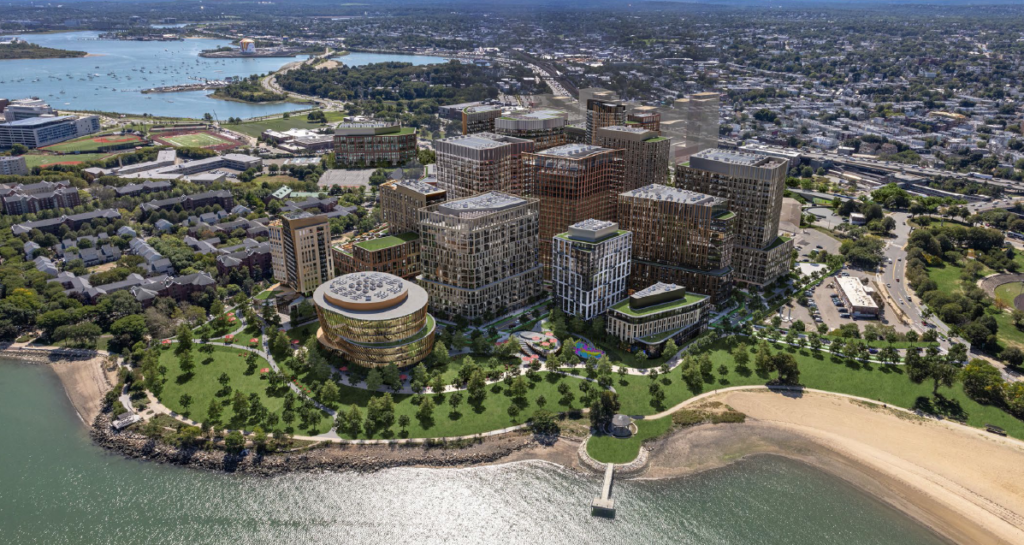
The development team behind the long-delayed Dorchester Bay City (DBC) project are pursuing a roughly $400 million federal loan that they hope will allow them to launch a first phase of more than 700 housing units on its Columbia Point site.
The loan pursuit is part of a new strategy aimed at kick-starting the massive redevelopment of a 20-acre waterfront site that was approved by city officials three years ago, but has languished amid financing and rising costs that have stymied many larger projects in Boston and nationally.
The Boston Planning and Development Agency approved a master plan for the DBC project in September 2023, clearing the way for 21 buildings and more than 6 million square feet of development on a site leased from UMass, which owns the land. The approved plan contemplated nearly 2,000 housing units, more than 4 million square feet of office, research and development, and potentially academic space, along with retail, restaurants, and a new grid of streets.
Richard Galvin, a principal with Accordia Partners, told The Reporter in an exclusive interview last week that his team has been working the US Department of Transportation’s Build America Bureau on an application for financing a phase-one start through its Railroad Rehabilitation and Improvement Financing, or RRIF, program.
“We’ve gone and applied for a loan — approximately a $400 million loan — to support more than 700 units in two buildings,” Galvin told The Reporter in an interview this week. “They encouraged us: Don’t think small.”
He added: “Our goal is to get a project going, with the most obvious first phase being housing, given the pent-up demand that would support that.”
The two residential buildings would rise from what is now a giant parking lot used by UMass Boston on the former Bayside Expo Center site along Mount Vernon Street.
When asked if Accordia is now looking at whether Dorchester Bay City should ultimately include more housing than envisioned in the approved master plan, Galvin said: “The short answer is yes. We’ll look at that. Obviously, with the changes in the life sciences market and changes in the office market, we still think a mixed-use project is the right, viable thing to do… Could there be more housing? Potentially, for sure.”
The federal RRIF program is intended to help jump-start transit-oriented residential and commercial development near rail stations at fixed rates tied to US Treasury securities, with repayment periods generally extending up to 35 years. Payments can also be deferred for up to five years after substantial completion — terms that can give developers substantially more flexibility than conventional financing.
Dorchester Bay City is located across the street from JFK-UMass MBTA station, which includes both Red Line and commuter rail service. Galvin said that Dorchester Bay City is one of three projects nationally that has completed a letter-of-interest stage with the Build America Bureau and is positioned to move into further underwriting.
“We’ve been actively working on this,” he said. “We’ve been spending time in D.C., spending time on Zoom calls,” while working through details of the program.
Another factor that could help Dorchester Bay City proceed is that the site is located in an “Opportunity Zone,” a federal designation intended to attract long-term private investment through tax incentives. Galvin said Accordia has worked with city and state officials on the new round of designations and are “pretty confident Columbia Point will remain as an Opportunity Zone.”
Galvin said the combination of an RRIF loan, Opportunity Zone capital, possible investment from union pension funds, and some form of city property-tax relief could begin to bridge the financial gaps that have stalled Dorchester Bay City to date.
“All those things, all of a sudden, start to make the economics potentially work,” he said.
The Wu administration has recently been exploring new tax incentives designed to kick-start housing construction that has been sidelined by high interest rates and construction costs. Galvin said Accordia has had informal conversations with city officials, including Planning Department chief Kairos Shen, about Dorchester Bay City, although it has not yet made a formal request for assistance.
“The main message from the city is: When you’re ready, let’s have a conversation about how we can help,” Galvin said.
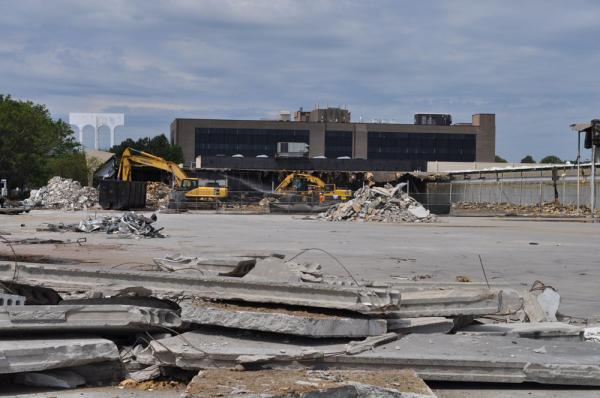
The Bayside Expo site while being demolished. File photo
The developers also remain involved with the University of Massachusetts Building Authority, which owns the nearly 20-acre former Bayside Expo parcel and selected Accordia to redevelop it in 2019.
“We continue to be under contract with UMass. We continue to invest in that contract,” Galvin said. “The construct is in place, and we’re moving forward. We talk to them all the time about our progress toward getting to the goal line.”
Galvin said he expects the financing picture to become clearer during the first quarter of next year as the federal loan process progresses and potential Opportunity Zone financing takes shape.
“My main message is that we’ve been spending a lot of time working on all this — time and money,” he said. “It’s a hugely important project to the city and the state. And we think there’s a strategy here that could be successful in launching a pretty significant Phase One.”
The future of the separately owned 2 Morrissey Boulevard portion of the Dorchester Bay City footprint remains less certain. Accordiaand Ares Management bought the 13.6-acre property for $110 million in 2019, shortly after Accordia was selected to redevelop the Expo Center site.
The property, which includes roughly 425,000 square feet of office space, was later incorporated into the Dorchester Bay City master plan at the city’s urging. Earlier this year, the ownership group hired a real estate company to test the market for a possible sale of that land.
Galvin said that marketing process remains underway, but stressed that a sale is not certain and is separate from Accordia’s agreement with UMass for the Bayside property.
“The main investor-owner of it — well, the clock was sort of up, I’ll say, just because of these investment horizons,” he said. “We bought it in 2019, so we wanted to test the market.”
Galvin said there could be “more to say about that” over the next few months, but added: “In terms of getting a Phase One project going, DBC is our focus.”
Copyright © 2026 Boston Neighborhood News, Inc. This content may not be re-published or re-used without written permission.
