

By George Lehman, Camille Bugayong and Ellen Dong
Special to the Reporter
Arrests for shoplifting in Dorchester by Boston police increased nearly fivefold, or 468 percent, from 2023 to 2025, far outpacing the statewide jump of more than 73 percent, according to a Dorchester Reporter analysis of three full years of data.
From the big box stores like Target and Home Depot in the South Bay Shopping Plaza to shops on Geneva Avenue and in Fields Corner, shoplifting has led merchants to lock up everything from shampoo to milk to baby diapers.
Overall, arrests in Dorchester have increased five percent over the past three years, but most crimes have been on the decline, with double-digit or more decreases in offenses including rape, assaults, weapons violations, and drugs, among others, department records show.
Shoplifting represents the second largest increase in arrests in Dorchester between 2023 and 2025. Only prostitution charges were statistically higher, rising from one arrest to eight.
The thefts have contributed to the closing of two Dorchester CVS Pharmacy stores– one on Geneva Avenue and another in Uphams Corner. The Walgreens on Gallivan Boulevard shuttered as well last year.
As in other parts of Boston, repeat shoplifters have plagued Dorchester businesses for years. Over 300 pages of Boston police reports reveal a litany of items shoplifters have stolen from Dorchester retailers.
Last June, a Home Depot security guard called police about a suspected theft of multiple air conditioners when two men entered the store and stacked air conditioners onto dollies before heading to the exit and loading the merchandise into a car, where three people were waiting.
“Security for Home Depot stated to the suspects that they had to pay. The suspects said nothing and kept walking out the store,” the police report states. “It was later discovered that the suspects took 17 AC units valued at $4,863,” a police report states.
Chronic offenders have led Suffolk County District Attorney Kevin R. Hayden’s office to obtain indictments against at least three convicted shoplifters accused of stealing everything from vacuums and children’s clothes to shampoo, a cordless nail kit, and $74 worth of steaks from Dorchester retailers.
Another repeat offender was caught last December at Target hiding 27 bottles of lotion inside a black duffel bag, a police report says. All three men have been indicted as “common and notorious” thieves under a 19th century state law allowing for stiffer sentences for those convicted of three or more larcenies.
That group includes Jeramie Alan Croft, whose multi-decade criminal history involves thefts in Dorchester. Croft was arrested last June for stealing $734 worth of merchandise from the Home Depot at the South Bay Plaza. Police say he placed a cordless finish nailer kit, a cordless wet/dry vacuum, and a 27-gallon tote into a wheeled trash can and left without paying. At the time, Croft had 12 active warrants and had been the suspect in three separate shoplifting incidents at the same store throughout May 2025, according to Hayden’s office.
By July 2, 2025, Croft had stolen $2,579 in items from the store, according to police reports. In February, he was indicted in Suffolk Superior Court as a common and notorious thief. He pleaded not guilty, and the case is pending. Croft’s lawyer, Kelli Lea Porges, declined to discuss the case with The Reporter.
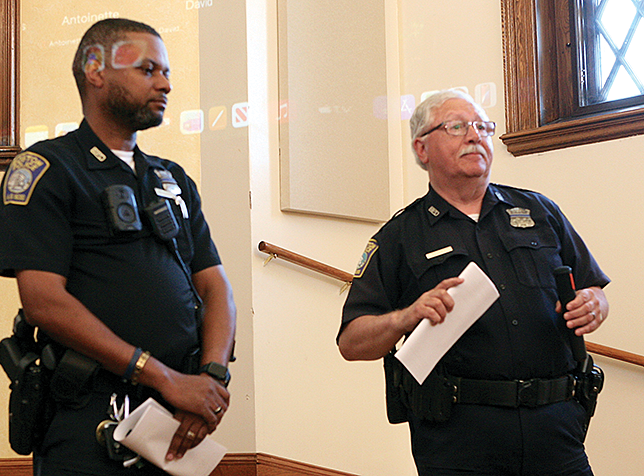
Boston Police Superintendent Paul McLaughlin and Ryan C. Kearney, general counsel for the Massachusetts Retailers Association, a 4,000-member trade group, said the increased arrests in Dorchester are due to more robust enforcement of state shoplifting laws and not necessarily more crime. Both warned that failing to aggressively punish shoplifters would embolden them to steal.
Shoplifting prosecutions waned under Hayden’s predecessor, Rachael Rollins, who held the post from 2019 to 2022 before serving as US attorney in Massachusetts for just over a year, when an ethics scandal forced her resignation.
Within two months of taking over as district attorney in 2019, Rollins announced that her office would not prosecute accused shoplifters if they had substance abuse or mental health issues, were unemployed and without resources, and if the items were food or diapers for child-care related.
In April of this year, Rollins requested nomination papers from state officials to qualify for the November ballot, indicating she may run for her former seat.
Hayden rescinded the shoplifting policy when he took office in 2022, his spokesman, James Borghesani, said.
Between 2019 and 2022, when Rollins left the district attorney’s office, Boston police made 42 shoplifting arrests in Dorchester. Without naming Rollins, McLaughlin said that in prior years “because of different attitudes about prosecution of shoplifting from the DA’s office” there was an “apathy” about punishing shoplifters.
In the past three years, police made 313 shoplifting arrests in Dorchester, department records show.
McLaughlin and Kearney said returning to the days when shoplifters could escape prosecution would set the city backward. “People were being arrested and let back out and doing the same thing, the same day,” said McLaughlin, who is chief of the Bureau of Investigative Services.
They also credited the increased enforcement of shoplifting offenses to a public-private partnership launched in 2024 and led by Hayden to track incidents more vigorously and punish offenders. The Safe Shopping Initiative is composed of retailers, the Boston police, the Mayor’s office, the Boston Chamber of Commerce, and other stakeholders.
“It was just a frustration about this kind of revolving door of shoplifting – people just really with impunity coming into the stores, taking what they wanted, not even hiding it and walking out,” McLaughlin said.
Kearney said prosecutorial stances on shoplifting, like those taken by Rollins in 2019, were an outgrowth of the decriminalization movement sweeping the nation at the time.
“Now the consequences of those policies have come home to roost,” Kearney said. “They think they can do it.”
Retailers across Massachusetts are grappling with increased thefts, Kearney said. In 2023 law enforcement agencies in Massachusetts reported 1,900 shoplifting arrests to state officials pursuant to a 2018 law established to better track statewide criminal activity. By 2025, the number had swelled to 3,291 arrests, the data shows.
Shoplifting costs Massachusetts retailers $1.2 billion a year in revenue and the state $78 million in sales tax, Kearney said.
The shoplifting arrests in Dorchester offer one glimpse into thefts from retailers. Individuals can also be charged with larceny, a felony if the merchandise stolen is over $1,200. Boston police arrests for larceny in the past three years rose at least 35 percent. About 37 percent of those arrested between 2023 and November of 2025 were for thefts in Dorchester, department records show.
District 2 Boston City Councilor Edward Flynn, who wants police to dedicate more resources to fight shoplifting, said Boston is falling victim to teams of thieves who carry out coordinated, large-scale thefts.
“This isn’t about a parent that has taken or stole milk out of a store for her child,” Flynn said. “This is sophisticated, organized rings that we’re seeing now in Boston where they’re stealing thousands of dollars’ worth of valuable merchandise.”
Boston police and Suffolk County prosecutors are working with Safe Shopping Initiative partners to make sure the right action is taken for those arrested who are also burdened by challenges like drug addiction, mental health, homelessness or other problems.
In cases with such mitigating factors, or in juvenile arrests, efforts are made to connect those charged with the help they need – and not just punish them for stealing, McLaughlin said.
“This isn’t a problem you can arrest yourself out of,” McLaughlin said. “Some people might be stealing because they are hungry, but they are not the chronic offender, necessarily, that we are focused on right now.”
This story was produced in Boston University Professor Maggie Mulvihill’s Data Journalism course in a partnership between the Dorchester Reporter and the BU Department of Journalism’s Newsroom program.
