


At a virtual candidate forum for the First Suffolk State Senate primary election held last Wednesday (Aug. 12) by the Massachusetts Affordable Homeownership Alliance (MAHA), no one asked about property tax relief, but the incumbent, Nick Collins, brought it up anyway.
The very next day, the topic boomeranged against him, in an Instagram post by one of his Democratic challengers, Latoya Gayle, in which she cited “the truth” about his voting record on the issue.Whether upfront or tacit, the combined political exchange was herky-jerky. Spliced over different platforms for a scatter of followings, the updated feed reflected an age-old dilemma for voters: a conflict between position and practice.
“If I’m reelected again, I’m going to commit to the same level of passion as I have in the past and raising two young girls in the city,” Collins said in trying to assure the MAHA forum participants. “And my wife and I know how hard it is to own a home and to maintain our footing, and also to continue to work to lower the tax burden on people, particularly working families, seniors, as we have passed significant legislation to do that.”
Touted by Collins as tax relief for seniors, the legislation was an amendment passed by the State Senate, for a second time this year, in June. If approved by the House of Representatives and the governor, it would increase the property tax exemption for eligible homeowners, with higher eligibility ceilings on assets and income for seniors.

Sen. Collins spoke to members of the Columbia-Savin Hill Civic group last year. Seth Daniel photo
A Collins press release suggested that the relief could be provided with the city’s surplus funds. As he detailed in a later Instagram post, “The legislation triples the property tax exemption for seniors, triples the personal property tax exemption for small businesses, and authorizes the use of surplus funds for direct homeowner rebates.”
Though similar to an item that was filed last year by the Massachusetts Municipal Association (MMA), as well as a city order approved in June, the amendment has met with a mixed reaction from Boston Mayor Michelle Wu. She acknowledged that it could help some homeowners living on fixed incomes, but WBUR reported that she opposed drawing tax relief from the city’s revenue surplus—money that she insists should be used only for emergencies.
In a letter to Wu on July 23, Collins pointed out that the city’s reserve fund was more than three times larger than previously reported. “That surplus was built up by the tax dollars of Bostonians,” he contended, “and it presents an opportunity to provide meaningful relief.”
In the city’s June 30 announcement of the local order, the source of money for tax relief is unspecified. And, according to the executive director of the Boston Policy Institute, Gregory Maynard, either form of new tax relief would amount to “foregone revenue,” with differences over the drawdown being “immaterial to the policy that’s on the table.”
Collins and Wu have been at odds over relief since 2024, when slumping values in downtown commercial real estate shifted more of the property tax burden to the residential class—including some longtime “house rich” owners living on a fixed income.
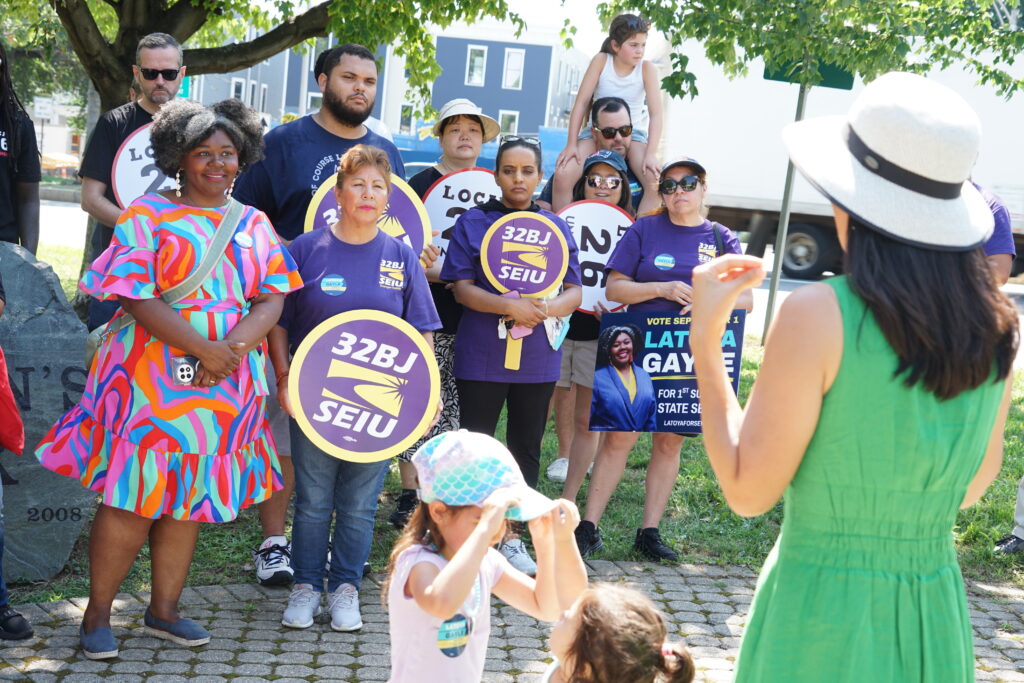
Latoya Gayle is shown (left) during canvass event on Aug. 8 in Dorchester. Mayor Wu is shown speaking to a group of Gayle’s supporters at right. Yawu Miller photo
Wu tried to soften the blow on residential owners through a home rule measure that would adjust rates temporarily, similar to one supported twenty years earlier by former mayor Tom Menino. Her measure was quickly opposed by real estate and property groups.
And by the end of 2024, after shifting projections of the tax burden, it also faced opposition from Collins and one other state senator representing part of Boston, William N. Brownsberger. The two Democratic senators are currently facing primary challenges from candidates supported by Wu.
Though the home rule measure has failed to advance at the State House, Wu still maintains that it would provide even more relief to residential property owners, and Collins challenger Gayle reinforced that message one day after the MAHA forum, in that Instagram clip that showed her displaying a promotion of the Senate amendment in a piece of Collins campaign literature.
“You may have gotten this in the mail,” Gayle wrote in alerting her followers to the video, “but I’m here to tell you the truth. Senator Collins is claiming to fight to lower your property tax bills, but the truth is, when the city of Boston put forward a tax shift proposal that would have saved the city $150 million over the last two years, that’s $8 million in South Boston, $8 million in Dorchester, $2 million in Roxbury, the senator blocked it.”
In April of 2024, when Wu announced her home rule measure, one of the speakers at her briefing was MAHA’s executive director, Symone Crawford. And, at a mayoral forum last year, MAHA members showed enthusiasm for Wu’s commitment to extend city support for its homebuyer programs, in addition to backing legislation to increase funding for housing.
A year later, there were no questions about tax relief at MAHA’s state Senate forum, as Collins, Gayle, and second-time challenger Juwan Skeens were largely in agreement about the group’s housing agenda.
But MAHA’s treasurer and board member Acia Adams-Heath pressed Collins on earlier “reservations” about a proposed real estate transfer fee, which had been advanced by several groups to raise new revenue for affordable housing.
The fee would apply to transaction values above $2 million. In 2024, the Senate Ways & Means Committee, including Collins, played a key role in dropping a version of the transfer fee from a capital spending package, in the wake of stiff opposition by real estate and property owner groups.
In his response at the forum, Collins said he now favored the fee as a local option, with more flexibility on how the new revenue could be disbursed, potentially for programs such as “MAHA-STASH,” which offers downpayment help for first-time and first-generation homebuyers.
In other versions of the transfer fee, revenue would have been channeled through a local community’s housing trust.
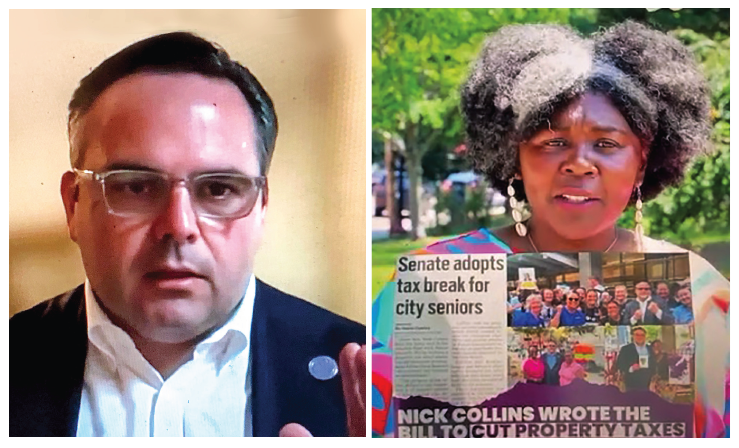
Sen. Collins (left) speaks during the virtual MAHA forum last week. Latoya Gayle (right) is shown in a clip from an Instagram post from her campaign.
“The flexibility to sometimes bypass the affordable housing trust to give funds right to programs like STASH,” Collins explained, “has changed my outlook that it can actually go right to the work that needs to get done.”
In the Democratic primary two years ago, Collins received 68.1 percent of the vote over Skeens, who received 18.3 percent, with blanks at 13.2 percent. From December of 2023 through July 2024, Collins raised $113,777 in campaign contributions, while Skeens raised only $1,378.93, including $350 that he loaned to the campaign.
Over the same eight-month stretch through July of this year, Skeens reported raising $398.02, with $300 of that covered by another loan. During the same period, Gayle reported raising $73,160.94, while the Collins total was $326,286.13—almost triple the figure leading up to the 2024 primary.
Contributors to Collins and Gayle include supporters of recent city election campaigns. Among the major donors to Collins was Jim Davis, the chair of the New Balance footwear corporation based in Brighton. A leading supporter last year of mayoral challenger Josh Kraft, Davis has also backed city council candidates, some competing against rivals who were supported by Wu, in addition to his earlier support of Donald Trump.
Over the past eight months, Collins has received contributions from multiple donors associated with real estate development and contracting, including trade unions. Among the current officeholders endorsing him are Gov. Maura Healey, district City Councillors John FitzGerald and Miniard Culpepper, and state representatives in various parts of the First Suffolk District. The district, which is wholly in Boston, includes Dorchester, South Boston, Chinatown, and part of the South End.
Collins has also reported campaign contributions from a number of former elected officials, including Dianne Wilkerson, Josh Zakim, Edward Coppinger, Sal LaMattina, Marie St. Fleur, Eugene O’Flaherty, Thomas P. O’Neill III, and Linda Dorcena Forry, who is co-publisher of The Reporter.
Gayle has endorsements from Wu and Allison Cartwright, who was elected Clerk of the Supreme Judicial Court in Suffolk County two years ago with support from the mayor. The only former elected official contributing to her campaign so far is Priscilla “Kenzie” Bok, the former District 8 city councillor and currently Wu’s appointed administrator of the Boston Housing Authority.
Gayle also has received support from past campaign contributors to the mayor and her allies on the City Council. These include Boston’s hotel and restaurant workers union, UniteHere! Local 26, and the service workers union, SEIU 32BJ, along with the Massachusetts Teachers Assn.
SEIU 32BJ was a leading supporter of the “Family Mobility Act,” which allows driver’s licenses for undocumented immigrants. According to the State House News Service, when that measure was passed in 2022, by a 32-8 margin in the Senate, Collins was one of five Democrats who voted in opposition.
The Collins campaign website posts even more endorsements from organized labor, including the Mass. AFL-CIO, the Mass. Nurses Assn., four other SEIU locals, the Boston Firefighters, and the International Brotherhood of Electrical Workers.
At last year’s mayoral forum, MAHA’s turnout could choose between an incumbent mayor who promised to continue delivering support for its programs and a challenger who promised to support at least part of the organization’s agenda. At this year’s forum, the difference was between an incumbent who could boast of past support and two challengers affirming the power of advocacy.
Last week, Collins told forum participants that he would advance MAHA’s agenda by teaming up with Senate colleagues and expecting to continue as a member of the Ways and Means Committee. “There’s not a project of affordable housing in this district,” he reminded forum participants, “that doesn’t have state funding that I’ve advocated for.”
Gayle pointed to her experience dealing with state legislators as a senior director of advocacy and family partnerships at an early education non-profit. She offered to help legislators hear directly from people who depend on programs, including MAHA members sharing the forum’s Zoom “call.”
“I think what could help be effective,” she said, “is bringing the voice of the folks who are on this call to the State House. So this is not just something that’s in a letter, but so they can see the real people who are impacted by this, the real people who have benefited from the programs and the people who are in the pipeline who want to take advantage of the programs that you guys are running and that other folks are running across the state.”
To illustrate his faith in the “power of numbers,” Skeens detailed his attendance initiative as a high school activist. In response to a question about getting state funding for a MAHA homebuyers’ program, he also mentioned his past role as a neighborhood liaison for the former District 4 City Councillor — and current State Attorney General—Andrea Campbell.
“I’ll definitely be working with the community to make sure that they’re aware of what’s happening, how they can be supportive,” he said. “I’ll be working with my legislative partners, my co-senators, to help get them on board to understand the importance around this issue, because I want to make sure that people understand that housing is a human right.”
Some veteran political observers view the First Suffolk race as a referendum on the power of incumbency and the power to bring about change.
“Nick Collins is an able and independent voice, very pragmatic, collegial, and respected by his colleagues,” Larry DiCara, a former city councillor and current supporter of Collins, observed in an email. “In that sense, he may be better able to deliver for his constituents.
Latoya is a thoughtful and well-spoken candidate, but will require some time to get up to speed on the workings of the Senate. Furthermore, only in legislative bodies and some religious organizations is seniority an important factor.”
Jonathan Cohn, the policy and political director for Progressive Mass., along with being a Gayle supporter, expressed differences over some of Collins’s positions, but concluded that, even short of victory, a challenge can make a difference.
“The thing that I think is always so true with challenges,” he reflected, “is that challenges do always force incumbents to suddenly start actually paying attention to what people in their district want, which is fascinating to see.”
Chris Lovett is a longtime newspaper and television reporter who has been covering city and state politics in Boston since the 1970s.
