
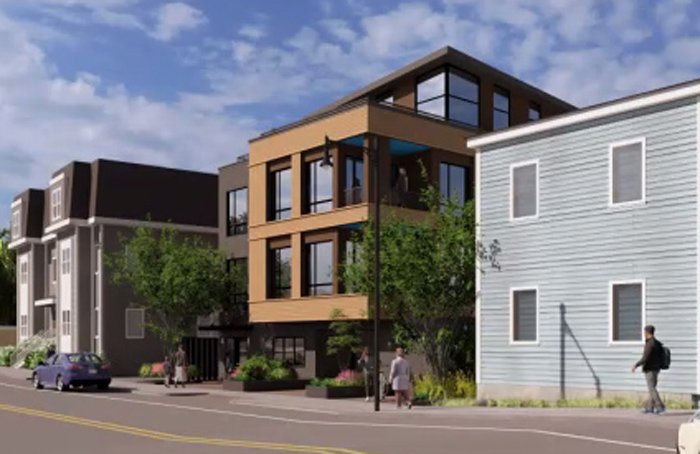
Above, This residential housing project at 1471 Blue Hill Ave. in Mattapan (shown in February 2026) has caused disruptions that should have been mitigated by better planning and communication with impacted neighbors, according to Chad Fletcher. Reporter file photo by Seth Daniel
For several weeks this past winter, my family developed a new morning routine. Between roughly 10 and 11 on weekday mornings, we knew the blasting at the construction site at 1471 Blue Hill Avenue was coming. Once we became familiar with the schedule, we would get up beforehand and brace ourselves.
We weren’t alone. Other nearby residents were especially vocal about what the blasting meant for people living closest to the construction site. Multiple media outlets documented some of their experiences and the concerns of longtime homeowners in the surrounding neighborhood.
The project’s own construction updates say that blasting was completed on Feb. 20 and acknowledge that it was a difficult portion of the project for nearby residents. The project team has also said recorded blast noise levels remained within allowable limits.
I mention both sides because my point isn’t to relitigate every disagreement surrounding this specific project. But there is a considerable difference between looking at a construction schedule on paper and living beside one.
That experience has stayed with me while attending meetings this month about something much larger coming to our neighborhood: the reconstruction of Blue Hill Avenue.
The City of Boston and MBTA’s updated proposal calls for a major reconstruction between Mattapan Square and Grove Hall, including center-running bus lanes, reconstructed sidewalks, accessibility improvements, new lighting, nearly 200 new street trees, and other improvements. More than $124 million in local, state and federal funding has been secured, and construction is anticipated to begin in 2028.
I attended the Sept. 10 town hall at Morning Star Baptist Church and the Sept. 14 open house at the BCYF Perkins Community Center. Those meetings helped me better understand both what planners are trying to accomplish and the concerns that residents continue to raise.
I see potential benefits. But my experience around 1471 makes me pay particular attention to something that receives less attention than the finished renderings:
What happens to residents and businesses while all of this is being built? Construction is part of the project, too.
We have already seen what overlapping construction can mean. Last fall, the Dorchester Reporter documented concerns as the 1471 development, Cummins Highway reconstruction, and other work affected residents in this part of Mattapan. One nearby resident described the neighborhood as feeling “boxed in.”
And 1471 is one development. The Blue Hill Avenue reconstruction will involve an entire corridor connecting Mattapan, Dorchester, and Roxbury.
At the recent meetings, I asked how roadway reconstruction would be coordinated with private development and utility work. I was told 1471 should be completed before Blue Hill Avenue construction begins. That’s helpful, but the broader question remains: Who looks across all these projects and considers their cumulative effect on a neighborhood?
Residents don’t experience a utility project, a housing development, and a roadway reconstruction as three separate organizational charts. We experience all of them as construction happening in our neighborhood.
Seth Daniel’s recent story in The Reporter also pointed me toward the years-long construction in Codman Square. We should listen to residents and business owners who have lived through it. What has prolonged construction meant for customer access, parking, and deliveries? What worked, what didn’t, and what should planners learn before work begins elsewhere along Blue Hill Avenue?
Those aren’t questions and complaints to collect after the fact. They’re lessons we can incorporate beforehand.
The City says it is already speaking with businesses and faith institutions and developing mitigation tools for the construction period. That’s important. Now residents and businesses need specifics.
What assistance will be available if access, parking, or loading is disrupted? Will financial assistance be available to businesses that can demonstrate significant construction-related losses? How far in advance will businesses know when work reaches their block? Who responds when construction creates a problem?
The answers shouldn’t arrive after the excavators do.
Accountability also matters after construction. Before work begins, residents should know how success will eventually be measured. Did bus travel times and reliability improve? Did crashes decline? What happened to congestion, parking, and surrounding residential streets? How did small businesses fare? If actual conditions differ significantly from projections, what can realistically be changed?
After attending the first two September meetings, I still have mixed feelings about aspects of the proposal. I’ve heard residents who strongly oppose it, while City and MBTA representatives have described the improvements they believe it can deliver.
I don’t think this conversation should be reduced to whether someone is simply “for” or “against” the project.
Blue Hill Avenue needs investment. Residents have identified longstanding concerns involving deteriorated sidewalks, congestion, double parking, and other conditions along the corridor. The harder question is: How do we make a major investment without asking the people who already live and do business here to bear an unreasonable share of the disruption required to build it.
We have time before 2028. We can learn from the neighborhood around 1471. We can learn from Cummins Highway. We can learn from Codman Square.
We can establish mitigation plans before businesses need them. We can coordinate projects before residents become surrounded by them. And we can decide how success will be measured before we’re standing at a ribbon cutting celebrating what was built.
The City has described the Blue Hill Avenue project as a “generational investment.” If that’s what it is going to be, the longtime residents, transit riders, homeowners, renters, and small businesses who will live through its transformation shouldn’t be treated simply as people waiting for the investment to arrive.
They are part of the investment, too.
Chad Fletcher is a Mattapan native and board member of the Greater Mattapan Neighborhood Council. The views expressed in this commentary are his alone.
Copyright © 2026 Boston Neighborhood News, Inc. This content may not be re-published or re-used without written permission.
