
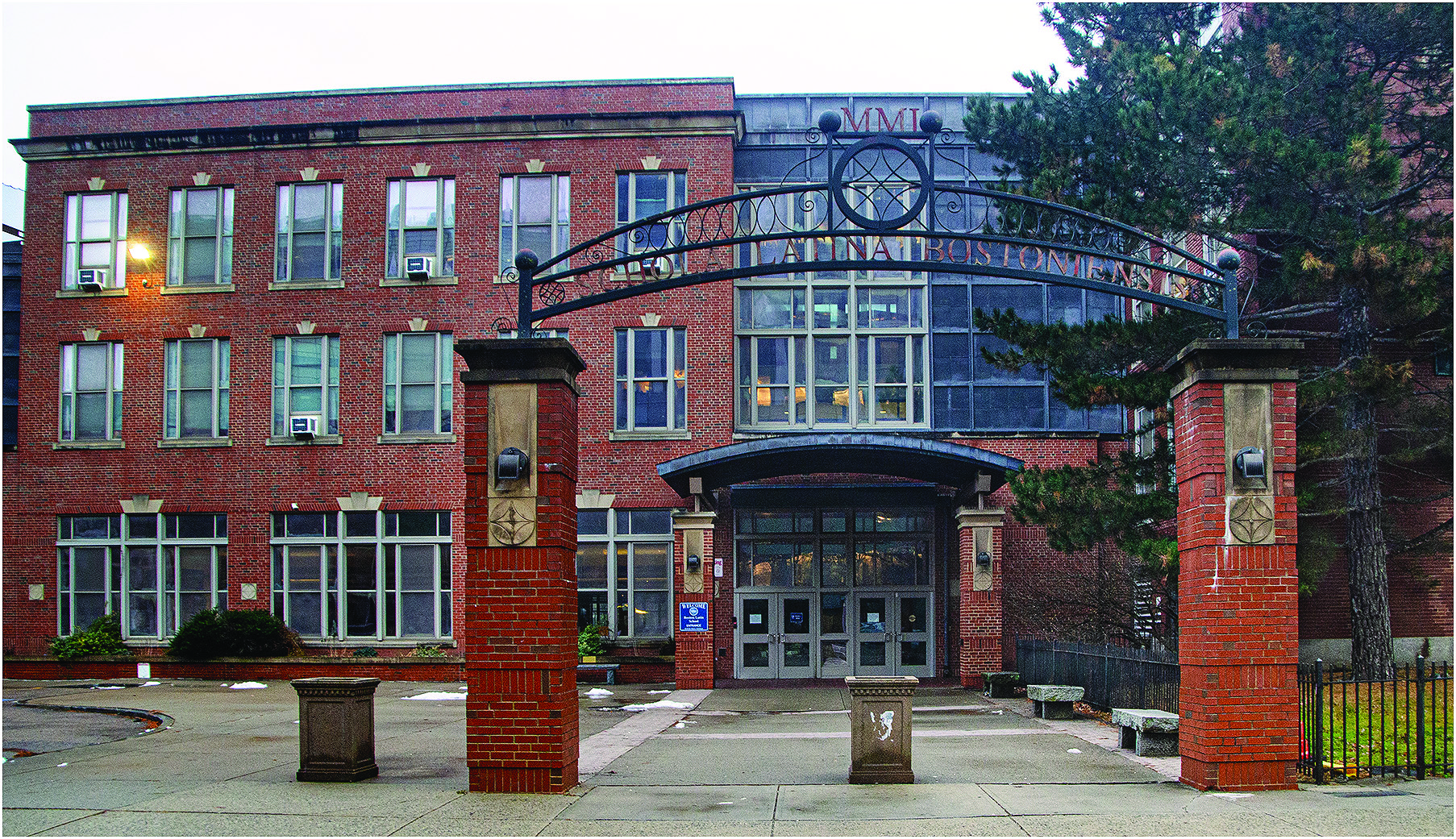

Boston Latin School, the country’s oldest, founded in 1635. Chris Lovett photo
Funding is tight in Boston’s public schools (BPS), with budget cuts forcing layoffs for more than 500 teachers as rising costs, flat revenues, and the loss of federal funding has put a hole in the city’s budget.
Still, there is bright spot in the financial outlook: Schools have reported more than $100 million in funds raised through private donations over the last decade. But that largess is limited to just 5 of the district’s 119 schools, with Boston Latin School claiming three quarters of that amount.
The Boston Latin School Foundation grew its net worth from $59.3 million in 2018 to the $76.3 million reported in the 2023/2024 school year, according to the BPS parent group Quality Education for Every Student (QUEST).
Coming in a distant second is the Boston Arts Academy Foundation, which grew its net worth from $5 million to $7 million in the same time period. Coming in third was Friends of the Eliot School, which saw its net worth grow from $690,000 to $1.08 million.
Boston Latin Academy comes in fourth, with $2.177 million, followed by Boston Latin Academy, with $2.168 million.
Those schools, which have foundations that file 990 reports, were easy for QUEST members to track. But the vast majority of schools — 87 — had raised less than $100,000 during that period according to an Ernst and Young audit of school fundraising undertaken in 2018 and 78 had less than $40,000.
The Ernst and Young report only covered the 97 schools that worked with the Boston Education Development Fund. An additional 29 schools were not part of that report.
Some schools have storied histories, such as The Latin School, which boasts prominent and wealthy alumni who over the years have donated generously. Boston English High School, which has an active alumni association, had $1,034,629 in its account in 2018, according to the Ernst and Young audit.
But for most schools, the income level and social connections of high-earning parents seems to be the determining factor. Hence the Eliot School in the North End with a 19.4 percent low- income student body, which had $669,667 in 2018 and the Higginson Lewis in Roxbury with a 90.7 percent low-income student body, which had $17,000 and just $7,024 in 2024. QUEST members are calling on BPS to track all school fundraising.
“Our feeling is that these are public schools that are publicly funded,” said QUEST member Travis Marshall. “When money comes into a school, it shouldn’t go un-noted. But these funds are going directly to schools and there’s no public acknowledgement of that.”
While QUEST has typically focused on equity issues in BPS, the group is not seeking a specific policy remedy for the inequity in private fundraising, but rather calling for a public conversation about the issue.
“Many cities have approached this with a number of solutions,” Marshall said. “We’re not promoting any particular one.”
Some major US cities, such as Portland, Oregon, have adopted revenue sharing systems to help schools in less affluent areas with costs. The Charlotte Mecklenburg School District in North Carolina raises funds through a central foundation that distributes funds to schools based on their needs. In Massachusetts, Newton takes the same approach.
“We’re approaching this as a transparency and accountability approach in a district that has had difficulty with transparency in the past,” Marshall said. “We want it to be public. People will draw from it what they will.”
Copyright © 2026 Boston Neighborhood News, Inc. This content may not be re-published or re-used without written permission.
