
A Boston Police deployment that saturates city villages with targeted, daily foot patrols is getting strong reviews from community activists after its first full year of implementation. First employed in the spring of 2007 – and then launched more broadly in several Dorchester and Mattapan villages last summer – Operation Safe Streets has become the signature strategy of Commissioner Edward Davis’s two-year-old administration and is likely to expand into new sections of the city in coming months – including Uphams Corner.
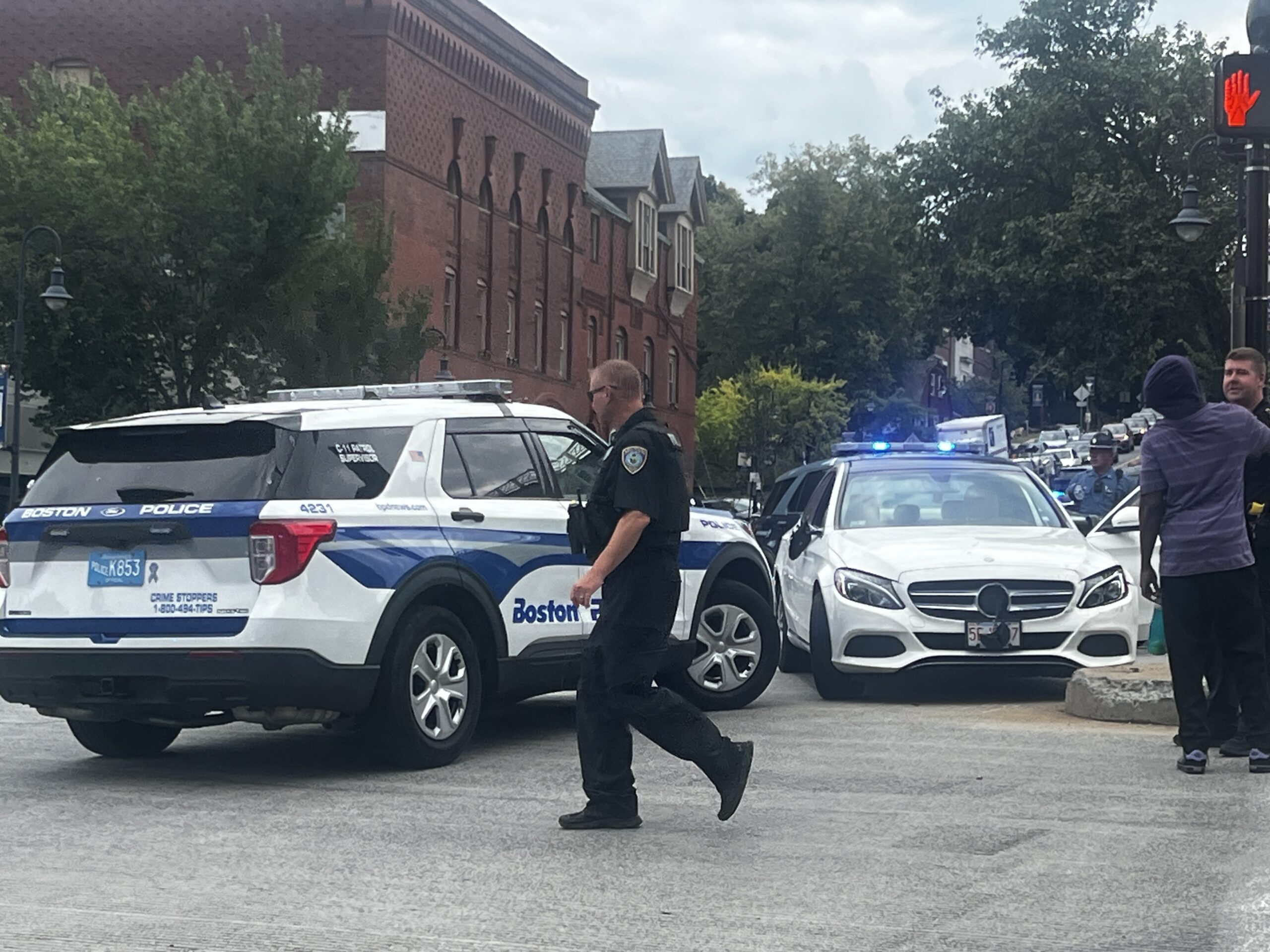
The deployment plan consists of a regular team of five police officers and one sergeant who embed themselves into a targeted business district and adjacent residential areas between the hours of 4 and 11 p.m. The Safe Street teams – equipped with marked cruisers or bicycles, depending on the weather – are not expected to field radio calls, but rather to dismount and engage local merchants and residents on a wide range of quality-of-life problems.
Locally, the patrols are deployed every day in Bowdoin-Geneva, Grove Hall, Codman Square, and the Morton-Talbot corridor that straddles Dorchester and Mattapan.
Davis, who borrowed elements of the initiative from one that he engineered as police chief in Lowell, says that the Boston version is bearing fruit.
“This is a strategy that’s been proven effective over the last year and we believe it will be effective for the long-haul,” Davis told the Reporter this week. “We believe the Safe Streets teams are driving a 17 percent reduction in property crime and a 9 percent reduction in violent crime citywide.”
Davis said that the reduction stats were based on a comparison between 2007 and 2008.
Specific data on the effectiveness of the Safe Streets teams were not available to the Reporter this week, but activists, merchants and neighbors who have been monitoring public safety over many years agree that, anecdotally at least, the deployment has had a direct and positive impact.
Davida Andelman, a Bowdoin-Geneva activist and a sometimes tough critic of past police tactics, has been impressed.
“It has been effective,” said Andelman. “Can it be even more effective? Sure it can. The group that’s out here now are engaging and interacting with people in the neighborhoods a thousand percent more than they have in the past. It’s great.”
That sort of endorsement is typical in Bowdoin-Geneva and Codman Square, two Dorchester villages where the threat of gun violence and street-level drug trade once loomed. Along Washington Street, Codman’s always bustling main drag, the presence of multiple police cruisers and officers each evening has sent a message that cops are in control of the sidewalks.

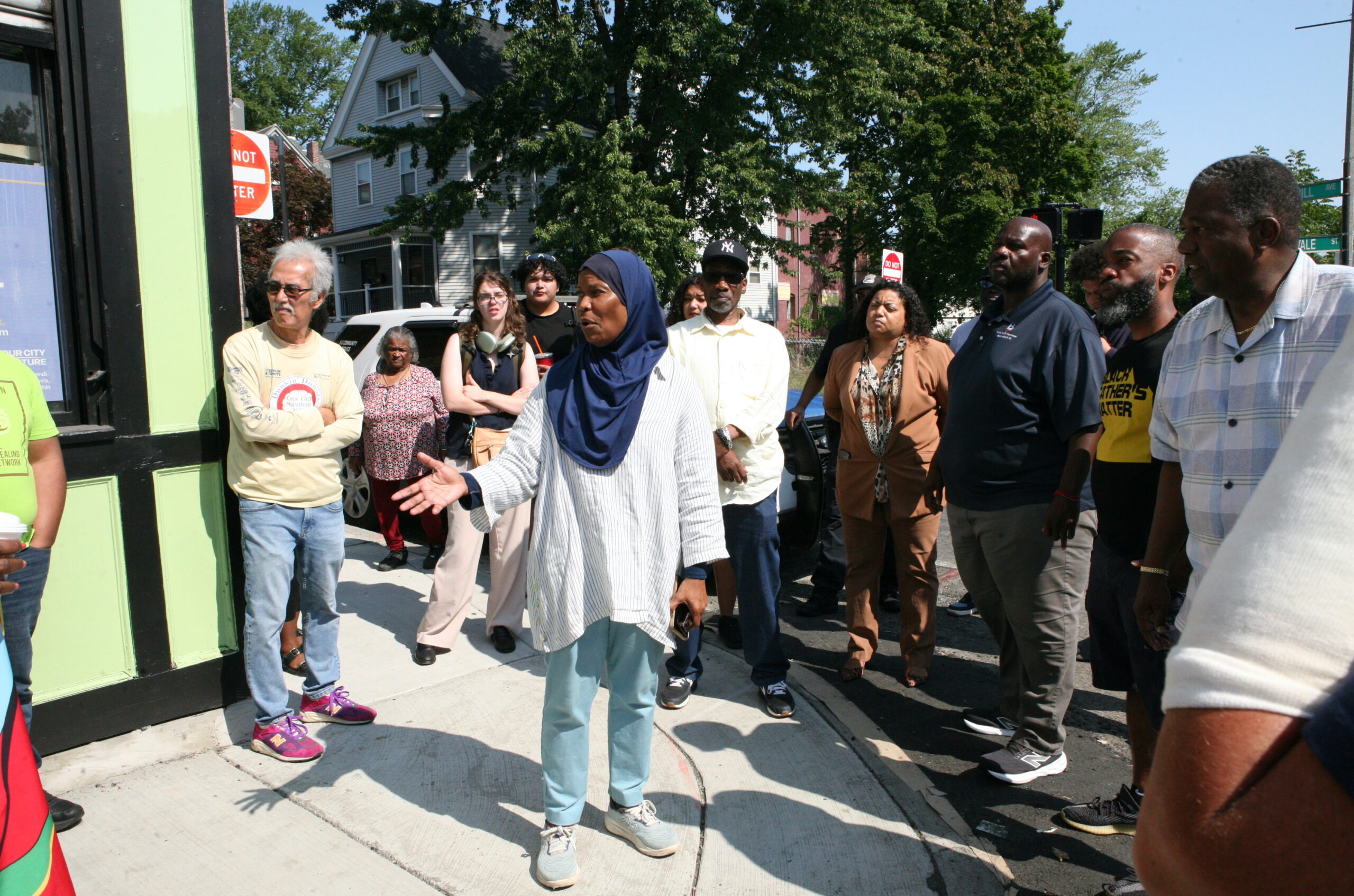
Cynthia Loesch spoke at the roll-out of the Safe Streets teams in Codman Square in August 2007, as Commissioner Ed Davis and Mayor Tom Menino looked on. Photo by Bill Forry
“I wouldn’t say it’s perfect, but overall it’s had a positive impact,” said Cynthia Loesch, president of the Codman Square Neighborhood Council. Loesch, who spoke when Davis and Mayor Tom Menino announced the Safe Streets expansion on Codman Common last August, said that civic leaders – especially teens – have played a key role in the evolution of the teams.
“A lot of work we’ve done is in re-training officers,” Loesch said. “Whatever training they’re getting at the academy is not about community policing. They need to know more about prevention.”
Loesch, 23, said that a group of Safe Streets officers meet weekly with the B.O.L.D. Teens program at Codman Square Health Center. The officers – who often attend meetings in civilian clothes and sometimes in their free time – plan recreational events, like a recent bowling outing to Hyde Park. Mostly, Loesch said, they have been able to break down barriers to trust on both sides.
“The young people are getting to know that the officers have kids and families and are normal,” she said. “The officers benefit from it too. They view the neighborhood differently and I like that idea. That is true violence prevention and community policing.”
Sergeant Lucas Taxter, who supervises District C-11’s Codman Square team, says that partnership with the teen group has been valuable.
“They act as recruiters for us,” Sgt. Taxter said Tuesday as he stood on a Washington Street corner. “They bring in their friends and some of these kids may never have had contact with police officers at all. That’s one of the goals here: To get people more comfortable to associate with police officers.”
As Taxter talks, there is ready evidence that the four cops set up in front of the Citizens Bank branch have taken that mission to heart. They wave at honking motorists, engage in chit-chat with customers heading in to use the ATM and help guide a confused motorist out of a bus stop and into a legal parking spot. Their posture is laid back. But for the uniforms and sidearms, they might be just another group of neighbors hanging out.
“We’ve had people tell us that they haven’t seen the square this quiet in 30 years,” says Taxter. Then he corrects himself. Quiet isn’t really the right word, he acknowledges, because this place is really buzzing with people–families, customers, kids on bikes. “More secure,” he says. “That’s what it is.”
Richard Heath, an organizer at the Codman Square Neighborhood Development Corporation, agrees. Heath walks the business district with Safe Street officers to point out trouble spots at NDC properties. The organization controls two storefronts along Washington Street and owns five residential developments near the business district.
“From my point of view, they’ve been extremely helpful in weeding out unpleasant people and activities at our properties. It wouldn’t have happened with out them,” Heath said. “It’s like a lot of things in life, they’re only as good as you make them. I’ve gone out of my way to get to know them and to set up walk-arounds in the square on a monthly basis, for a half-hour or 45 minutes. That has made a difference for both of us.”
Codman Square, which straddles the police district boundary between districts C-11 and B-3 actually boasts two distinct teams, one from each district. The result is a heavy presence that, on one recent Friday evening, resembled a police encampment near the intersection of Washington Street and Aspinwall Road. Sgt. Taxter says that the corner serves as a de facto base for the teams, who then fan out on foot or bicycle into local side streets. The C-11 officers make it a point to visit Wainwright Park, a source of complaints about loitering and gunplay in years past. The team usually ends its night back in the business district to make sure that the 11 p.m. closing of a Washington Street tavern goes smoothly.
Rev. Bruce Wall, who walks the Codman Square area each Friday evening, says that the police presence has helped to effectively curbed illicit activity along the main street.
Wall, who has periodically called for a citywide state of emergency in response to gun violence, believes that his advocacy helped to make Codman a bigger priority for the department.
“As long as someone’s making noise, they’ll be out here,” Wall said. “The problem is, there’s no comprehensive plan to sustain this.”
Davis responds that sustaining the Safe Streets deployments where they presently exist is not a question. Most teams are manned by new officers specifically dedicated to them and they don’t take other overtime assignments. Each officer volunteers for the posting. The mayor, Davis added, is committed to keeping the deployment permanent and even expanding it when necessary.
“Nothing was taken away from rapid response or specialty units,” he said.
Captain John Greland, District C-11’s commander, says that the permanent nature of the teams allow him to focus more resources elsewhere.
“The big difference when I had just one or two officers up [in Codman] was that it became a chore with manpower issues. [The Safe Street Teams] are separate. If a Safe Street Team member is off I don’t replace it with an overtime guy. They don’t go into my minimum manning that I have to maintain.”
There are limits, of course, to how much ground the teams can cover. And there is clearly demand for more of them. A group of activists in Uphams Corner has been quietly lobbying Davis to set up a team in their neighborhood.
This week, Davis confirmed that he intends to order a new team to take up patrol there by December, when 30 new cadets are expected to be sworn in as officers.
“[Uphams] is also an area where patrol and service units will be going through regularly,” Davis said. “There will be more than six officers assigned there because of routine patrols.
“We’ve been predicating these assignments on the level of crime in neighborhoods and we’ll look at the next one up statistically and look at whether we have the resources,” said Davis, who notes that in addition to Dorchester and Mattapan, the BPD maintains teams in Downtown Crossing, Boston Common and East Boston.
Bowdoin-Geneva’s Andelman says that the improvement in her neighborhood has been “not so much quantity as it is quality of interaction.” There’s still room for improvement in that area, she said. “If they could spend a little more time with people that’d be great,” Andelman said. Still, she said she has gotten to know all of the street team officers on a first-name basis.
Bill Walczak, who founded the Codman Square Health Center 30 years ago and remains the center’s executive director, said that the Safe Streets Teams in Codman have been a major morale boost for the square.
“The business district had problems in a couple of blocks, but really the square was never really that dangerous. But people really were afraid because of problems near there,” says Walczak. “What the presence of the police officers has done is given a lot more confidence that Codman Square’s okay. You don’t have to worry about coming here. There’s a general sense that things aren’t as bad as they were.”
Most impressive, Walczak said, is the consistency of the deployment. Past operations often began with a big show of force and bodies, but gradually fizzled out.
“You have to say that Davis has been able to pull off what no other police commissioner could do before,” says Walczak.
Related coverage:
C-11 cops gain new footing with “Safe Street” teams – Sept. 20, 2007
