
Achieving affordability and speed for new housing in Boston may not be as complicated as the wholesale reform of process that many are seeking, as some construction professionals believe that a simple re-thinking of the city’s long checklist of fees and deposits required of developers on projects large and small could result in major positive boost to housing production.
Builders and developers who have long decried regulations and fees as prime contributors to the seemingly endless rise in construction costs were eager to talk to The Reporter in recent months about a mundane example that they say lays out the larger issue: The collection and return of the sidewalk bond deposits required of every permitted project in the city to ensure that, at completion, walkways are in sync with both municipal law and the mandates of the Americans with Disabilities Act (ADA).
The process was designed to be a simple: Developers pay the deposits and finish their work; a city inspector checks on sidewalk compliance, and the developers get their deposit money returned.
But, citing the lack of timely inspection and what some see as nit-picking by inspectors, some builders forego an inspection and just add the bond deposit funds to their costs of doing business, raising prices along the line. And they say it’s just one of a number of exasperating examples.
While the city could use the bond deposit to go back and fix the sidewalk, in most cases they don’t, business professionals say. If a project is cited for sidewalks issues, and builders don’t call for an inspection, the city often just keeps the bond money.
Construction insiders who work with the city say the rules for the inspections and the returning of deposit funds are anything but concrete, and the consequence is millions in deposits left in escrow for years.
Four cases in point include sidewalk construction in front of the popular Comfort Kitchen Restaurant in Uphams Corner ($7,080), new residential buildings along Dorchester Avenue in the St. Mark’s area ($6,750), a large section of the Dot Block development on Pleasant Street ($45,802), and the highly touted public-private LGBTQ-friendly residential building – The Pryde – in a former Hyde Park public school ($102,250).
Several developers, contractors, and industry professionals were willing to discuss sidewalk bonds, which are collected using a formula that includes square footage, curb cuts, and numbers of required ramps, but anonymously, citing a fear of retribution from Public Works Department (PWD) or other city departments.
“It’s just a fee; I tell everyone that,” said one Dorchester builder. “I tell everyone don’t expect to get it back. These developers would rather just pay a fee than be told it’s a deposit that they will get back – but really not get back. It’s just not necessary. Nine times out of ten, developers are going to fix the sidewalk if they mess it up. They’re not going to leave the front door a mess when they’re trying to sell something.”
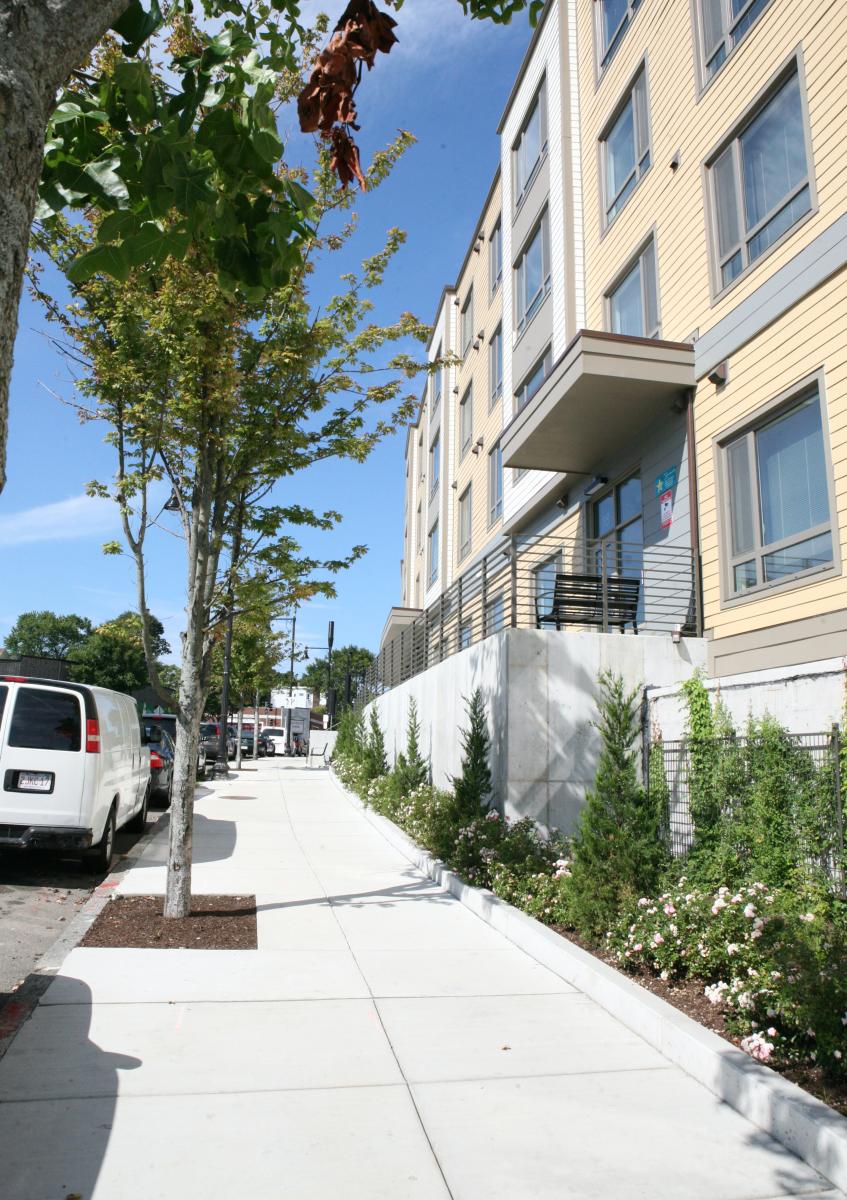
Above, new sidewalks in Four Corners at 10-20 Bowdoin St. outside the new Codman Square Neighborhood Development Corp. building have had a $30,957 sidewalk bond since 2023 when they started construction and now are awaiting an inspection. Seth Daniel photo
Added a Jamaica Plain-based sidewalk contracting veteran of 20 years, “That’s people’s payroll money and insurance money. I have thousands tied up with them, including about $10,000 [on a Dorchester job] that failed city inspections, but one that everyone walks on every day with no issues. If I got it all back, it would be significant money for me.”
The escrow situation spans decades and many mayoral administrations. According to city records obtained by The Reporter after a four-month wait, $24.558 million from 2,708 bond depositors sat in city limbo from 2012 on, with $11.8 million of that number outstanding from between 2022 and late June 2025 from 1,520 depositors citywide, all kept in a non-interest-bearing account.
According to the records, members of this group either failed an inspection, or were waiting on work completion/inspections, or never requested their money back. There were 300 deposits from Dorchester accounts, and 39 from Mattapan builders, ranging from $300 to more than $100,000, but most between $6,000 and $22,000.
One industrial campus on Alger Street in Andrew Square had $478,301 tied up going back to 2023.
That developer did not return an email request for comment.
When contacted, city Streets officials were quick to defend the sidewalk bond program, saying that most of the contractors and industry professionals The Reporter interviewed didn’t portray the situation accurately.
“We hold anyone performing sidewalk work in the City of Boston – including our own contractors – to the highest standards when repairing or rebuilding sidewalks,” said a spokesperson from the City’s Office of Streets. “This helps create safe, accessible, and durable walkways for everyone, regardless of how they travel. Inspections are conducted to verify that the work has been properly completed. It is common for construction to damage sidewalks which is why we require full restoration at the completion of a project.”
The spokesperson noted that between 2012 and 2024, 75 percent of sidewalk bonds met the required standard and were refunded, but 25 percent “were not returned due to failure to comply with policy standards.”
He said the city began an audit of the program last December to clean up lingering deposits and clear out the books – putting any forfeited deposits toward sidewalk work citywide.
“This effort was undertaken to identify and return old, abandoned deposits where possible, and to hold depositors accountable for completing sidewalk repairs associated with their work,” he said.
Said the JP-based contractor of the deposits: “Most of my larger customers don’t expect it; they just tack it on to the sales price. They simply add $5,000 on the back end of each unit. That’s what happened at a job I had in South Boston…And there are other such costs like this that they also add on.”
Comfort Kitchen and a Historic Farm
On a sunny day in June 2023, in front of Comfort Kitchen Restaurant at 611 Columbia Rd., Mayor Wu, city officials, Uphams Corner notables, the restaurant owners, and officials from the property’s non-profit developer, Historic Boston, Inc. (HBI), gathered on the sidewalk to cut the ribbon on the highly anticipated eatery that has now gained national recognition.
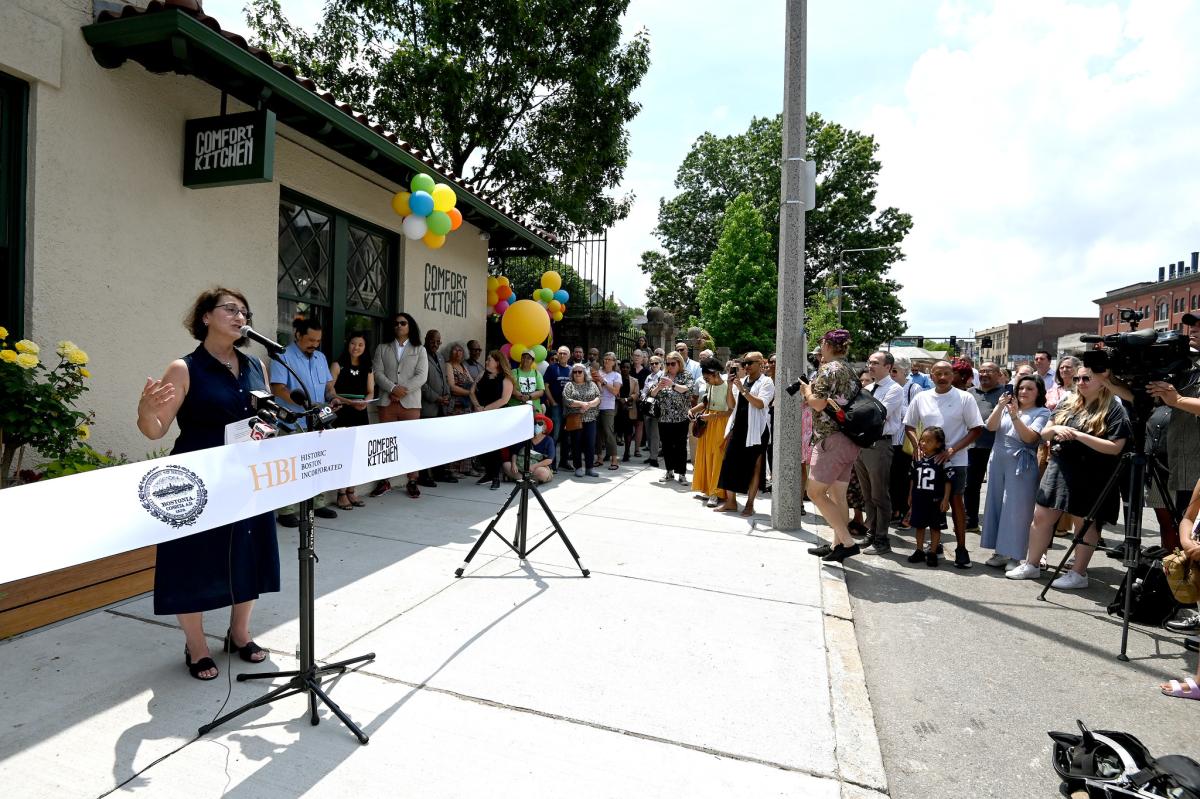
Months before the ceremony, the project had failed a city inspection and was deemed a hazard. The sidewalk contractor and HBI were told that they had failed the slope test – a controversial rule requiring that no sidewalk have more than 2 degrees of slope. They would not be getting their $7,080 sidewalk deposit back unless they ripped up and rebuilt the sidewalk.
Contractors and industry observers note that, as with the Comfort Kitchen example, it is often impossible to meet city standards in an old city where things cannot always be pieced together seamlessly – particularly on something like the 2-degree slope regulation.
One industry professional with past experience at City Hall said the inspections are a setup, and that the city is keeping too much money.
“You call for an inspection; they come out and find trivial issues,” he said. “The zinger is that the city’s sidewalk 20 feet away is deteriorating and broken down and the new one that failed is 1,000 times better…Most [rejected] don’t get their money back because the sidewalk is off a fraction of a degree. It’s absurd.”
Lisa Lewis of HBI noted to The Reporter that they are a small, non-profit, historic preservation developer and on a $2 million renovation like Comfort Kitchen, every dollar mattered to them. After the initial rejection, they asked the inspector to meet them on site. What seemed to her a perfectly fine-looking sidewalk was not, she learned, compliant with the Americans with Disabilities Act (ADA).
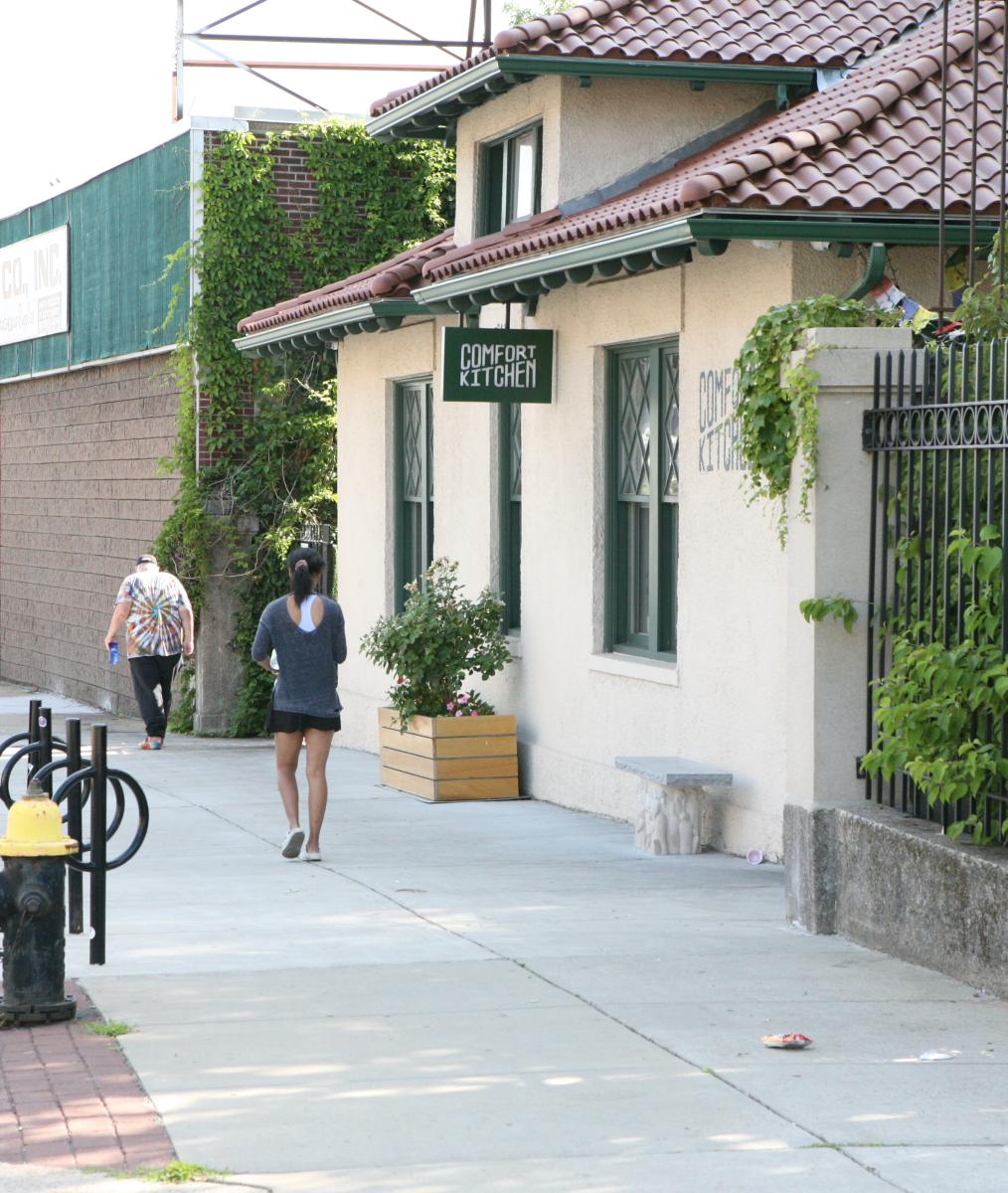
Because of a 4-degree slope coming from the historic building’s patio, adhering to the 2-degree slope regulation for the sidewalk was almost certainly impossible.
“The sidewalks throughout the city aren’t completely level and it feels like we’re being held to a different standard,” she said.
But it wasn’t the first rejection for HBI.
The non-profit and that same sidewalk contractor failed an inspection at Mattapan’s Fowler Clark Epstein Historic Farm on Norfolk Street in 2021 and 2022 – to the tune of about $20,000 in deposits. Lewis said it appeared they weren’t going to be refunded, until, by a stroke of luck, state Rep. Russell Holmes intervened.
Devin Edwards, a Holmes office staffer at the time, lived adjacent to the Farm’s new Hosmer Street sidewalks, and had developed a relationship with the work crew. When Holmes found out that the farm was in a bind, he got involved –pulling enough strings to get the non-profit’s money back.
For his part, Holmes told The Reporter that he wasn’t aware of larger sidewalk bond issues but took on the matter to help a constituent.
“That was,” he said, “all about the contractor having a good relationship with Devin, and me having a good relationship with the mayor and the Farm’s executive director, Patricia Spence. That is what made that materialize to where we could be persistent and educate and help the contractor. We were persistent, we had eyes on the situation and were well connected with the mayor…and that helped get their money back in that situation. The sidewalks were in very good shape.”
The City Audit
Sidewalk bonds moved to the forefront with developers last January when they and construction industry observers started getting letters from the Public Works Department (PWD) signed by Chief of Streets Jascha Franklin-Hodge, a letter that explained there was an ongoing audit of the sidewalk bonds program, and they had bonds in escrow. It advised them of a process and deadline for getting their money back. Another series of letters went out in July.
“Please bear with us as we work through our backlog, as it will take us at least several months to process deposits requests that date back many years,” read one of the letters sent to a 2022 Dorchester project last February and obtained by The Reporter.
“The Permit for which this deposit was put on file…was issued…and you, as the permit holder, may not have requested a return of your deposit after the permit expired. If you do not submit a request for inspection and return by March…the Department will exercise its right to keep your deposit and complete any necessary, outstanding work.”
Those in the construction community interviewed for this story said it was a shocking – and confusing – letter to get after so many years.
A City Streets spokesperson said that in December 2024, the PWD started a process to “return any long outstanding deposits to the appropriate individual or contractor. At the time, the City had thousands of abandoned sidewalk deposits dating back to 2012, where the individuals/entities that made sidewalk deposits failed to request an inspection per our policy.”
The spokesperson said that clearing the books has taken some time and has caused delays in inspections, but that they were working diligently toward a solution for that issue.
The city had not used any of the forfeited claims from the first round of letters yet, the spokesperson said, said, adding that once they get through their process, “we will deploy those funds to fix uncompliant sidewalks and ramps at those locations and citywide.”
It has been suggested by some that the audit was sparked by the need to do more sidewalk work in tandem with shrinking sidewalk-work budgets and by the possibility of accessing a pool of long-stagnant money from sidewalk deposits as the city is operating under an ADA curb ramp settlement that is ongoing. Slow work on that matter drew the ire of a federal judge who last year said the city needed to move faster.
The city spokesperson said that “the settlement regarding ADA-compliant curb ramps had no impact on our decision to audit sidewalk deposits,” he said.
Waiting Forever
A contractor doing work in Dorchester, who identified himself as “Ed,” said he has forfeited sidewalk bonds because it took too long for inspections, and because of frequent rejections.
“It takes so long for them to come around to inspect that by the time they get there, there’s a hairline crack in the sidewalk and they find it,” he said. “You have cold weather and salt and wear and tear for some time. Then they come around and look at it finally, and it looks bad. They’re just making it impossible to get your money.”
But a city spokesman disagreed with that assertion, saying that most contractors get their money back. He said the process is in place to protect the public.
“This is not a fair assessment,” he added. “Anyone performing work on City sidewalks is expected to restore them to an acceptable condition. We share the detailed reasons for all failed inspections with the depositor so that they have a chance to correct the problem.”
“Our goal,” he said, “is to ensure that all people, regardless of how they travel, can safely and easily navigate the area. Once the city confirms that all damaged areas have been repaired and that any new sidewalks or pedestrian ramps meet ADA/AAB guidelines and City standards, the sidewalk deposit is returned.”
The industry professional with City Hall experience said if the city wanted to streamline development and cut costs, they would do away with the bond.
“The point of the bond is that if a developer goes bankrupt and had torn up the sidewalk and left it a mess, there would be that money on deposit to come in and fix the sidewalk,” he said. “How many times does that happen? I don’t think very often.
“So, you have to wonder if this is a real problem requiring the bond…We’re collecting millions of dollars for problem that doesn’t exist.”
Greg Maynard of the Boston Policy Institute – a privately funded city government watchdog entity– agreed, saying this is one example of regulatory reform that should be prioritized ahead of larger reforms, like the Article 80 development review reforms focused on zoning and community process.
“Things like these sidewalk bonds are a bureaucratic problem and a leadership issue in City Hall,” he said. “As much as Boston’s zoning is tough, the city’s bureaucracy exacerbates the issue and muddies it up…Zoning and development have a lot of tough problems, but an awful lot of the problems are bureaucratic ones that City Hall could work on.”
The city spokesman said “streamlining” housing development and “reducing construction costs” is a priority. “However, ensuring safe and accessible sidewalks is a fundamental responsibility of the city.”
In the end, construction professionals said the sidewalk bond is only one of many hurdles in the process that make things expensive and slow down builders. For larger contractors, it’s a nuisance, but smaller developers said the litany of fees can break the bank.
“Why does it have to be this hard?” asked “Ed” the contractor. “It definitely stops you from moving forward. It’s these little things that keep you from moving to the next project. It’s a lot harder than it should be. It makes it harder on the little guy.”
