
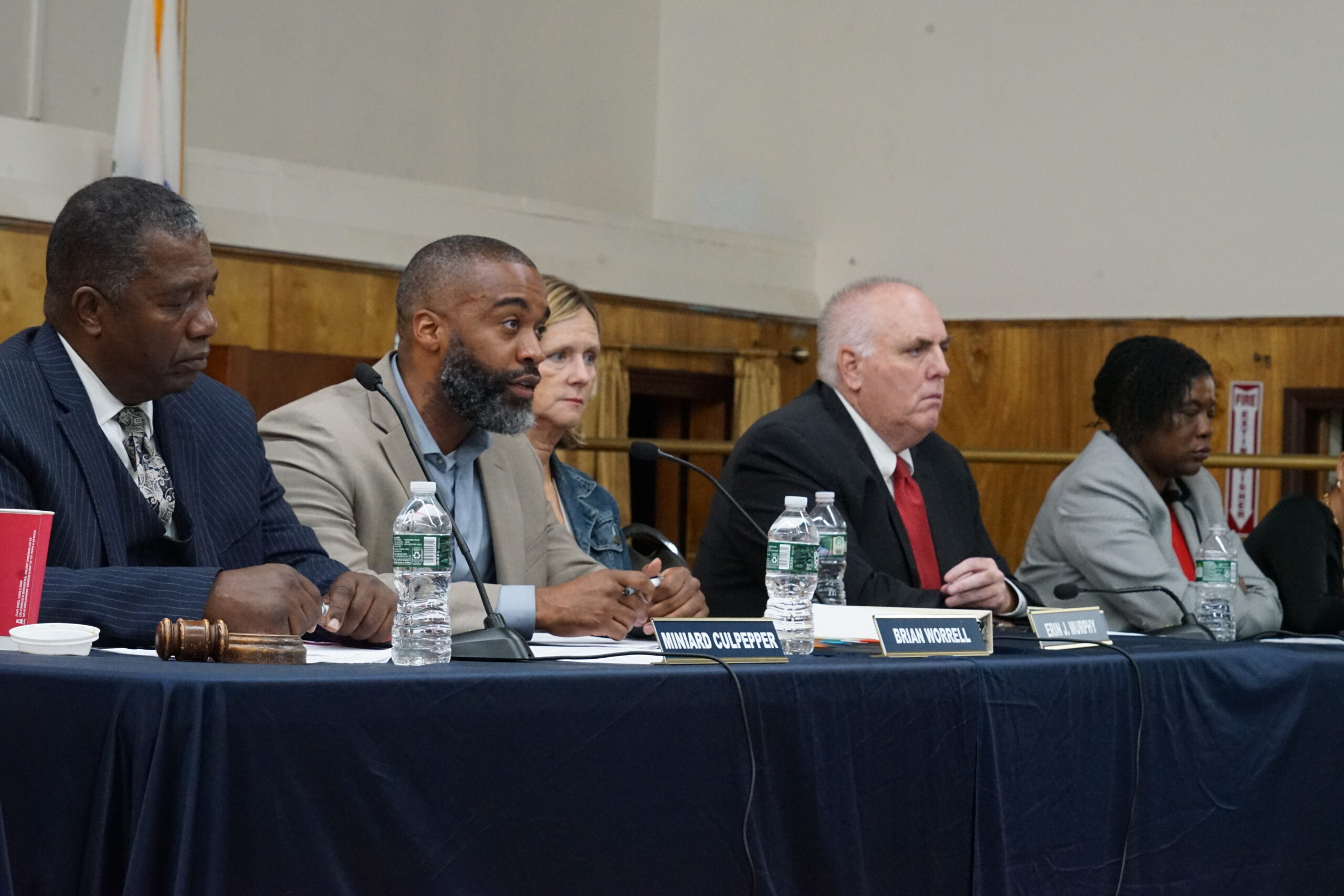
Rising property tax bills – and the potential for budget disruptions – topped the agenda at Monday’s Columbia-Savin Hill Civic Association (CSHCA) meeting where District 3 City Councillor John FitzGerald and state Sen. Nick Collins answered questions and offered updates to a group of about 50 people.
Homeowners in Columbia-Savin Hill were among the hardest hit neighborhoods citywide last year when tax bills under new property assessments came due. And with the value of commercial properties, particularly downtown, in decline, many of them are worried that the drop in tax revenues might negatively affect future cycles of city budgeting.
“Personally, I do feel we should be very wary due to the potential dollar losses, with the devaluation of some downtown buildings and when abatements come in,” FitzGerald told civic members. “I think there could be a significant loss and it’s my job to set our priorities.
“We might have to cut things. Some of them are very good services and we’ll have to decide what is our bread and butter and what do we have to deliver on. There will be potentially some difficult discussions.”
FitzGerald said that assurances he has received from the city’s Assessing Department have not relieved his concerns on the matter.
“When you take that hit on downtown buildings and residents having to bear the brunt, I don’t know that we’ll be able to have the same numbers in our budgets in the future,” he said.
“We’re going to have to look at what’s important to us and it will be 13 people [on the Council] and the mayor trying to create our priorities; that will be interesting.”

State Sen. Nick Collins wants to extend Morrissey Commission’s time.
Seth Daniel photo
For his part, Sen. Collins criticized the Wu administration’s attempts last year to shift more tax load to the commercial sector through a Home Rule petition to the Legislature – a move that he played a key role in blocking. He praised the Council’s efforts to cut the city budget, taking it from what he said was a 9 percent increase in spending to a 4.4 percent increase.
He also said that FitzGerald’s take on making deep cuts to future budgets is the likely path at the city level.
“They like to say the budget has nothing to do with revenue and that’s not the case; you tax for a purpose,” he said.
Collins noted that he has filed legislation that would prevent “spiking” tax bills, such as what happened earlier this year when bills went up significantly in January and May as opposed to earlier quarters. That “spiking” would be accomplished by allowing municipalities to use surplus funds to plug gaps temporarily.
Both men also discussed the situation at the Carney Hospital property, which closed on Aug. 31, 2024.
FitzGerald said there is “news on the way” this fall, with a potential developer in the wings having early conversations about what could happen there.
“You’re going to hear a lot more on Carney Hospital publicly in late October or early November,” he said. “We’re excited to see what can happen there and a health care use is a proposed use. I cannot say a hospital use, but an Emergency Room would be part of that…There will be residential on the site. It depends on the percentages…but senior housing is a key need here and in alignment with the healthcare portion.”
Collins addressed the plans for use of White Stadium by women’s professional soccer franchise to use private game-day shuttles looping from JFK MBTA station to the venue in Franklin Park, a considerable distance, saying that he rejects the use of private shuttles for fans and is calling for the team to invest in the Route 16 bus – which follows the same path.
“We’d rather see them invest in the MBTA bus route and we get some better service, and it leaves the place in better shape and there’s the equity of it, too,” he said.
Regarding Collins’s “no” vote earlier this summer on the Morrissey Commission report, resident Don Walsh noted that the association is enthusiastically working with the City Planning Department on comprehensive planning, creating what he called a “Northeast Dorchester Planning District.” The senator said he would participate in that process, but he was more supportive of extending the time on the state commission to avoid having city-inspired transportation plans on state property.
“My concern with the BPDA,” he said, “is if they sic some of the same transportation planners on us. So, I am for extending the Morrissey Commission.”
He and FitzGerald also addressed new “tweaks” being proposed for the admissions process to the city’s three exam schools. A current plan looks at increasing automatic admission to those who score in the top 20 percent on the exam, then reducing the number of “tiers” that were developed to increase diversity from eight to four.
The idea is to open up more admission possibilities for those in schools that aren’t in low-income areas. Students currently get extra points toward admission for attending a “high needs” school.
“I wish the percentage being let in from the test were higher,” FitzGerald said.
“Me, I’d like to see that number up to 50 percent, and the other half could be admitted through the tiers.”
Mass. and Cass concerns aired
Boston Police officers from Area C-11 who were on hand for the civic meeting discussed heightened quality of life and substance abuse concerns that have been raised by some in the neighborhood over an alleged “migration” of unhoused people. The focal point of police enforcement recently, they said, has been at Edward Everett Square where loitering, drug use, and panhandling have spiked.
“We have seen an uptick of people migrating from Mass. and Cass,” said Capt. Steve Sweeney. “We’re trying to have officers come and move them along. It is an issue…We move a group out and two hours later another group will be sleeping there.”
Sweeney said the city has installed new lighting in Everett Square and there have been drug arrests on site and nearby as well. He sai that police have served three search warrants at an address on East Cottage Street with “high end drug activity.”
Further into Savin Hill, neighbors on Sagamore Street and Grampian Way said the negative impacts have come their way, with reports of people coming onto their properties or sleeping on the sidewalks. “There’s more loitering and more people snooping around and going in backyards and on porches,” said Jaclyn Price.
