


Above, US Rep. Ayanna Pressley spoke during a roundtable inside the Dorchester Food Co-Op on Bowdoin Street in Dorchester on Nov. 3, 2025. Next to Pressley are City Councillor Brian Worrell, right, and City Council President Ruthzee Louijeune, left. Seth Daniel photo
Congresswoman Ayanna Pressley made a visit to Bowdoin Street on Monday afternoon to highlight businesses impacted by the SNAP food benefit funding pause caused by the federal government shutdown.
Payments to SNAP participants – typically low-income or disabled households – stopped on Nov. 1, with about 140,000 Bostonians affected, most of them in six zip codes in Dorchester, Mattapan, Hyde Park, and Roxbury. A less publicized effect has been the hardship on businesses that serve them.
“Your stories have not been amplified enough,” said Pressley in a roundtable inside the Dorchester Food Co-Op (DFC). “These stories have not been heard – the corner stores, bodegas, mobile food trucks, and the urban farms that are heavily reliant on SNAP participants for their business models – both for-profit and non-profit.”
The fluidity of the situation is such that the press conference was interrupted by news that the Trump administration had agreed to follow federal court orders issued last Friday and Saturday requiring some amount of payment. The were no specific details, but part of the SNAP payments for November would come from a Department of Agriculture contingency fund, according to published reports.
“Whatever it is, it should be more — having not even seen the number,” Pressley said upon learning of the development Monday afternoon.
The roundtable discussion focused on businesses and non-profits – including farmer’s markets that have largely shut down for the season – and the money they stand to lose from the interruption.
Sarah Assefa, a board member of the Dorchester Food Co-op, said SNAP sales account for 10 or 11 percent of their business, and would put a dent in sales. Pat Spence, of the Urban Farming Institute in Mattapan, said they have increased a coupon program at the Clark-Fowler-Epstein farm stand on Norfolk Street because the situation “was too personal.”
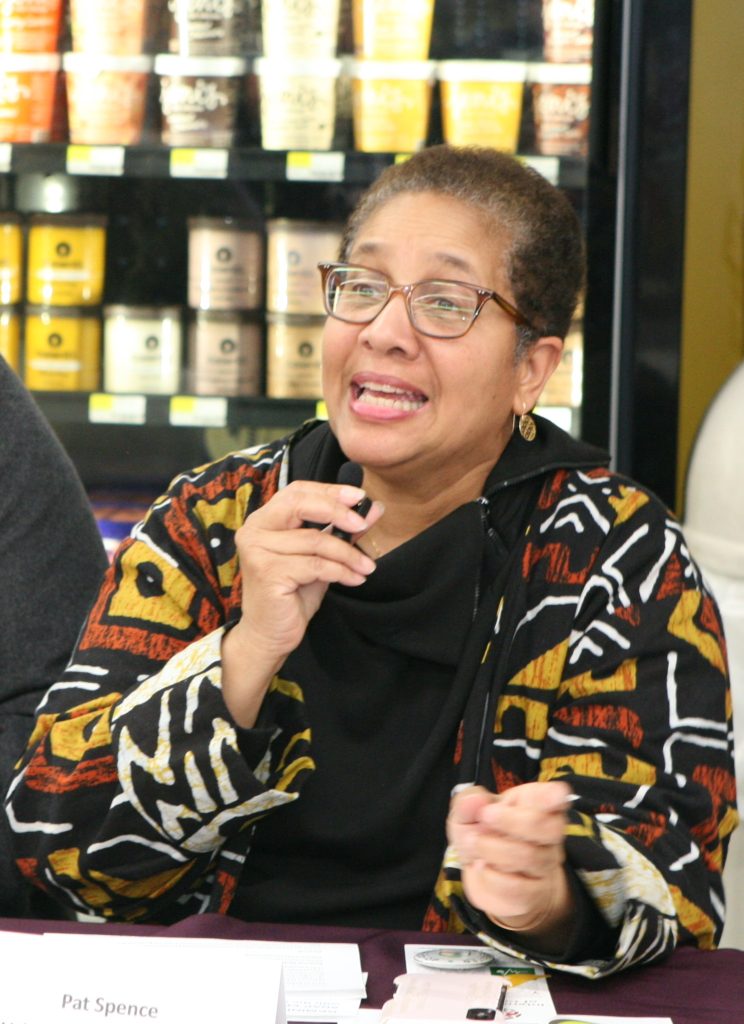
Pat Spence of the Urban Farming Institute and Mattapan’s Clark Fowler Epstein Farm. Seth Daniel photo
“We don’t want to just make sure our community has food, but that they have the best possible food,” she said. “We have a coupon program already and we’re going to increase that number for everybody – everybody that comes in.”
Ronald Garry, operator of Tropical Foods in Roxbury, said SNAP sales are about 30 percent of his business.
“We want to know what will happen if this goes two or three weeks,” Garry said. “I feel like they’re spoiling for a fight…We want to know what it is in two or three weeks and what’s the contingency plan for that.”
City Food Justice coordinator Aliza Wasserman and Erin Quinn, of the state Department of Transitional Assistance (DTA), addressed the shortfalls saying there is no way to fill the gaps completely.
But Wasserman noted the city has partnered with The Boston Foundation to help fill some gaps, and donations are being accepted for the fund but cautioned “no private sources, city or state, can replace the federal government’s responsibilities.”
Quinn said even if the SNAP benefits are restored, the region should stay vigilant because there are many changes coming in the recently passed ‘Big, Beautiful Bill’ that change eligibility requirements for citizens and non-citizens and implement work requirements.
“This crisis will continue well beyond what we’re talking about today,” she said.
