
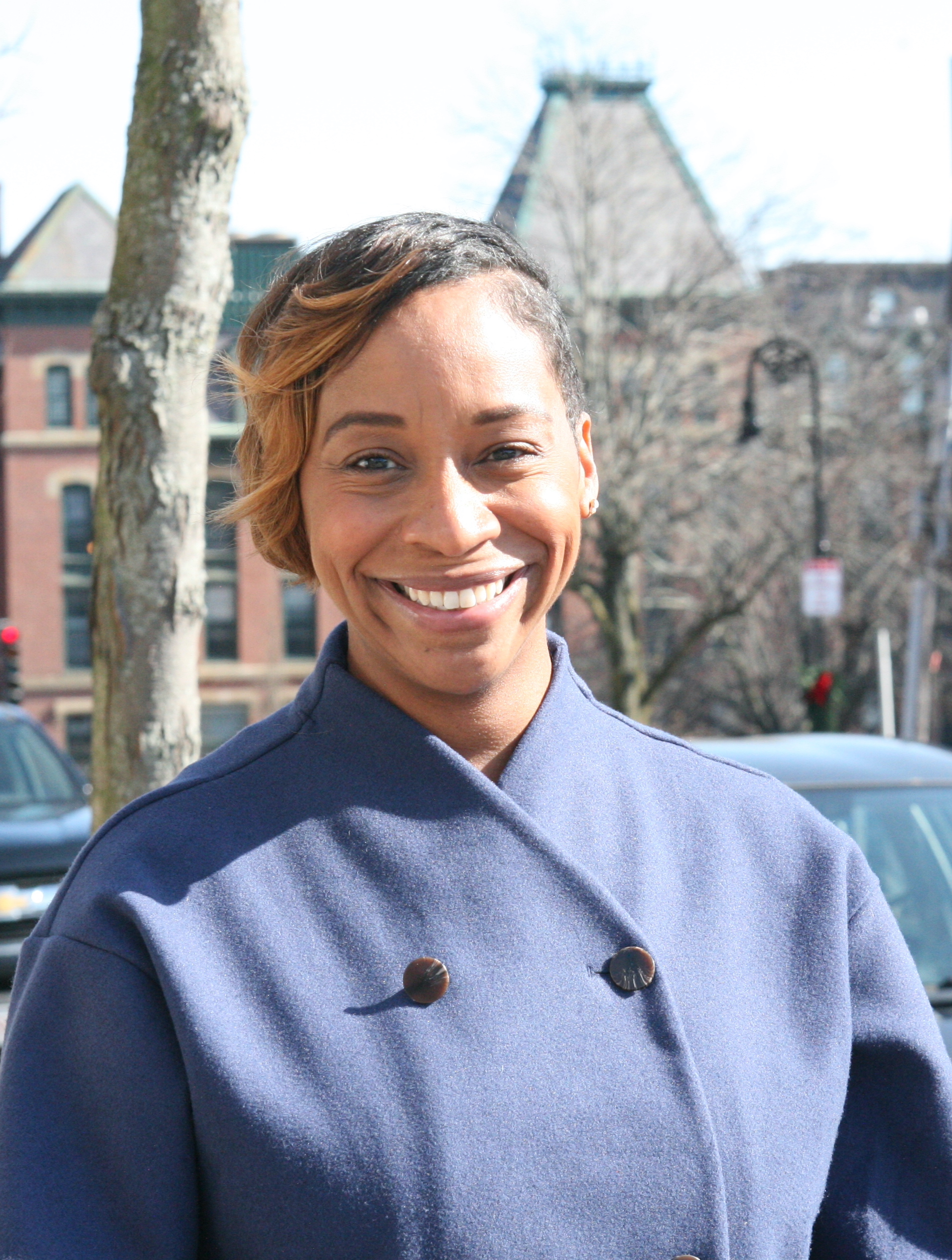

Above: Secretary of Labor and Workforce Development Lauren Jones testifies at the State House, flanked by Assistant Secretary for Communities and Programs Juan Vega and Health and Human Services Secretary Kiame Mahaniah. Yawu Miller photo
Despite some modest gains, Blacks and Latinos in Massachusetts are trailing whites in homeownership, business ownership, and wealth accumulation, state officials said during a State House hearing held last week.
Black, Latino and Native American households in the state earn just two-thirds of what white households earn, presenting challenges to their ability to build wealth, even as the poverty rate in the commonwealth has decreased by more than 20 percent, noted Juan Vega, assistant secretary for Communities and Programs.
Whites account for 87 percent of business owners, while making up 67 percent of the state’s population. Their businesses average $3.8 million in revenue.
Blacks, who make up 6.9 percent of the population, account for 2.9 percent and average $150,000 in revenue. Latinos are 14 percent of the population and make up 4.7 percent of business owners and average $100,000 in revenue.
“These figures are not abstract,” Vega said. “They translate directly into differences in who can self-finance a startup, who can secure a loan on reasonable terms, who can withstand a temporary balance turn, who can scale from sole proprietorship into an employer. The racial wealth gap is also a racial entrepreneurship gap.”
Members of the Massachusetts Black and Latino Legislative Caucus who convened the hearing asked panelists to describe how Trump administration policies are affecting the racial wealth gap. Business experts and state officials cited the administration’s vilification of diversity, equity, and inclusion (DEI) programs and the targeting of immigrants as factors affecting businesses owned by people of color.
“Today, Black-owned businesses are operating in a significantly more hostile and more uncertain economic environment — one shaped not only by market forces, but also by federal policy decisions that are slowing growth and increasing risk,” said Nicole Obi, president and CEO of the Black Economic Council of Massachusetts.
Obi cited tariffs and supply chain disruptions that have raised costs for local businesses.
“Black-owned businesses are more likely to operate with thinner margins and less access to flexible capital, making it harder to absorb these increases,” she said. “And the result is lost revenue, reduced hours, postponed expansion, and in some cases, businesses pausing or closing their operations entirely.”
With the Trump administration ending DEI programs and threatening businesses and institutions with legal action for maintaining them, many Black-owned businesses have lost out on contracting opportunities.
“Even where programs remain technically lawful, agencies, institutions, and private partners are pulling back due to legal uncertainty and political pressure,” Obi said. “This is translated into contracts being delayed, narrowed, or denied, cutting off one of the most important growth pathways for black-owned firms.”
As the Trump administration has increased immigration raids, detaining undocumented immigrants and those with green cards or other forms of legal authorization to work in the US, Black businesses have suffered another hit.
“Whether or not they directly target a specific business, they have helped to destabilize local economies,” Obi said. “Business owners report losing employees overnight, seeing foot traffic drop sharply, and being forced to reduce hours or temporarily close.”
Obi also cited federal cuts to educational institutions, health care, and the nonprofit sector as challenges for Black and Latino-owned businesses, as those sectors have in recent years relied on minority businesses for goods and services.
“As these institutions pull back, Black-owned firms lose contracts and revenue at the very moment costs are rising,” she said. “And as the anticipated contract dollars dry up, it’s our members that are feeling the pinch the most.”
Compounding the financial challenges facing Black and Latino-owned businesses is a move at the federal level to stop collecting data related to race, making it harder to identify and address disparities, Obi said.
In spite of the strong headwinds facing Black and Latino-owned businesses, the administration of Gov. Maura Healey is committed to increasing business ownership in those communities, testified Lauren Jones, secretary of Labor and Workforce Development.
“The Healey/Driscoll administration is focused on reducing barriers to employment, and closing disparities that have long persisted, including fore employment, wages, and occupational access,” she said.
Jones cited increased investments in English as a Second Language classes, which help immigrants improve their job prospects and earning power, as well as job training programs that have helped more than 3,500 people a year — more than half of whom are Black or Latino — to obtain better-paying jobs.
Jones acknowledged the wage gap between whites and Black and Latino workers and said the Healey administration’s programs are aimed at those disparities.
They “are driven in part by occupational segregation and underemployment, with many workers of color concentrated in lower wage sectors,” she said. “For example, more than 35 percent of Massachusetts’s Black and Latino workers with a bachelor’s degree work in a job that does not require one — an indication for underemployment.”
Lawmakers have not advanced legislation on closing the racial wealth gap, but are seeking information from experts in the field. State Sen. Liz Miranda said solutions to the problem of wealth inequality could benefit the whole commonwealth.
“This isn’t a zero-sum game,” she said. “If the wealth gap were closed, everyone could and would benefit. More people with disposable income would contribute to more wealth and prosperity for all of us.”
