


By Shangcao Yuan
Special to The Reporter
Jody Gold, who uses a power wheelchair, doesn’t drive it with her hands, she drives it with her head.
Gold, a resident at The Boston Home on Dorchester Avenue since 2017, has multiple sclerosis (MS) and is unable to walk or use her hands. Her customized chair is equipped with a set of small controls positioned around her head that allow her to steer it with slight movements.
With the controls in place, she can go downstairs for coffee, use her iPad, attend activities, and get to where she wants to go next.
“I can do everything with this chair,” the 68-year-old Gold said. “It’s like my legs.”
Given that, when it breaks down, the loss to her is more than a slight inconvenience, and that is when The Boston Home’s Wheelchair Enhancement Center steps in to keep her chair and those of others moving by making repairs quickly in house.
Led by assistive technology coordinator Corinne Curran, of Dorchester, the center handles repairs, custom adaptations, and makes small inventions that make a difference to the 96 people who live in the long-term care residence, most of whom have advanced MS and other progressive neurological disorders.
Curran said the center has been around longer than she has worked there, but its purpose has evolved with advances in wheelchairs and assistive technology. The goal, she said, is to help residents remain independent when available equipment does not satisfy their needs.
“There are many things that are just not commercially available that need to be custom made for our residents to be able to do that,” she said. “It’s not even necessarily a cost thing. It just doesn’t exist.”
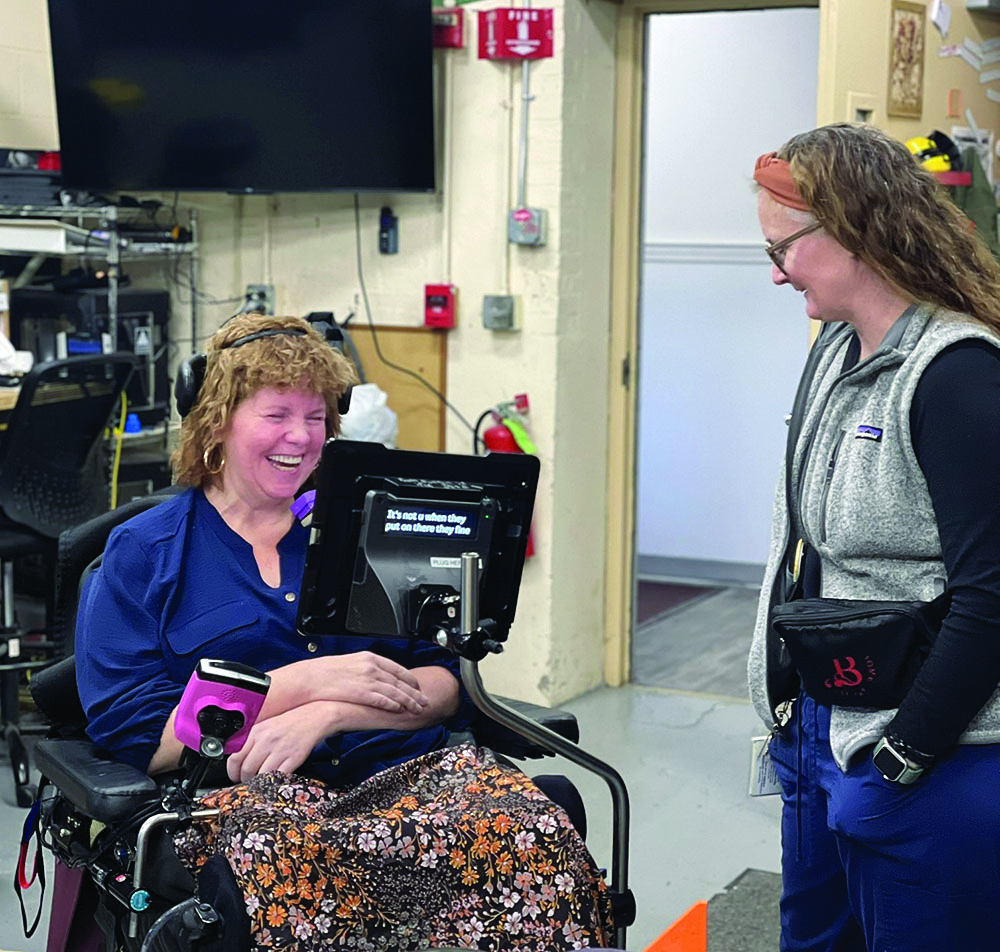
Corinne Curran, The Boston Home’s assistive technology coordinator of Dorchester, worked on a repair with resident Laurie. Photos by Shangcao Yuan
The work can be as simple as replacing a worn joystick topper at their innovative 3-D printer lab. For residents who use their hands to drive, a topper can make a big difference, but one commercially available dome joystick topper costs $97, Curran said. The center can make a 3D-printed temporary version for 37 cents in materials.
When one wears out, Curran said, a wheelchair company might send someone out weeks later to assess the problem, then submit a quote to insurance before a replacement arrives. In the meantime, the center prints a temporary part so the resident can keep using the chair.
With 3D printing, Curran said, the center can also test designs repeatedly until they fit a resident who may need a specific shape because of limited hand movement. Others may need phone holders placed where they can reach them. A small part may go through several design variations before it is right.
Other adaptations are made from repurposed parts. Curran showed how old wheelchair headrest hardware can be used to build iPad mounts. She also demonstrated an adjustable cup holder made from a microphone stand, an old wheelchair wheel, casters, PVC pipe, and 3D-printed pieces.
For Gold, having a cup holder means she can drink coffee, wine, or another beverage at her own pace. If someone else is holding the drink, a resident may feel rushed, especially when staff members are helping several people at once. For residents with MS, drinking too quickly can cause health risks, including aspiration and pneumonia, Curran said.
“For somebody like Jody, it’s some dignity,” Curran said. “She’s an adult human being.”
The center works closely with the rehabilitation team before adding or changing parts on a chair. A device has to be safe and not interfere with therapy or positioning.
Victoria Stevens, the home’s director of communications, said properly fitted power chairs are important not only for mobility, but also for health.
Residents who cannot reposition themselves are at risk for pain and pressure sores, Stevens said. Power chairs can tilt, recline and support residents in ways that standard manual chairs often cannot. Living life with mobility, she said, also supports mental health, social life and cognitive engagement.
“The physical and the medical are really entwined,” Stevens said. “Being able to maintain your independence also really helps to maintain your cognitive ability.”
Before coming to The Boston Home, Gold said she spent much of her time at a different facility isolated in her room. Some days she stayed in bed; other days she sat in a chair and watched the Game Show Network.
The change after moving to The Boston Home, she said, was “night and day.”
Now, after staff help her into her chair with a Hoyer lift, an assistive device used to transfer residents from their beds to their wheelchairs, Gold can move through the building, join activities, and even take part in an online book club with friends from outside. With voice-control accessibility features on her iPad, she can read, listen to audiobooks, and watch shows.
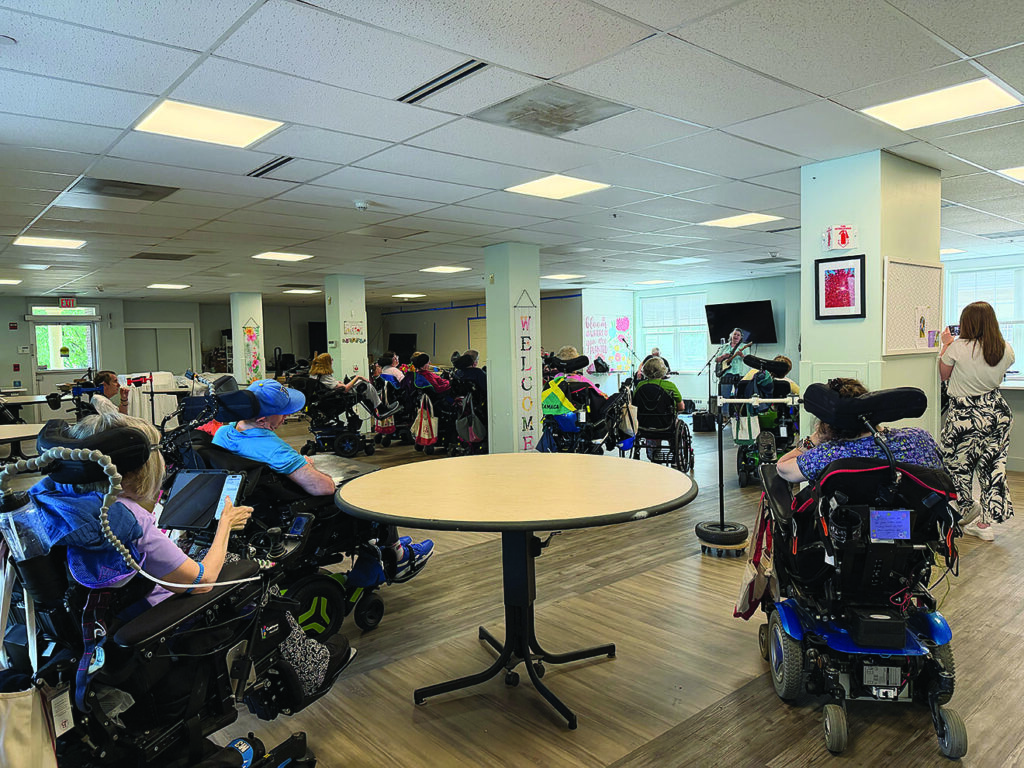
Gold’s chair is also part of her life outside The Boston Home. Curran said some adaptations are designed with family outings in mind, including a slimmer phone mount that Gold can use when family takes her out. Curran also considers how changes to the chair will work with her family’s van, ensuring that the equipment that helps her move through the facility can supports her life beyond it.
For other residents, power chairs can provide them with a “lifestyle.” Curran said some residents drive down Dorchester Avenue to get coffee at Dunkin’ or go out for community events, including Dorchester Day celebrations. Residents who want to leave campus independently go through a rehabilitation evaluation to make sure they can safely navigate traffic, curbs, and street crossings; others can take part in staff-supported outings.
Gold said she turned down the chance to move to The Boston Home twice because she did not like change. The third time, a few months before her daughter’s wedding, she and her husband decided to give it a go. She said she has never looked back.
“Before I was here, I was existing,” Gold said, “and here I am living.”
And Curran and the Wheelchair Repair shop will make sure her life continues to move on no matter what cog enters the wheel.
This story is the product of a partnership between the Dorchester Reporter and the Boston University Department of Journalism. For more about The Boston Home, watch the most recent episode of DotLife podcast, available on YouTube, Spotify, and Apple Music.
