
Plans to establish a Dorchester history garden on an underutilized park on Columbia Road are advancing this summer, according to organizers who convened more than a dozen neighbors and stakeholders on Monday at the proposed site, which includes the historic Blake House and an oddly placed statue of the mid 19th-century statesman, Edward Everett.
On hand were John McColgan of the Pear Square Collaborative, City Archeologist Joe Bagley, and Dorchester Historical Society President Earl Taylor, along with neighbors and architectural students and representatives from the Hideo Sasaki Foundation, who discussed a pre-design report they will produce this summer.
Sasaki produced a conceptual design last year via a state earmark secured by state Sen. Nick Collins that suggested designs and themes for a history garden. The ongoing visioning process is being run by Estafany Benitez, with oversight from others at Sasaki.
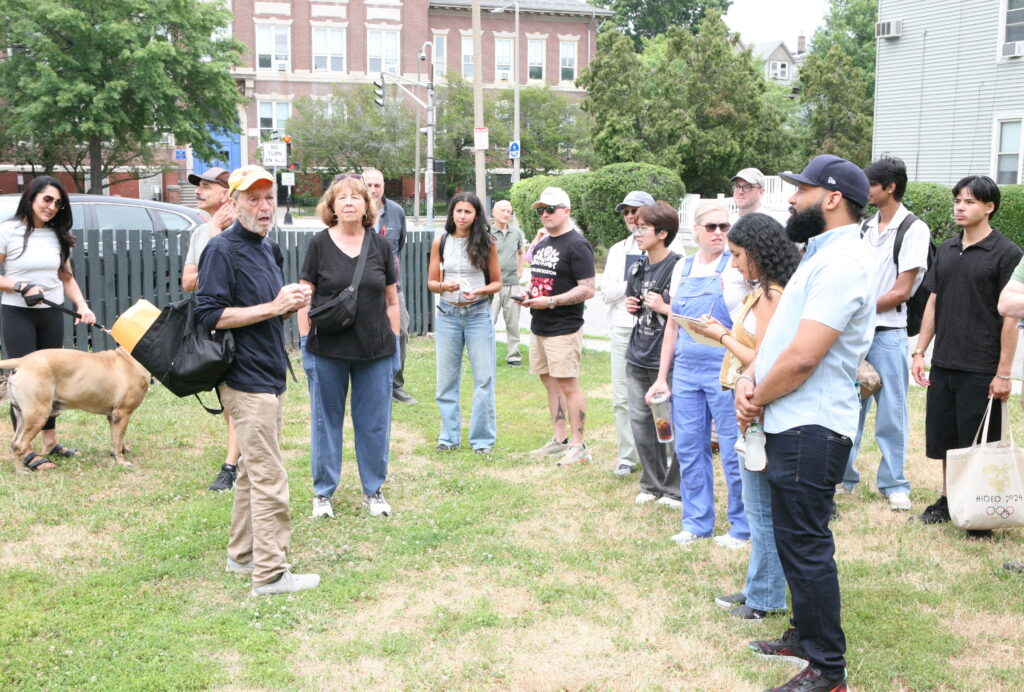
Interested neighbors and preservationists took a walking tour of Richardson Park on Monday. Seth Daniel photo
McColgan, a Dorchester resident and retired city of Boston archivist, welcomed everyone in front of the Blake House – the oldest standing home in Boston. “My idea,” he said, “was to make this place a cultural asset that would provide an opportunity to highlight all of the cultures and groups that call Dorchester home.”
Collaborative board member and neighbor Michael Keamy noted that the site – known as Richardson Park – already has a history theme with the Blake House and the Clap Pear sculpture positioned at Edward Everett Square.
“I have an interest in seeing this park used to the best of its ability,” he said. “I think it’s underutilized by the public and if re-designed could become used a lot more beneficially.”
For his part, Annapolis Street resident Isaque Rezende has high hopes.
“I think it would be exciting to think of the possibilities, but now it’s up in the air so it’s hard to have strong feelings about it as it currently stands,” said Resendes, who attended the Russell Elementary School across the street and often walked through the park as a kid. “However, the history of this neighborhood is fascinating and anything we can do to preserve and honor it gets my vote.”
The walk featured stops at the open field hill next to the Blake House where generations of families have sledded in the snow and children have played baseball and other games – while also serving as an important cut-through pathway for pedestrians.
Neighbors suggested the area should remain open, but perhaps used for performances and art fairs – as once happened on the site.
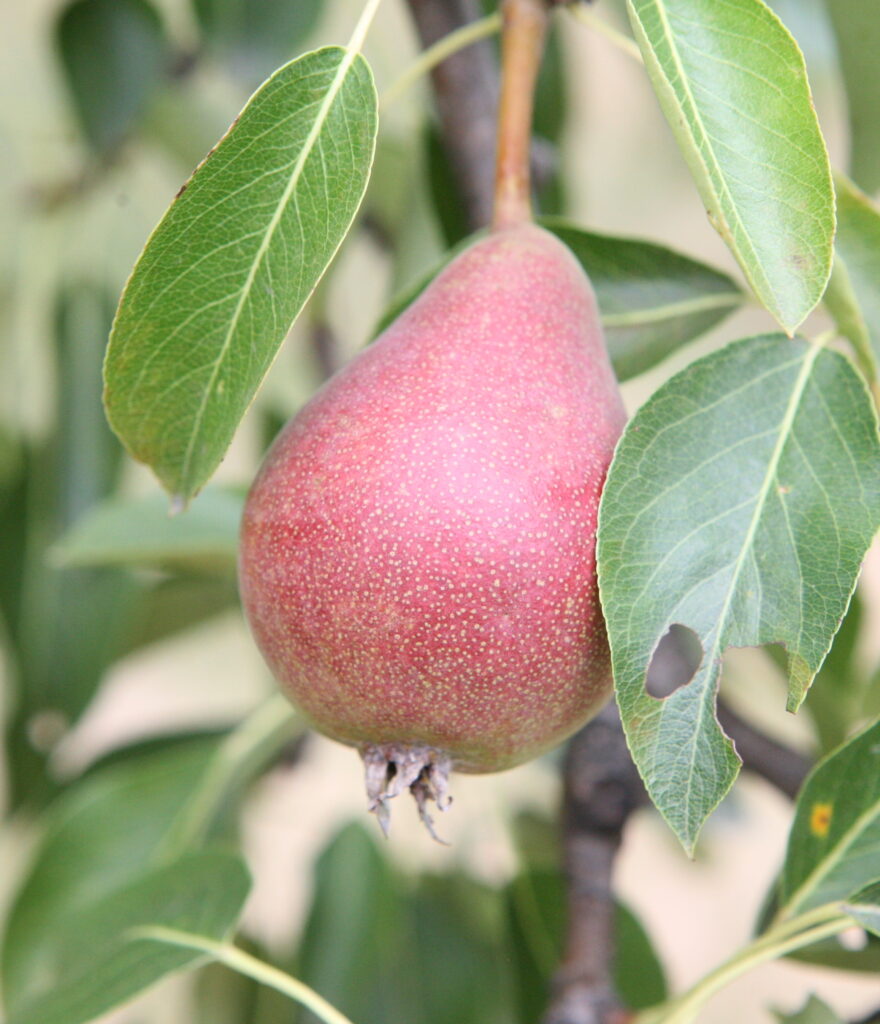
One of the pear trees in the park that highlight the area’s agricultural heritage. The Clap Pear was created in the immediate area, and the Bartlett Pear was first cultivated nearby in Roxbury. Seth Daniel photo
Bagley noted that it was the first Dorchester Town Green, and that an important native and Colonial freshwater asset – known as Great Pond – existed adjacent to it. It was filled in when the Blake House was moved to that location in 1895.
“Having fresh water so near the ocean would have been a big deal,” he said.
Bagley also plans to study re-locating the historic Capen House on the site permanently.
Other spots on the tour included highlighting the fruit trees planted behind the Blake House that attest to the area’s agricultural heritage, including the development of the innovative Clap’s Favorite Pear in the immediate area during the 1800s.
While current pear trees that were planted are thriving, neighbors said they would like to see more of those laid out like an orchard, and with the history spelled out prominently.
Most at the gathering said a focal point should be the statue of Everett, who served as US Secretary of State and delivered an oration ahead of President Abraham Lincoln at the dedication of the National Cemetery in Gettysburg in November 1863.
The site around the statue is surrounded by a fence and unsightly with weeds and trash strewn around it. Overgrown apple trees obscure the statue and, neighbors complain, they provide cover for illicit drug use and unhoused people.
Most residents felt the statue should be moved to the apex of the park so that Everett’s image could be easily seen, and his history better explained.

Shamus Hyland, a St. Mark’s resident and member of the Union Club that counts Everett and his descendants as members, said he would like to connect the club to the history garden project. He also noted that sound mitigation would be a key improvement.
“Until now I didn’t realize how loud it is in here,” he said, as an ambulance and a large dump truck drowned out the discussion. “It would be nice to have some kind of noise mitigation in any new park.”
There was also agreement that some sort of cultural highlight – maybe even an immigration timeline with robust histories of Dorchester immigrant groups – could be part of a walking pathway around the park. That could include Native American populations, early Colonial settlers, and immigrant communities from Ireland, Poland, Vietnam, Haiti, Cape Verde, Germany, Spanish-speaking countries, and many others.
That was McColgan’s initial concept, and it seemed to carry interest on Monday.
Key hurdles remain, though, as ownership of the park is in dispute between the state and the city – neither of which seem to want it. Sen. Collins mentioned there is an effort afoot in the Legislature to transfer ownership of the park to the Dorchester Historical Society – which already owns the adjacent Blake House.
Benitez said that students will be taking input gathered Monday to inform a mid-summer presentation on July 22 at 10 a.m. – with location to be determined.
A final presentation will be made on Thurs., Aug. 11, at 1 p.m., with location to be determined.
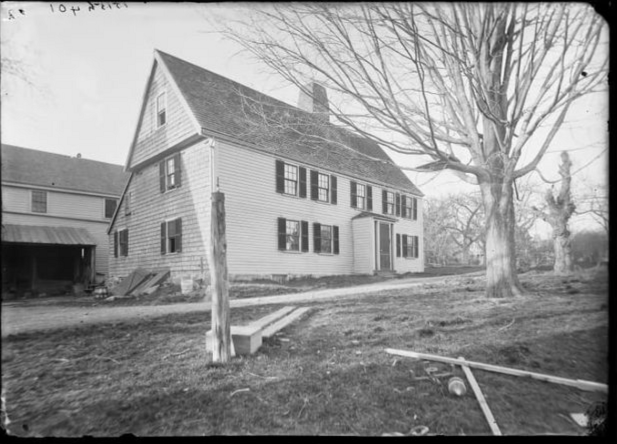
Another historic home next to the Blake House?
If all goes well this week, the Capen House that once was located across the street from the Dorchester Courthouse will again be in Boston courtesy of City Archeologist Joe Bagley, who’d like to someday return it to Dorchester.
After an interesting journey within the city procurement process, Bagley said he expects to purchase the historic building from a collector in Wisconsin – who has the home stored in pieces at a warehouse in Ipswich.
It would be the second oldest home in Boston (1675) behind the Blake House (1661) and Bagley is taking the temperature on locating it next to the Blake House.
“We didn’t realize what we were buying when we proposed to get it,” he said. “We didn’t realize how incredibly intact it was. The big question is where does it go? We want to give it back to Dorchester eventually.
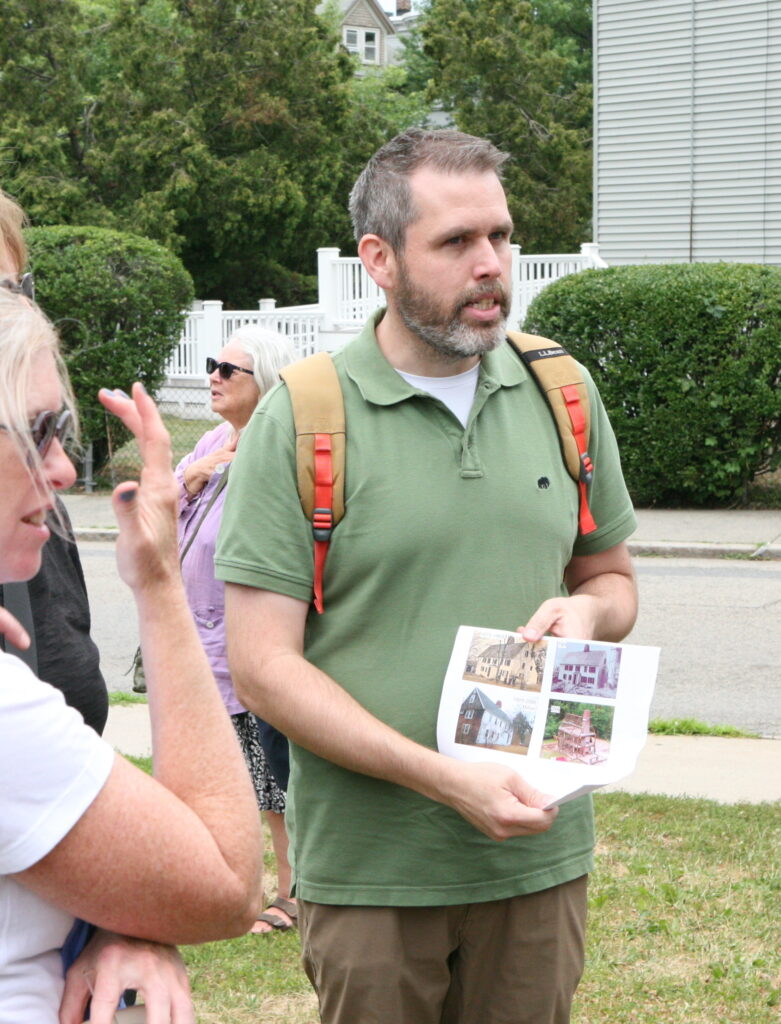
City Archeologist Joe Bagley has hopes to one day relocate the historic Capen House in Dorchester. Seth Daniel photo
“This park is already a great contender for it. We’re also looking at Mullen Square (Edison Green) nearby as another location…We want it to be an historic preservation model, and I don’t want it to be just another Blake House.”
Right now, he is working out legal concerns about parkland and what the home is legally defined as. If it becomes a “home” and not an object, they may have to replace the parkland, which would present added problems.
He also doesn’t want it to block the sledding activities on the site.
The home stood on Washington Street until 1909 when it was to be demolished. But instead it was saved and reassembled in Milton near the Blue Hills.
In 2006, the home was to be demolished again when its site was purchased for development. Several preservationists bought it, and, Bagley said, it “disappeared from the face of the Earth” until he tracked down the Wisconsin owner.
