


By Andrew Bradshaw and Samuel Marsh
While the City of Boston’s workforce is projected to shrink this year, its personnel spending isn’t slowing to match. Some of the city’s fastest-growing personnel costs are climbing faster than city revenue, and contract negotiations are approaching for several of the city’s largest collective bargaining units. How effectively Boston plans for renegotiated contracts will help determine its fiscal footing in the years ahead.
Personnel costs make up more than two-thirds of Boston’s operating budget. In nine of the last ten years, personnel spending outpaced annual growth in personnel fulltime-equivalents. This year alone, the City cut its workforce by 2.6 percent while overall spending on wages grew by 1.6 percent. Health insurance costs are a major driver, rising 23.9 percent in a single year, more than ten times the City’s revenue growth. The result: a budget with limited flexibility to address rising costs.
Collective bargaining leads to benefits for City employees, allowing for updated compensation and other conditions of employment to improve standards. However, the ways collective bargaining agreements influence future budgets are not always as clear as they should be. While City Council reviews contract terms that impact individual employees prior to approval, the long-term budgetary impact of collective bargaining agreements on departmental spending is not always clear. A long-term perspective is critical to understanding how these terms affect Boston’s budget, given the low-growth environment that the City has been experiencing.
Of the 34 collective bargaining units that the City negotiates with, the Boston Teachers Union (BTU), Boston Police Patrolmen’s Association (BPPA), and International Association of Firefighters (IAFF) Local 718 are the largest three by represented employees. Examining these contracts illustrates both that the City’s current revenue growth is not keeping up with personnel spending and that budgetary impacts can present themselves in indirect ways.
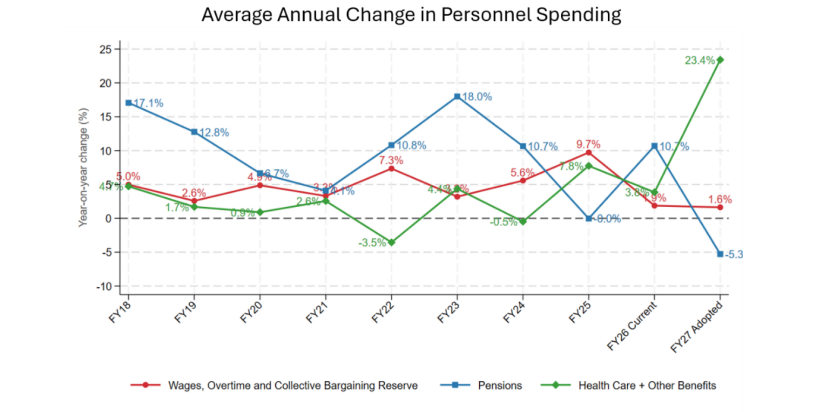
Some contract terms are not transparent in how much they will cost the City. This year’s budget cut teacher full-time equivalents by a dramatic 5.2 percent, while teacher salary funding declined only 1.0 percent because of salary increases already locked in by last year’s BTU contract renegotiation. New terms for paid workout/meditation time and summer vacation in the December BPPA agreement have the potential to put additional pressure on Boston Police Department staffing, where overtime pay already drives costs and has been cited by the City as a contributor to last year’s budget deficit.
Additionally, the most recent IAFF Local 718 collective bargaining agreement approved by City Council in February exemplifies such unclear cost impact, with the effect of incremental adjustments to base salary by employee years of service not immediately visible at the department level. These examples demonstrate a mismatch between decreasing City worker positions and increasing costs for the City.
Given how difficult this year’s budget process was, with many departments experiencing cuts, City personnel and programs could be at risk if costs continue to increase faster than revenue growth. Nine collective bargaining agreements will be up for renegotiation by the end of this fiscal year, so it is imperative that the City plan to accommodate updated contract terms while avoiding additional cuts to programming and worker positions.
The City should 1) provide a detailed breakdown of the full impact on spending for collective bargaining agreements prior to City Council approval; 2) compare analyzed costs to future revenue growth projections; 3) present a clear explanation for all non-financial contract terms to City Council; 4) hold an annual hearing with City Council and the City’s Labor Relations team to review the status of employee representation and collective bargaining; and 5) evaluate agreements alongside those of comparable cities and municipalities.
A city’s workers are its most valuable asset. These recommendations aim to ensure Boston is proactive about recognizing the full cost of collective bargaining agreements. In doing so, the City will protect its ability to retain employees and better support their needs in the long-term.
Andrew Bradshaw is a Research Assistant at the Boston Municipal Research Bureau and a current Northeastern University co-op student. Samuel Marsh recently completed a Northeastern University co-op as Research Assistant at the Boston Municipal Research Bureau.
The Research Bureau’s recent report, Collective Bargaining Shapes Boston’s Personnel Spending, is available on its website.
