
Copyright © 2026 Boston Neighborhood News, Inc. This content may not be re-published or re-used without written permission.
City and MBTA officials have a substantially revised the plan for the $163 million reconstruction of Blue Hill Avenue to show the public in a series of four meetings that start next week. The updated project preserves a controversial element that will bring dedicated, center-running bus lanes that they say will better serve the roughly 40,000 daily MBTA bus riders who use the 10 different bus routes along the corridor.
The revision seeks to answer critics by preserving two lanes of vehicle traffic in each direction, adding more parking spaces, consolidating bike infrastructure to one side of the road, and working closely with retailers and churches along the route to ease concerns about impacts.
Mayor Michelle Wu, State Rep. Russell Holmes, and state transportation officials previewed the latest design during a media briefing ahead of four public meetings that begin Sept. 10 at Morning Star Baptist Church in Mattapan.
The plan— which will be finalized next year with phased construction slated to start in 2028—will reconstruct six miles of streets and sidewalks. It also adds safer pedestrian crossings, roughly 200 new trees, all-new street lighting, pedestrian signals, and fresh pavement.
The city and MBTA have secured more than $124 million in local, state and federal commitments to date, including an $80.3 million federal Small Starts allocation that was awarded in March. MBTA officials said Thursday that the federal money has been appropriated but still requires completion of a formal grant agreement, while a separate $38 million state funding request remains pending.
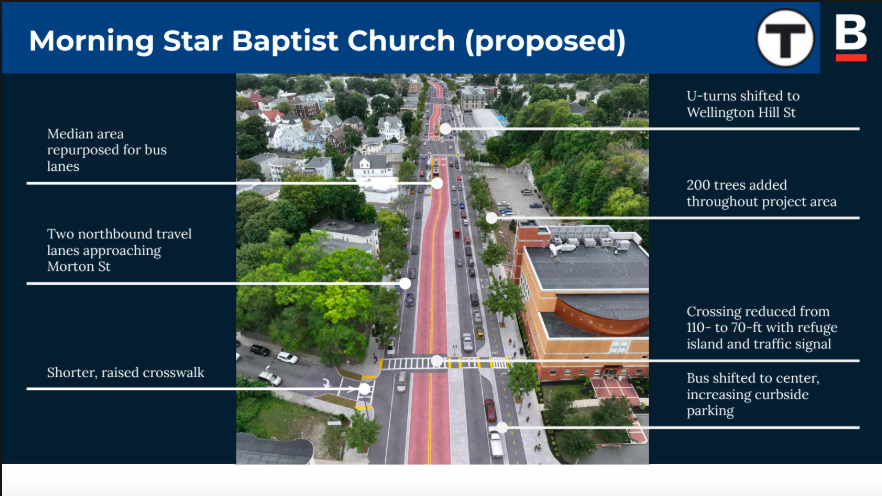
The revised proposal shown to The Reporter on Thursday differs significantly from the conceptual design first shown publicly two years ago in multiple ways:
• The new design scales back and consolidates the proposed bike infrastructure. Instead of separate northbound and southbound bike lanes along most of Blue Hill Avenue, the new plan calls for a two-way, sidewalk-level path on the west side of the street, running from Woodhaven Street a half mile north of Mattapan Square and ending at Franklin Park. Officials said the change frees up space for more parking and vehicle travel lanes. The bike path would not continue through every part of the corridor, including Mattapan Square. As Mayor Wu noted, “there are really no bike facilities anywhere along Blue Hill Avenue today,” adding that the project would be “not only protecting them but actually creating them.”
• More than 70 percent of the corridor would now have at least two general-purpose travel lanes in each direction. In lower-volume areas, one lane could be used at certain times for parking and at peak periods for moving traffic. The previous design would have reduced traffic to one lane in a direction on certain stretches.
• It adds 42 new parking spaces along the corridor, a benefit achieved by moving bus stop zones away from curbs.
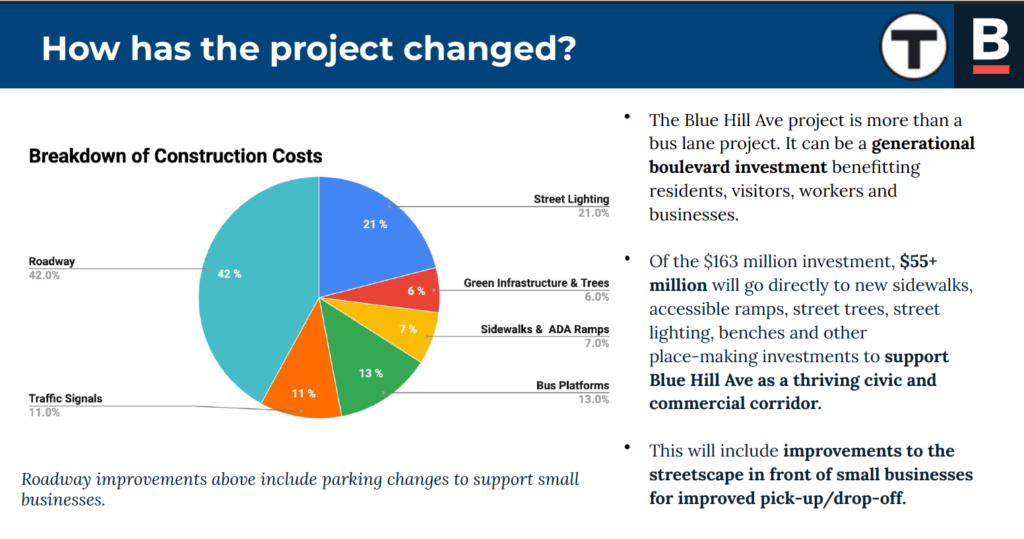
Above: An infographic supplied by MBTA/City of Boston
Wu said the changes reflect what the city and state heard repeatedly from residents over several years of community engagements with residents, merchants, and commuters. She grouped that feedback into three categories: beautification; safer and more reliable transportation; and protection of small businesses and parking.
“It’s just not acceptable for one of the major residential and commercial corridors in the city to feel so worn and dated,” Wu said. “The sidewalks need repairs in many areas.”
“The streetlights could use upgrades, and we need more of them in many places. It feels very wide, barren and not green,” she added. “People want to see not only improvement in the transit part of this, but to feel like they’re living in a thriving economic and neighborhood area.”
Rep. Holmes, the biggest political booster of the project along with Wu, said Blue Hill Avenue was rebuilt in the mid-20th century around automobiles to serve people commuting into Boston from the suburbs.
“This is a road that historically had trolleys running down the middle,” Holmes said. “Essentially, we want to take a road that has been designed for cars to come through my neighborhood and make it a street where we understand that we live and play — not a street designed simply for people to drive through my neighborhood as fast as possible.”
“We’re now going to have a road that’s designed for those of us who live here — lighting for cars, yes, but also lighting for those of us who walk on the sidewalk.”
Block-by-block design
The mayor said planners have tried to translate community concerns into block-by-block design changes.
“This has been a seven-year process for this program, and there have been decades of conversations prior to that about how Blue Hill Avenue needs to be improved and how important this corridor is for the city,” she said.
She pointed to Happy Supermarket at Blue Hill Avenue and Talbot Avenue, where she recently met personally with owners about parking, deliveries and the unusual shape of the building created by a long-removed traffic rotary.
“If we take the time and have the resources to really get into these little details, a little investment can serve multiple purposes and modernize us for what we need today,” Wu said. “And a whole lot of investment, like we’re talking about at the scale of this corridor, will be generationally transformational if we get the details right.”
A widespread concern about safety was another near-universal complaint, Wu said, that informed the revisions.
“We heard universally — documented in this report — that it doesn’t feel safe to cross the street,” she said. “It feels chaotic with double- and triple-parked cars.”
“When you’re driving, you have to weave in and out and avoid people crossing the road. It just feels unsafe from many perspectives, depending on how you’re using the road.”
The city says Blue Hill Avenue averages a crash requiring an EMS response about once every three days and ranks in the top 3 percent of Boston streets for motor vehicle crashes per half mile.
The latest plan calls for reconstruction of sidewalks along the entire corridor, nearly 200 accessible curb ramps and 19 new traffic signals intended to create more frequent and shorter pedestrian crossings.
And while many elements of the plan have changed, the center-running bus lanes remain. Wu argued that moving buses away from curbside congestion is essential to making the project work.
“With a corridor of this size and this volume of traffic, and with businesses, takeout uses and so many different things happening at the curb, getting the buses out of the chaos on the side and into the center is the best and only way to ensure that there’s true reliability on the corridor,” she said.
She said projected bus frequencies of every three to six minutes would make the corridor function more like rapid transit.
“That is Orange Line frequency or better,” Wu said. “It is really a rapid transit experience that can only be possible here with this kind of change.”
The city estimates the center-running lanes would cut travel times for bus-riders between Mattapan Square and Grove Hall by 10 to 15 minutes.
“Those are local residents, not just people passing through,” the mayor said. “Those neighbors and residents should and will benefit from the many additional uses of these dollars besides public transit improvement, which is important on its own.”
A look at new renderings
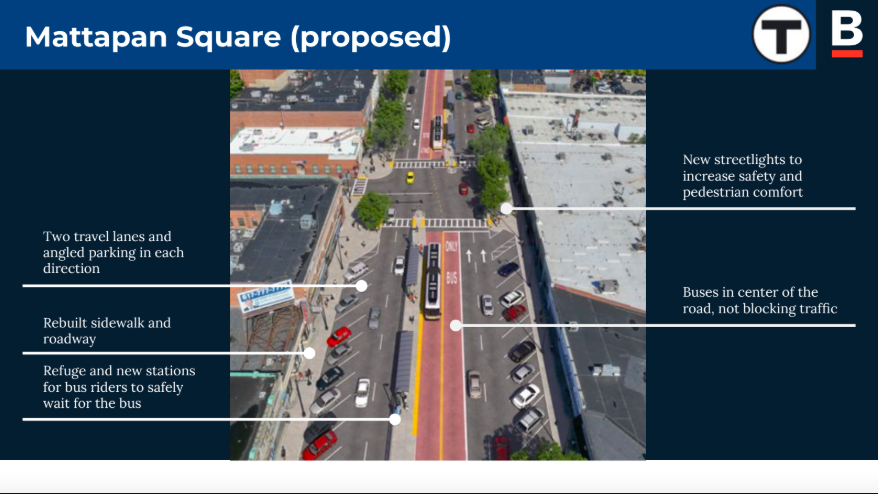
Design elements at Mattapan Square show two travel lanes and angled parking in each direction, with buses operating in the center of the roadway and passengers waiting on new protected platforms.
Near Morning Star Baptist Church, the proposal would preserve two northbound travel lanes approaching Morton Street and allow additional event parking in the median area on Sundays. A 110-foot unsignalized crossing would be shortened to about 70 feet and equipped with a refuge island and signal.
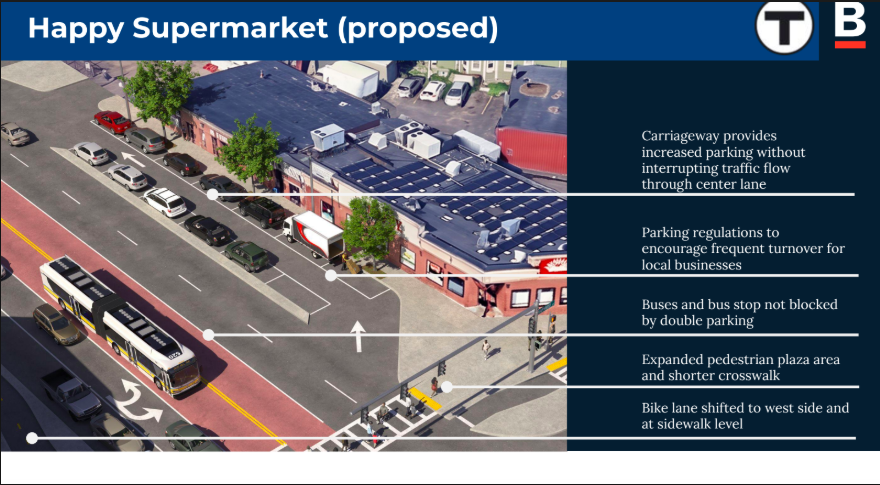
At Happy Supermarket, planners propose a carriage-road-style parking area to remove customers from the main stream of traffic and discourage double-parking. The plan also includes a larger pedestrian plaza and shorter crossing.
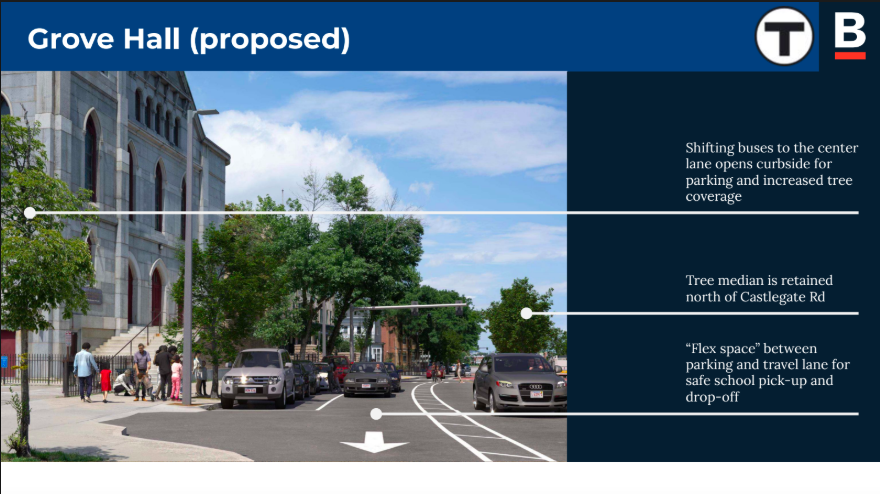
Closer to Grove Hall, the plan creates additional curbside parking and “flex space” that could accommodate school pick-up and drop-off at Mother Caroline Academy.
Wu said the city has been trying to design for what businesses actually need rather than simply counting spaces.
“The details have allowed us to target interventions for specific businesses that not only preserve their parking, but reformat or redesign it so it’s even better for the uses they actually need — whether it’s a grocery store, Morning Star Baptist Church or a school that needs drop-off space,” she said.
Holmes: enforcement must start now
Rep. Holmes says chronic double-parking that is a problem on stretches of Blue Hill Avenue now needs to be addressed before any shovels hit the pavement on this project.
“We should begin today, two years before this project gets started. We should be teaching the neighborhood that we’re going to do enforcement.”

Holmes (shown above) said drivers have developed habits around years of lax enforcement and fear of being blocked in by other drivers if they park at the curb.
“We have taught them, year after year, ‘Don’t pull to the curb because you might be blocked,’” he said. “We want to teach them now: Get off the street and pull to the curb.”
“I live here. I see it. I don’t like it,” Holmes added. “So for me, enforcement is number one.”
Holmes said businesses will also have to change some of their own practices, including delivery schedules and the use of curb spaces by owners and employees.
“We pushed business owners a little hard this week to say some of the basics are: Why don’t you stop parking in front of your own business?” Holmes said.
“We have to have some real conversations with these guys and say, ‘Why don’t you coordinate when people come?’”
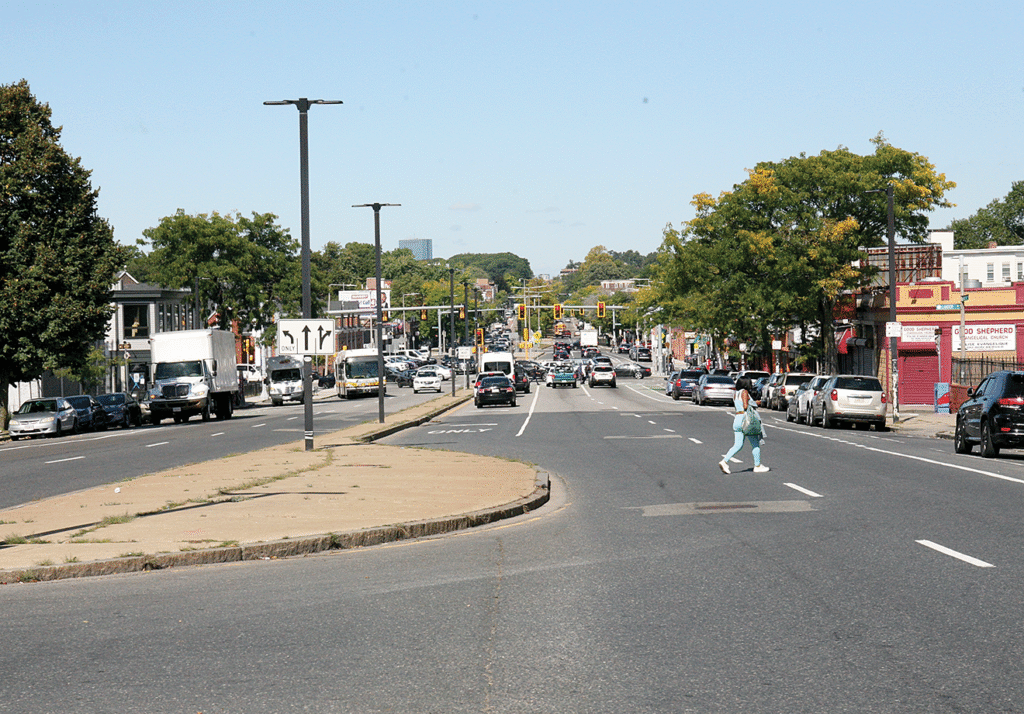
A view of Blue Hill Avenue looking north near the Morton Street intersection. File photo
Business protections
Donald Wright, the city’s economic chief, said officials have already begun meeting with specific businesses to plan for construction impacts and get their guidance on how to best assist them before any work begins.
The emerging strategy includes a dedicated point person for businesses, translated materials, weekly updates, clearly marked customer access, “We are open” signage, published construction schedules, rodent mitigation and technical assistance to help businesses adjust operations during disruptions.
Officials also envision campaigns encouraging construction workers and residents to patronize businesses throughout the years-long work.
Wu said business protection was one of the clearest messages received during earlier outreach.
“Everyone universally wanted to make sure that businesses were protected during construction and came out on the other end with even greater investments and supports,” she said.
Meetings will focus on the block level
The September meetings in Dorchester and Mattapan are intended to move the conversation from broad concepts to individual blocks, intersections and properties, according to Wu, who said earlier public discussions focused largely on whether residents supported making major changes at all.
“There was a lot of deserved and rightful skepticism about whether promises and big goals could actually be translated into reality,” she said. “That is all about the details, block by block.”
One earlier design problem, Wu said, involved proposed mid-block bus stops that would have required many additional traffic signals.
“An earlier version of the design nearly doubled, or at least very significantly increased, the number of traffic lights on the corridor,” she said. “That would have made traffic and commute times exponentially longer, and that is not something we wanted.”
Those stops have since been moved and crossing and turning patterns revised.
“The goal of the upcoming meetings is to walk everyone through the latest version of the design, but also to have people physically be able to see every single block and renderings of what it would look like,” Wu said.
“How many parking spaces have been added or moved around? Where will the new trees go? Where will there be two lanes of travel in both directions? All of that isn’t real until you can visualize it.”
The first public session will be a town hall-style meeting on Thurs., Sept. 10 at 6:30 p.m. at Morning Star Baptist Church, 1257 Blue Hill Ave. An open house will follow Mon., Sept. 14 at 6:30 p.m. at the BCYF Perkins Community Center, 155 Talbot Ave. A second open house is set for Tues., Sept. 22 at 6 p.m. at the Mattapan Branch Library, 1350 Blue Hill Ave., and the series concludes with another town hall Wed., Sept. 30 at 6:30 p.m. at the Holland School of Technology (formerly Burke High), 60 Washington St.
Copyright © 2026 Boston Neighborhood News, Inc. This content may not be re-published or re-used without written permission.
