
Copyright © 2026 Boston Neighborhood News, Inc. This content may not be re-published or re-used without written permission.
As more than 100 people gathered on Wednesday evening in the William E. Reed Auditorium in Grove Hall for a City Council hearing on transit equity,District 4 Councillor Brian Worrell opened his statement with a question.
“What level of transportation investment does our community actually deserve?” he said. “The MBTA spent more than $1 billion extending rail service to New Bedford. After a year, that line is carrying roughly 2,500 riders a day. Here on Blue Hill Ave., we’re talking about close to 20,000 riders every day. That is a huge difference.”
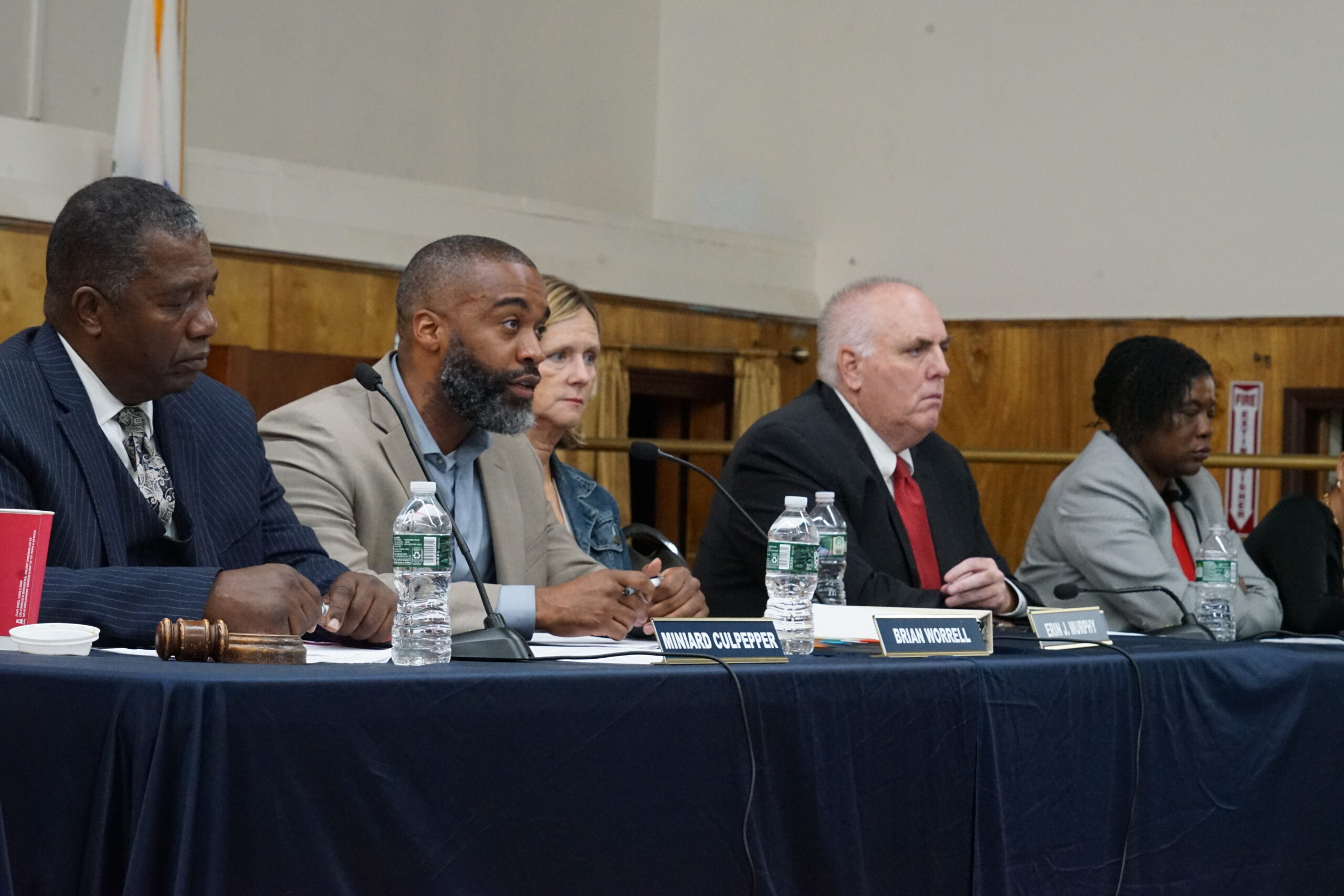
The evening meeting of the Council’s Committee on Civil Rights was convened by the Worrell and District 7 Councillor Miniard Culpepper and billed as a discussion of “transportation equity in access to rapid transit and the evaluation of a potential Orange Line extension along Blue Hill Avenue.”
But much of the discussion focused on the $163 million project backed by the administration of Mayor Michelle Wu and MBTA officials that would run buses down the center of the avenue between Mattapan Square and Grove Hall. The project would eliminate 9 of the 19 existing stops on the route and reduce by an estimated 10 to 15 minutes the amount of time bus trips take between Mattapan Square and Grove Hall, according to proponents.
During the meeting, foes of the project argued that state and federal officials have ploughed far more money into rail extension projects elsewhere in the MBTA system, providing better service to fewer riders. Worrell and Culpepper have proposed a new branch of the Orange Line that would branch off from Ruggles Street, proceed through Nubian Square and Grove Hall and extend to Mattapan Square.
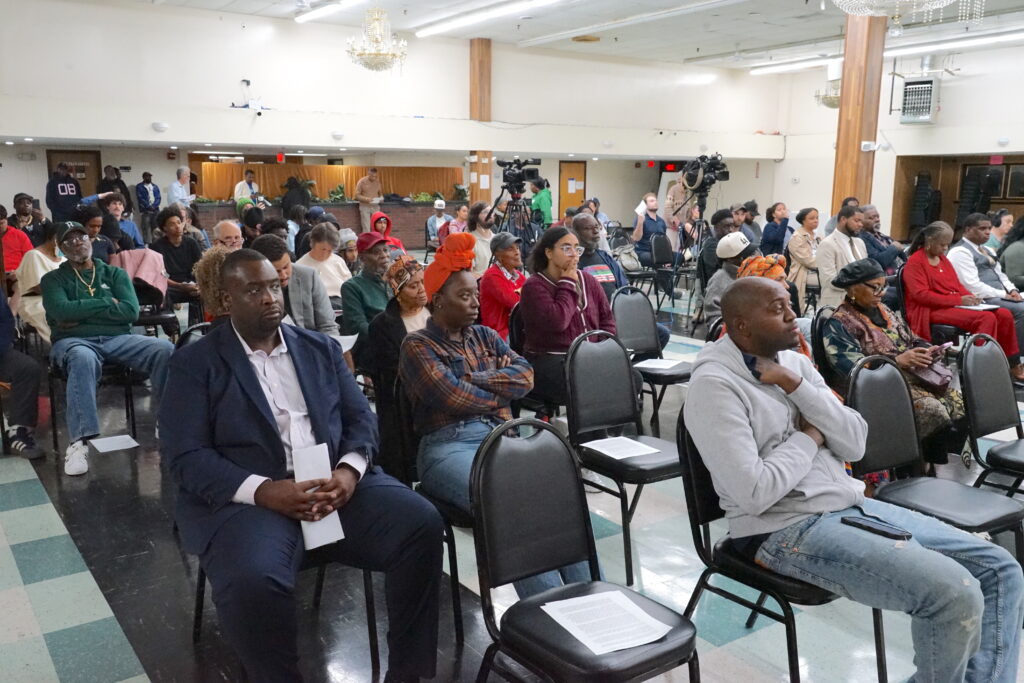
The scene inside William E. Reed Auditorium in Grove Hall on Wed., Oct. 14,2026. Yawu Miller photo
“When you look at the MBTA’s rail map, most of the city has convenient access to rapid rail transit,” Culpepper said. “Our neighborhoods do not. Blue Hill Avenue is the busiest corridor in the MBTA system, accounting for 11 percent of the total ridership, yet the people who rely on the MBTA the most have no rail.”
The Fairmount Line, the existing commuter rail line that includes a station at Blue Hill Avenue in Mattapan along with several other neighborhood stops on its route from Readville to South Station, was not mentioned at the meeting. In the past, Culpepper and other proponents of the Orange Line extension concept have argued that the Fairmount Line does not serve as a viable rapid transit option.
Culpepper said his constituents have consistently opposed the idea of a center-running bus lane since then Gov. Deval Patrick’s administration first proposed it in 2009. Worrell and others in the meeting said the city’s push for improved bus service on the route should be weighed against other options, pointing to the $2.3 billion Green Line extension into Somerville and Medford.
Last year, the Legislature directed the Massachusetts Department of Transportation to spend $100,000 in revenue from the Fair Share Amendment tax revenue on a study of the feasibility of extending Orange Line Service from Forest Hills to Roslindale Square.
“If this corridor really needs a generational investment, we should be looking at every available tool to make that generational investment happen,” Worrell said. “Residents deserve to see the analysis, they deserve to see comparisons, and real engagement means people have some say in the biggest question: What kind of transportation system do we want serving this community for the next 50 or 100 years?”
Called on to testify by the councillors, Anne McKinnon, an urban planner who has done work for the MBTA, called the city and state’s planning process for Blue Hill Avenue a failure.
“It’s failed by design,” she said. “Transit equity cannot be achieved without talking to people, without developing alternatives and analyzing them and selecting the alternative that meets most of their goals. Transit equity requires really thoughtful and serious planning and bold action, and neither of them happened here.”
McKinnon said the city and state has chosen buses to serve the Blue Hill Avenue corridor because they’re inexpensive and easier to implement. The tradeoff, she said, comes in quality.
“They’re the lowest capacity transportation mode that exists,” she said. “They have the lowest ability to impact land use and development decisions.”
She said the 10-to-15 minute time savings state officials have estimated the dedicated bus lanes would produce would not induce drivers to take public transit.
She also said those time savings are overstated, with MBTA officials acknowledging that eliminating the U-turn buses currently make in Milton and allowing them to turn directly into Mattapan Station would account for five minutes of their estimate.
“The project would do nothing to speed traffic north of Grove Hall, and that’s 50 percent of the trip,” she said. “So a lot of the trip is still stuck in traffic. And for all this the MBTA says that it might be able to add maybe 10 additional round trips over an 18-hour day on the 28 bus, which is hardly a noticeable increase in service.”
McKinnon noted that past studies going back to 1978 recommended higher quality transit service for the corridor, but said city and state officials appear to have excluded them from their current planning.
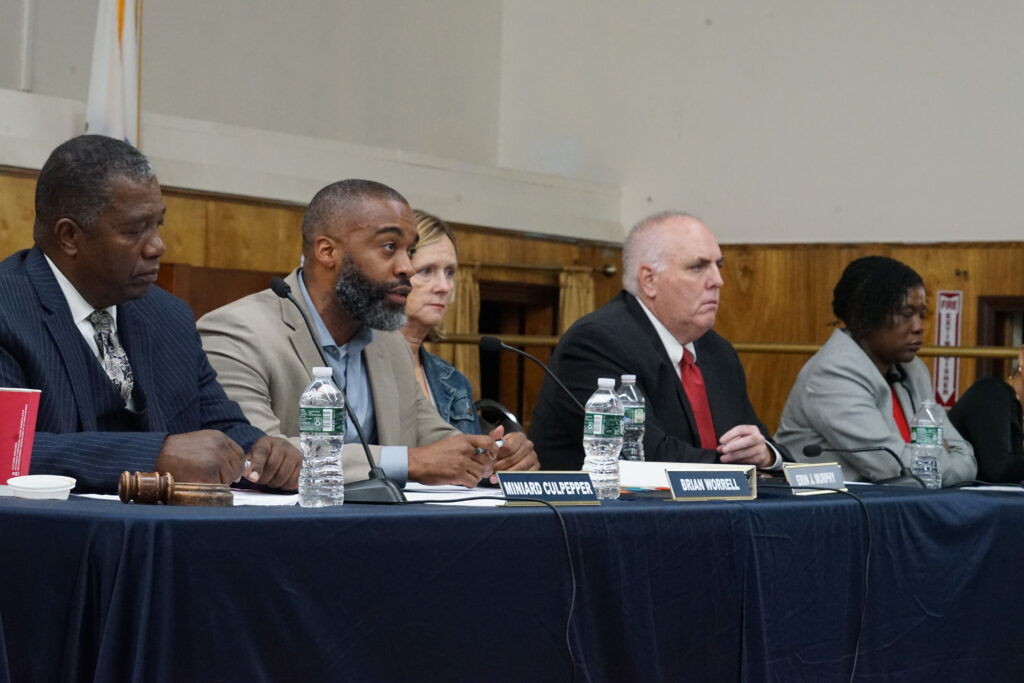
Councillors at Wednesday’s hearing, from left: Miniard Culpepper, Brian Worrell, Erin Murphy, Ed Flynn , and Ruthzee Louijeune. Yawu Miller photo
“Nobody cared or they ignored them,” she said.
Center-running street cars serviced Blue Hill Avenue until it was discontinued in the mid 1950s. In the 1970s, then-Gov. Frances Sargent announced that the elevated Orange Line, which ran along Washington Street from downtown to Forest Hills, would be dismantled. In response to Black community opposition to the plan, the governor promised a replacement service that would be “equal to or better than” the elevated line.
After the MBTA spent $23 million on new compressed natural gas buses and street improvements, the Silver Line was launched in July 2002, following the former route of the 49 bus from Dudley Station to downtown crossing.
Activists have long advocated for an “equal to or better than” transportation option, noting that the Silver Line buses, which currently serve 37,905 weekday riders in Boston and Chelsea, are subject to street-level traffic and do not provide a one-seat, one-fare connection to the subway system.
Speaking during the Wednesday meeting, Dorchester resident Reggie Stewart said the loss of the elevated Orange Line in 1987 effectively cut off the Black community from the rest of the city, despite Sargent’s promise.
“And here we are four decades out still waiting for that promise to be fulfilled,” he said. “In the meantime, Massachusetts has spent billions of dollars — $2.3 billion for the Greenline extension into Medford. I agree with everyone when they say it’s a civil rights issue because it can’t be lost on us that the communities of Somerville and Medford are 70 percent white residents.”
During the Wednesday meeting, councillors Worrell and Culpepper, Ed Flynn, Julia Mejia, Ruthzee Louijeune, Erin Murphy and Henry Santana raised concerns about the project. Louijeune said she’s worried about displacement of businesses and residents along the corridor during and after construction.
District 5 Councillor Enrique Pepén, whose district includes part of Mattapan, expressed support for the project.
“Many of you know that I do support this project,” he said. “But it’s not because of any relationships or any new ideas for me. It’s because I truly believe in the uses of public transportation. I do believe that if we allow this type of infrastructure to come, it does give the opportunity to build a light rail down Blue Hill Avenue, like many of you are asking for.”
Also speaking in favor of the project was Tony Baez, a Beacon Hill resident and former staffer for District 8 Councilor Sharon Durkin who has registered with the Office of Campaign and Public Finance to run for an at-large seat on the Council.
“We know that the grant is specifically allocated for buses and not for any other project,” he said. “We know that if not used, this money would be returned and not invested in this community.”
Culpepper, however, offered a differing view of the funding status, arguing that the current push from city and state officials for the redesign of Blue Hill Avenue is a false choice: “Accept the bus lane or lose the safety and beautification improvements that are part of the same project.”
Culpepper said that though the city and MBTA signed a 2024 memorandum of understanding with the Federal Transit Administration pledging to implement a center-running bus lane, federal officials have told him and Worrell that no funds have yet been transfered to the project.
“We were being criticized by folks saying stop opposing this because the money’s going to go back,” he said. “Well, the money can’t go back because the money hasn’t been given to the state or the city.”
Asked for comment on the funding, a spokesperson for the city issued a statement.
“Residents of Mattapan, Roxbury, Dorchester and across our city deserve streets that are safe, accessible and welcoming, and transit that is frequent, affordable, and reliable,” the statement reads. “The City is focused on working with residents and its partners at the MBTA to deliver projects that advance these goals now while planning for continued needed investments in the future.”
The council hearing follows a series of four meetings convened by city and state officials in Roxbury, Dorchester and Mattapan on the Blue Hill Avenue project last month. Wu attended two of the meetings along with MBTA general manager Philip Eng and other city officials.
On the Java With Jimmy talk show on Wednesday morning, Wu pushed back on the contention that a majority of people in the surrounding communities are opposed to the plan, noting that at the end of the Sept. 10 meeting at Morningstar Baptist Church, Bishop John Borders asked those opposed to the project to stand.
“In that room, at that time it was about a third or less people who stood up,” she said. “I would say it is not universal that everyone is opposed to this project.”
Host James Hills pushed back.
“We know that when those meetings happened, we know that a good third of the people in the room were city and MBTA employees, so I just wanted to raise that observation,” he said.
No representatives from the Wu administration or the MBTA spoke during the Wednesday hearing. Culpepper said he would subpoena MBTA officials to appear in a future meeting.
City and state officials have said they plan to hold more community meetings in 2027 and hope to begin construction on the project in 2028.
Copyright © 2026 Boston Neighborhood News, Inc. This content may not be re-published or re-used without written permission.
