
By Isabelle Zhang
Special to the Reporter
The Edward M. Kennedy Institute commemorated the 25th anniversary of the Sept. 11 attacks on Thursday, reflecting on the late senator’s response to the tragedy and his efforts to support those who lost loved ones.
The commemoration featured a panel with Steve Kerrigan, former political director for Sen. Edward Kennedy, and Tom Crohan, a former aide in Kennedy’s office who worked to help families following the attacks. Cindy McGinty and Christie Coombs, two Massachusetts residents who lost their husbands on Sept. 11, also joined the panel to recount their experiences.
Victoria Reggie Kennedy, the late senator’s wife, opened the event by reflecting on her husband’s connection with families of victims. Massachusetts was particularly affected by the attacks, as both planes that struck the World Trade Center had departed from Logan Airport.
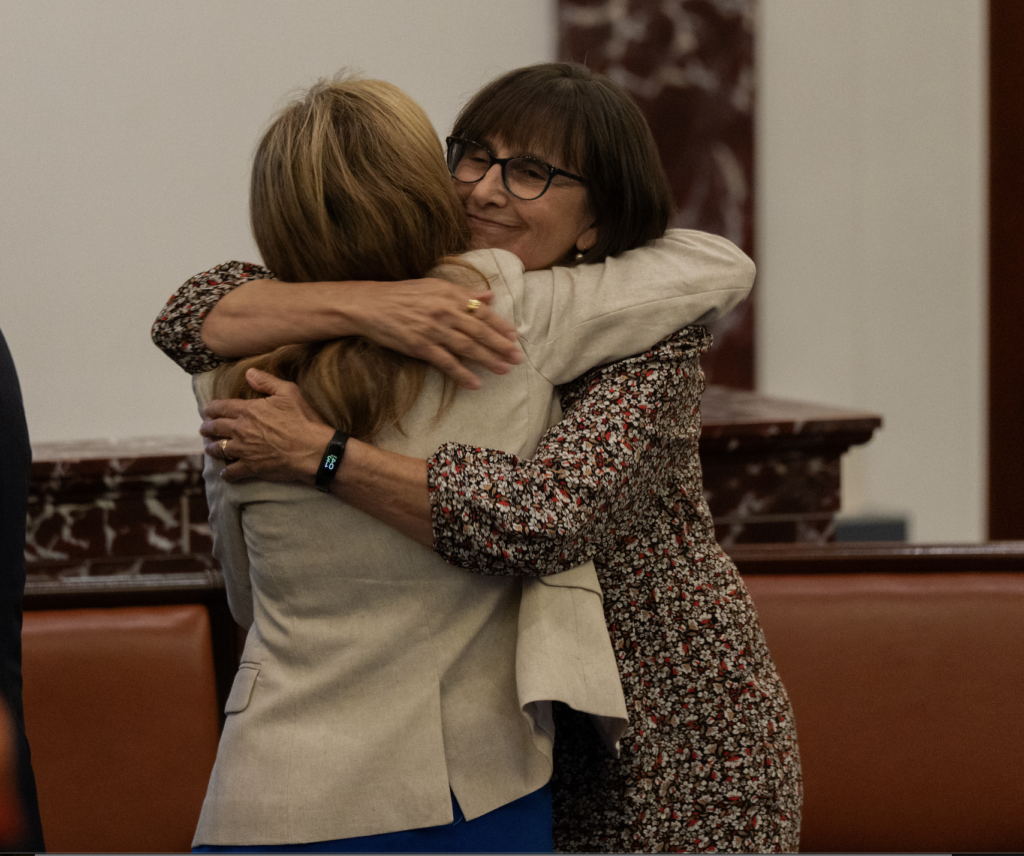
Two speakers, Christie Coombs and Cindy McGinty, embrace each other after the panel. Photo
by Qiyuan Wang
“We’re especially honored to commemorate this solemn anniversary in this space because it bears the name of a man who felt special, deep and abiding connection to the families who lost loved ones among them,” Kennedy said.
In the days following the attacks, Sen. Kennedy called nearly 177 Massachusetts families to provide comfort and ask how he could help.
Coombs, whose husband was aboard one of the planes that struck the towers, recalled receiving a phone call from Kennedy in the aftermath of the attacks.
“I remember he said, ‘I’m calling not as your senator first. I’m calling as a family member who understands what it’s like to experience a great loss, and I want you to know we’re here for you.’” Christy said. “It gave me a lot of solace knowing that going forward, … we had somebody we could call for that kind of help.”
Kennedy’s support extended beyond those initial calls; he and his staff also organized town halls and met with families from Massachusetts who lost loved ones in the attacks.
McGinty, a Foxborough resident whose husband was killed on Sept. 11, shared her struggles with the senator at one of the town halls.
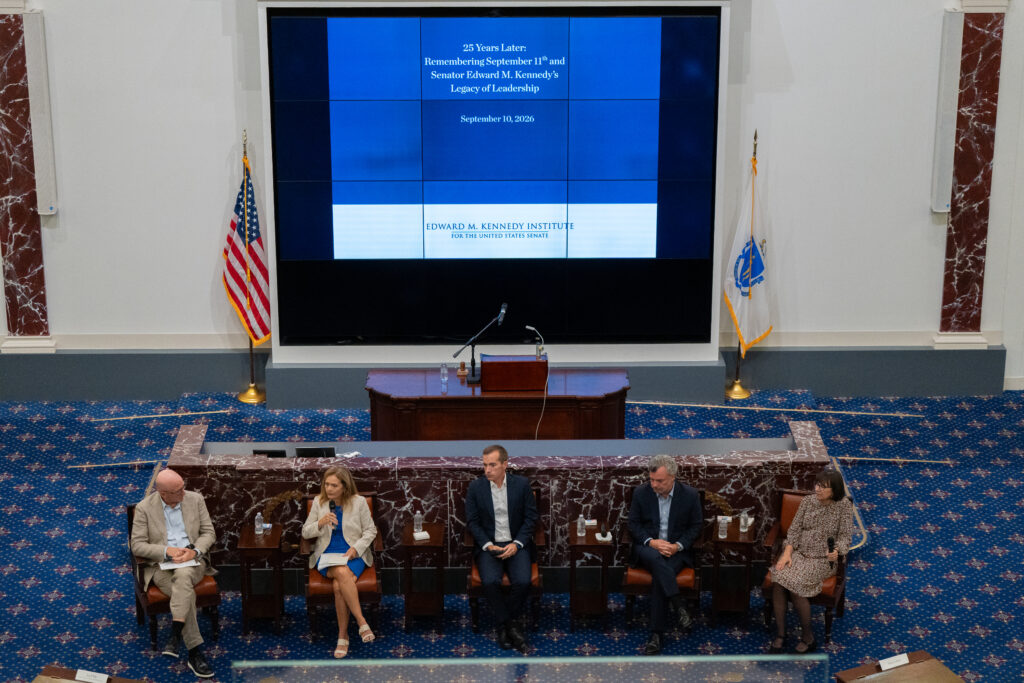
From Left, Charlie Rose (Senior Vice President and Dean of City Year), Christie Coombs, Tom Crohan (Vice President and Counsel, US Law and Government Relations at John Hancock and former Aide in Senator Kennedy’s office), Steve Kerrigan (President and CEO of the Edward M. Kennedy Community Health Center and former Political Director for Senator Kennedy), Cindy McGinty. Photo by Qiyuan Wang
“I stood up and said, ‘My husband died in the building, and nobody’s helping me. I have two traumatized kids at home, and every time I fill out a form through the Red Cross, they want a different form. I have to make copies of my driver’s license, a death certificate, which I don’t have, and they want birth certificates — and I can’t do it anymore.’” McGinty said.
Crohan said McGinty’s comments illustrated a problem that their office hadn’t anticipated: Although the State was offering help, navigating the systems themselves could become a burden for grieving families.
“If you have 25 agencies or organizations that are all offering help and are all sending mail to a mom just looking to take care of her kids, that mail is not going to get opened,” Crohan said. “And Cindy just put voice to that, and the room in which a leader listened.”
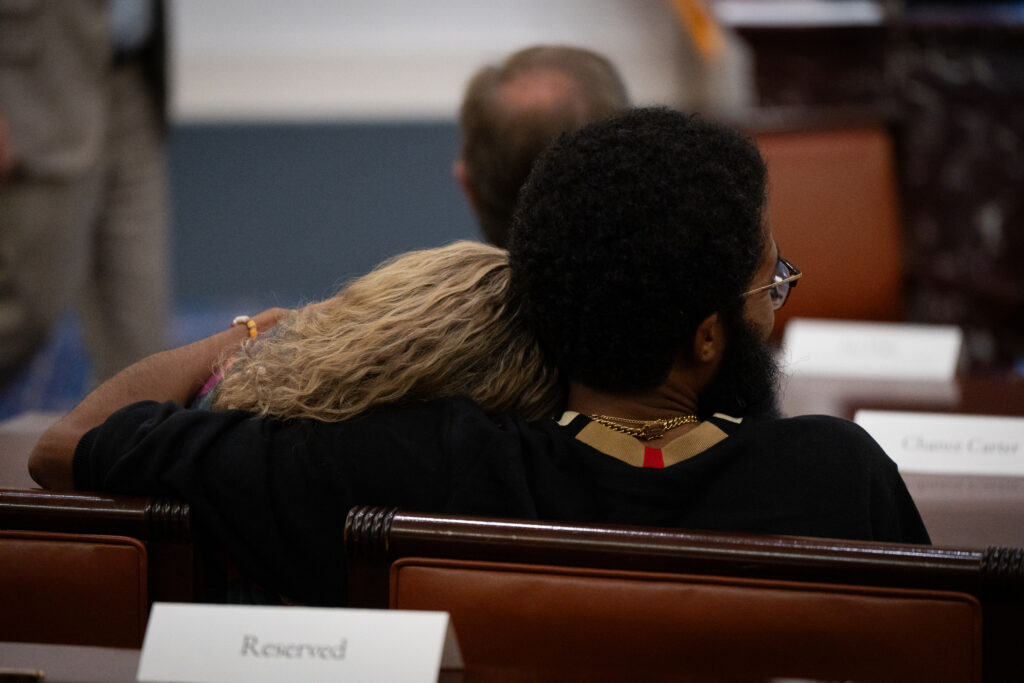
A tender embrace among audience members in the US Senate replica chamber. Photo by Qiyuan Wang
In response, Kennedy’s office created a system that paired Massachusetts families with trained social workers to support them with counseling, filling out forms or anything else they needed. Rather than navigating dozens of agencies themselves, families could turn toward the social worker as a single point of contact.
Coombs said being connected with a social worker as “an absolute lifesaver.”
“I’ve never in my life had to file for a death certificate before, and there were questions on there we couldn’t answer, and they did that for us,” Coombs said.
For Crohan, Kennedy’s response offered a lesson in what public service should look like.
He recalled, in November of 2001, McGinty sent the senator a letter thanking him and his office for their help — and mentioned Crohan by name. Sen. Kennedy later gave the letter to Crohan with a message on top: “Tom: it doesn’t get better than this.”
“He taught me as a young person that leadership was, at its core, about how you are showing up for people,” Crohan said. “And I don’t think there’s a better example of it than what Senator Kennedy did after September 11th.”
In an interview with the Dorchester Reporter, Victoria Kennedy said her late husband’s response offers a lesson for today’s political climate.
“We’re living in a time that feels that we’re divided, but I think there’s so much more that really unites us,” Kennedy said. “When he called those families, he didn’t ask whether they were Republicans or Democrats or independents; he was a person who understood grief and was reaching out to them in their grief.”
The message resonated with attendees. Ray Czwakiel, an attorney who attended the event, said the commemoration “hearkens back to a time when people were focused more on pulling together and cooperating.”
Chance Carter, 32, said he attended the event to support his friend who lost a family member in the Sept. 11 attacks.
Carter said he hopes younger generations remember not only the devastation of the attacks but also what people have done in the years since to honor those who died, including through the Sept. 11 National Day of Service.
“The ways in which people … have been able to take something so terrible, and make it into something that benefits not just other people but help keep the names and the spirits of the people that they lost alive is really crucial,” Carter said.
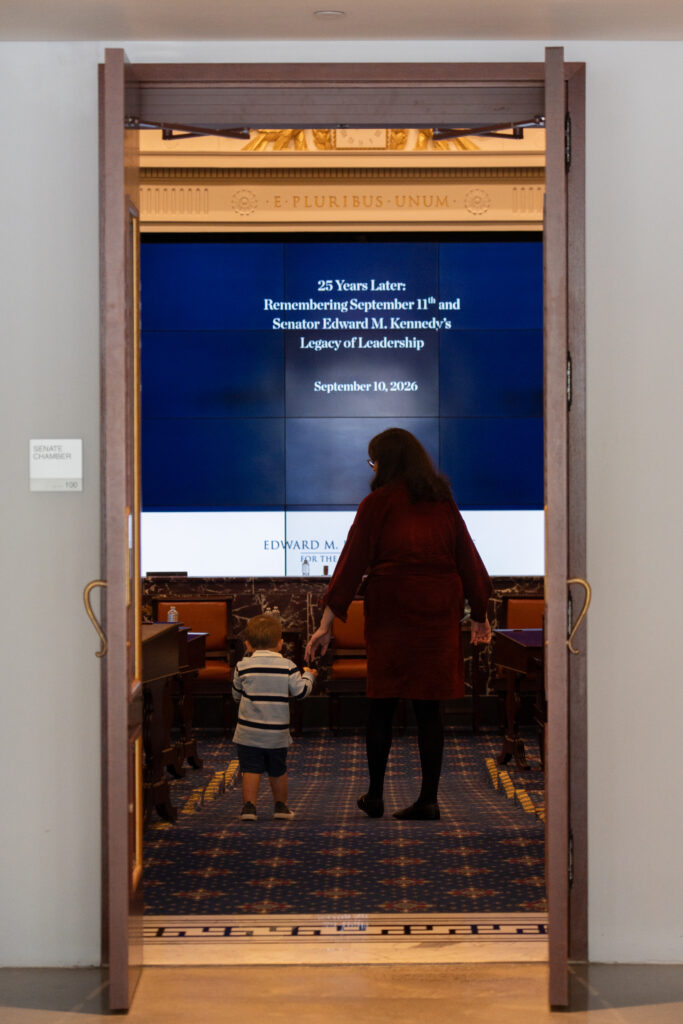
The youngest attendee of the event entered the replica US Senate chamber on Thursday, Sept. 10, 2026. Photo by Qiyuan Wang
Victoria Kennedy said turning Sept. 11 into a day of service and remembrance demonstrates that America is not “defeated by terrorism” and will continue to go and help others.
“If evildoers want to rip us apart … the best way we can counter that as citizens is to make sure that we’re united,” Kennedy said. “And we do that by seeing our commonality, by seeing that we’re part of the same community.”
This story is part of a partnership between the Dorchester Reporter and the Boston University Department of Journalism’s Newsroom program.
