By Chaplain Clementina M. Chéry
The Savannah African Art Museum shares a teaching associated with the Maasai people of East Africa titled “Kasserian Ingera,” translated as “How are the children?”
The hoped-for response is “Sepati Ingera”— or “The children are well.”
In recounting this greeting, the museum describes Maasai Chief Joseph ole Tipanko’s emphasis on the lives, health, and happiness of children. The message invites a profound question: What if we measured the health of our communities by how our children are doing?
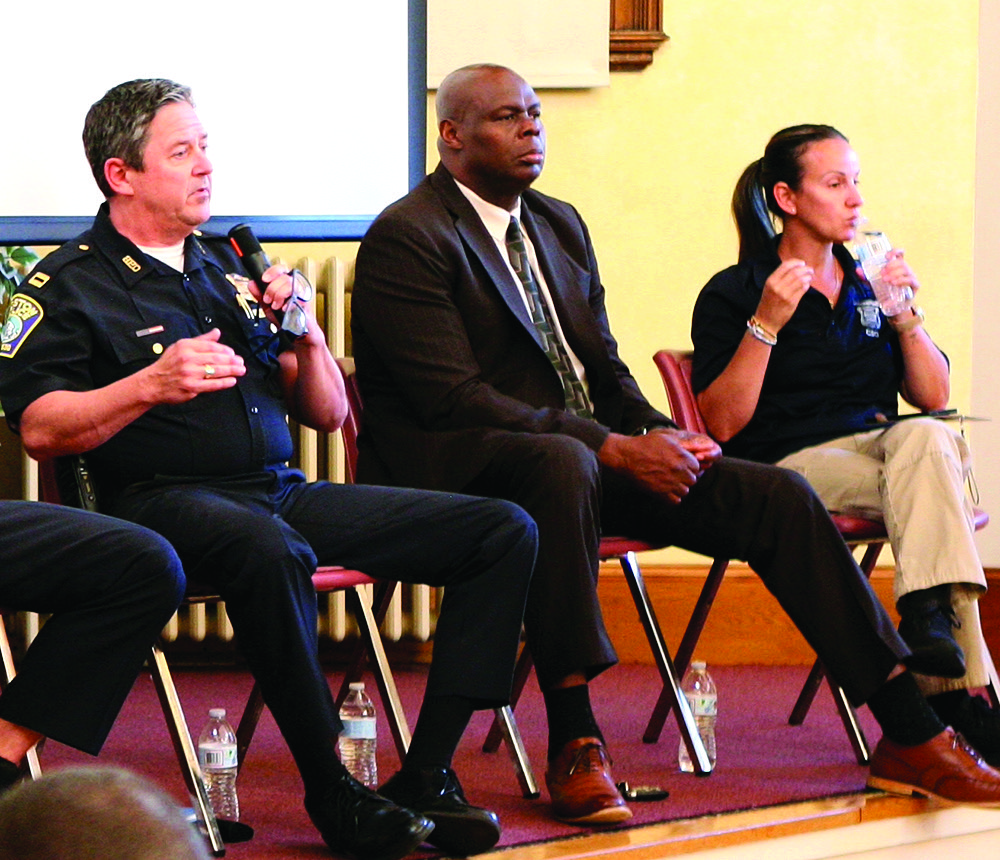
On Mon., Oct. 12, I walked through Fields Corner alongside young people, parents, elders, faith leaders, community members, and officers from Boston Police District C-11 in support of Heal Boston. What moved me was not simply seeing young people march for their future. It was seeing adults walk beside them: families, neighbors, faith leaders, and police officers sharing responsibility for our children.
As we walked, I thought about my son, Louis D. Brown. Louis was 15 when he was shot on Dec. 20, 1993, caught in crossfire after leaving home. He died the following day.
Louis believed in his generation. He believed young people could make a difference and help create a more peaceful world. More than three decades later, I carry that belief. I saw it alive in Heal Boston’s young people and the adults who refuse to give up on them.
I thank Officer Emmanuel “Manny” Dambreville, Mrs. Eleanor Forbes, the young people, families, mentors, faith leaders, and District C-11 members who joined this effort. Heal Boston’s mentoring, neighborhood service, family support, and efforts to build relationships among young people, police, and residents create opportunities for belonging and leadership. These are not merely activities to occupy children. They are investments in their lives.
Yet funding uncertainty threatens the continuity of community work like this. And so I ask: How are the children when programs offering support, mentorship, and opportunity must struggle to survive? Why do we wait until another child is killed, or another child takes a life, before we recognize the urgency of investing in young people?
When tragedy happens, we often ask where the parents were. We question a young person’s choices and point fingers at families and neighborhoods. We should also ask: Where were we, the adults? Where were our institutions, our resources, and our shared responsibility?
Primary prevention asks what we can do before someone is harmed. It means strengthening families, connecting children to caring adults, creating safe environments, and giving young people meaningful opportunities to grow and contribute. The Centers for Disease Control and Prevention identifies these approaches among its strategies for preventing youth violence. Prevention is not only about stopping something terrible; it is about making possible something good.
The financial case matters, too. Research highlighted by the CDC estimated that youth homicides and nonfatal assault injuries imposed an economic burden of approximately $122 billion nationwide in 2020, while the Washington State Institute for Public Policy found that some community mentoring programs can generate benefits exceeding their costs. Those findings show why prevention deserves serious, sustained investment.
Still, as a mother whose son was murdered, I know there are costs no economic model can fully capture. How do we calculate the cost of a mother burying her child? How do we measure the grief of siblings, grandparents, classmates, and neighbors, or the dreams a young person will never realize? We can estimate the economic burden of violence. We cannot put a price on a child’s life.
At the Louis D. Brown Peace Institute, our purpose is to transform society’s response to homicide while cultivating cycles of peace for this generation, and generations to come. For more than 30 years, we have walked alongside families living with murder, grief, trauma, and loss. We must care for survivors after violence while investing in the conditions that help prevent violence in the first place. Primary prevention should not have to compete with crisis response for survival. A community committed to public safety must invest in both.
I am reminded of Dr. Deborah Prothrow-Stith’s pioneering work treating violence as a public health issue. That approach calls for health professionals, educators, law enforcement, faith communities, families, and policymakers to work together. No single institution can do this alone. Our walk through Fields Corner showed what that shared responsibility looks like.
I invite our elected officials, businesses, philanthropic partners, faith communities, and neighbors to help sustain Heal Boston and other community organizations cultivating peace. Let our commitment be visible in our budgets, partnerships, policies, and actions, not just our words.
And how are the children?
Until the answer is that all our children are safe, supported, loved, and given opportunities to thrive, our work is not finished. Let us not wait for another funeral or another family’s heartbreak. Let us cultivate cycles of peace now, for this generation and generations to come, so that in the days and years and decades to come, our answer will be, the children are well.
The writer is the founder, president & CEO of the Louis D. Brown Peace Institute in Dorchester.
Copyright © 2026 Boston Neighborhood News, Inc. This content may not be re-published or re-used without written permission.