
Copyright © 2026 Boston Neighborhood News, Inc. This content may not be re-published or re-used without written permission.
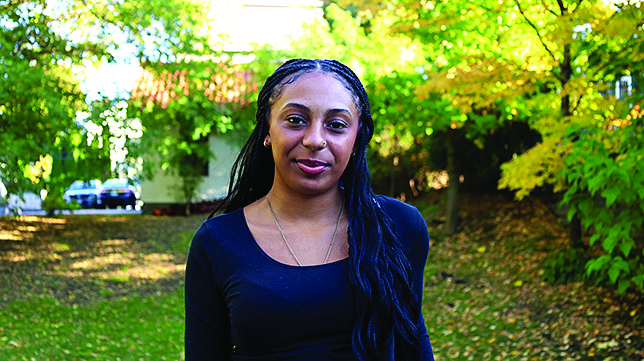
Selena Daley. Photo by Irene Yimmongkol
By Jack Schwed
When asked in high school to write an essay on an unexplored facet of her identity, Selena Daley naturally reflected on being mixed-race. Her father is Black, and her mother is Greek, but Daley said she presents as a fully Black woman, which makes her stand out on her mother’s side of the family.
“Especially for teen girls, identity is a hard thing,” she said, “and growing up being more than one race can be confusing sometimes.”
Daley, then a freshman in high school, received feedback on the essay from her teacher — a mixed-race woman — that reshaped how she saw her identity.
“I started to realize that this isn’t just my experience,” Daley said. “This is a universal experience for mixed women.”
She began looking into resources available for mixed-race individuals, only to discover that most were targeted toward the parents of mixed-race children. So, last November, Daley founded SisterBridge, a nonprofit organization dedicated to fostering a supportive community for mixed-race teenage girls.
The 16-year-old Brighton resident, a student at Buckingham Browne & Nichols School in Cambridge, has since expanded the SisterBridge collective to more than 100 members worldwide, launched a mentorship program, hosted educational talks at schools across Massachusetts and organized multiple widely attended community-focused events.
She could not have done all of this alone, she said. “I’m so grateful for this amazing team, and I think SisterBridge would not be where it is today if we didn’t have them,” she said.
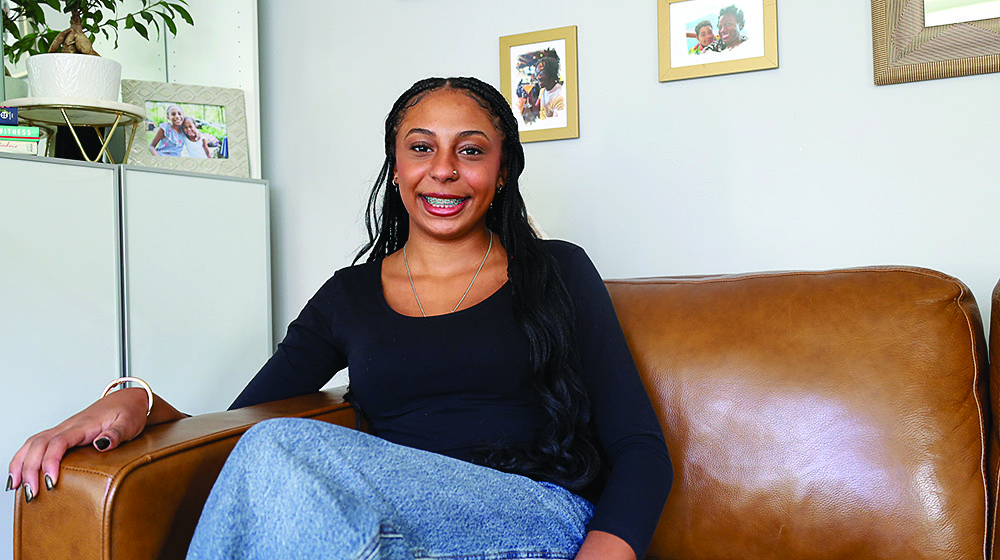
Selena Daley of SisterBridge “It’s something that has grown from just an idea from an essay I had to something that’s a real passion of mine,” she said. “I’m really proud of us.” Photo by Irene Yimmongko
The search for team members began right after the founding, when Daley launched SisterBridge’s TikTok and Instagram accounts to encourage viewers to join the organization. Less than two weeks later, she said, a 20-member board was in place.
Liya Tilahun, a founding member and the design editor for SisterBridge, said six board members, including herself and Daley, attend BB&N.
At a conference held by the school’s Diversity, Equity, Inclusion, and Global Education office, Tilahun gave a presentation to students in grades 5 through 8, discussing colorism, its pervasiveness in various cultures, and how to help erase it in media and society.
Throughout her life, Tilahun said, she has often felt alone as a mixed-race girl at predominantly white schools.
“I imagine myself in their shoes,” she said. “I could have never imagined that for myself at their age, and it’s really nice to see that for them.”
Daley held several of these talks in March of this year at other schools across Massachusetts, including the Atrium School in Watertown and the Croft School in South End. Tilahun said she has more talks planned soon at schools in the Cambridge area.
Not all of SisterBridge’s members are from Massachusetts. Daley said the collective spans nationwide — from New York to California — and internationally, with members from both England and France.
Sydney Woods, a founding member and production editor for SisterBridge, is from southern Connecticut. When she, the daughter of a Black father and white mother, came across the SisterBridge TikTok account, a post of Daley telling her story resonated with her.
“I just really connected with that and what she was trying to do because I felt I had no role models when I was growing up,” Woods said. “I really wanted to get involved and make a pathway for girls, younger girls like us, to feel connected to other people.”
Woods said she grew up in a predominantly Black neighborhood, where she was made fun of for being half white. SisterBridge gave her a platform to push back against this stigma, and she hopes it empowers younger mixed-race girls to do the same.
“A lot of the younger girls growing up having SisterBridge will be able to … fight back against society’s ideals of fitting in one box and be able to branch out and hopefully … change people’s ideas of how they’re supposed to be,” she said.
Despite the distance between her and other board members, Woods said she has connected with them through their weekly virtual meetings. “Right away, I feel like we all clicked, like we had all known each other for years.”
Then came the opportunity to meet them in person.
In June, Woods made a two-and-a-half-hour trip up to Massachusetts for “Hair University,” which drew more than 150 attendees and brought together 13 local hair salons at the Cambridge Community Center to demonstrate different hairstyles, instruction needed, says Daley, since mixed-race girls often grow up not knowing how to do their hair.
Woods said there was a line out the door when she arrived. “It felt great that people were excited and eager to take from the community and what they have to offer,” she said.
By no means was this the only time SisterBridge gave back to the community.
In September, SisterBridge organized a “free thrift store,” where anyone could come and grab clothing, furniture, books and toys. Daley said three brands provided public relations packages for the event after she reached out over social media, and the Boston Public Library donated books and magazines.
For those girls living beyond Massachusetts, there are still plenty of opportunities. Woods and Tilahun oversee the SisterBridge blog on Substack, where members can apply to submit writing or artwork related to their experiences as mixed-race women.
The organization also recently launched a mentorship program, pairing mixed-race girls, ages 8 to 18, with older women who share all or part of their racial background.
While preparing for SisterBridge’s launch, Daley said she received a technology grant from her school, in partnership with the city of Cambridge, which she used to develop the organization’s website and conduct background checks on the mentors.
“We’ve been working hard at that, and we’re hoping to launch our first cohort by the end of the year,” she said.
As SisterBridge approaches its first anniversary in November, Daley looks back at the team’s accomplishments with pride.
“It’s something that has grown from just an idea from an essay I had to something that’s a real passion of mine,” she said. “I’m really proud of us.”
This story is the product of a partnership between the Dorchester Reporter and the Boston University Department of Journalism’s Newsroom program.
Copyright © 2026 Boston Neighborhood News, Inc. This content may not be re-published or re-used without written permission.
