
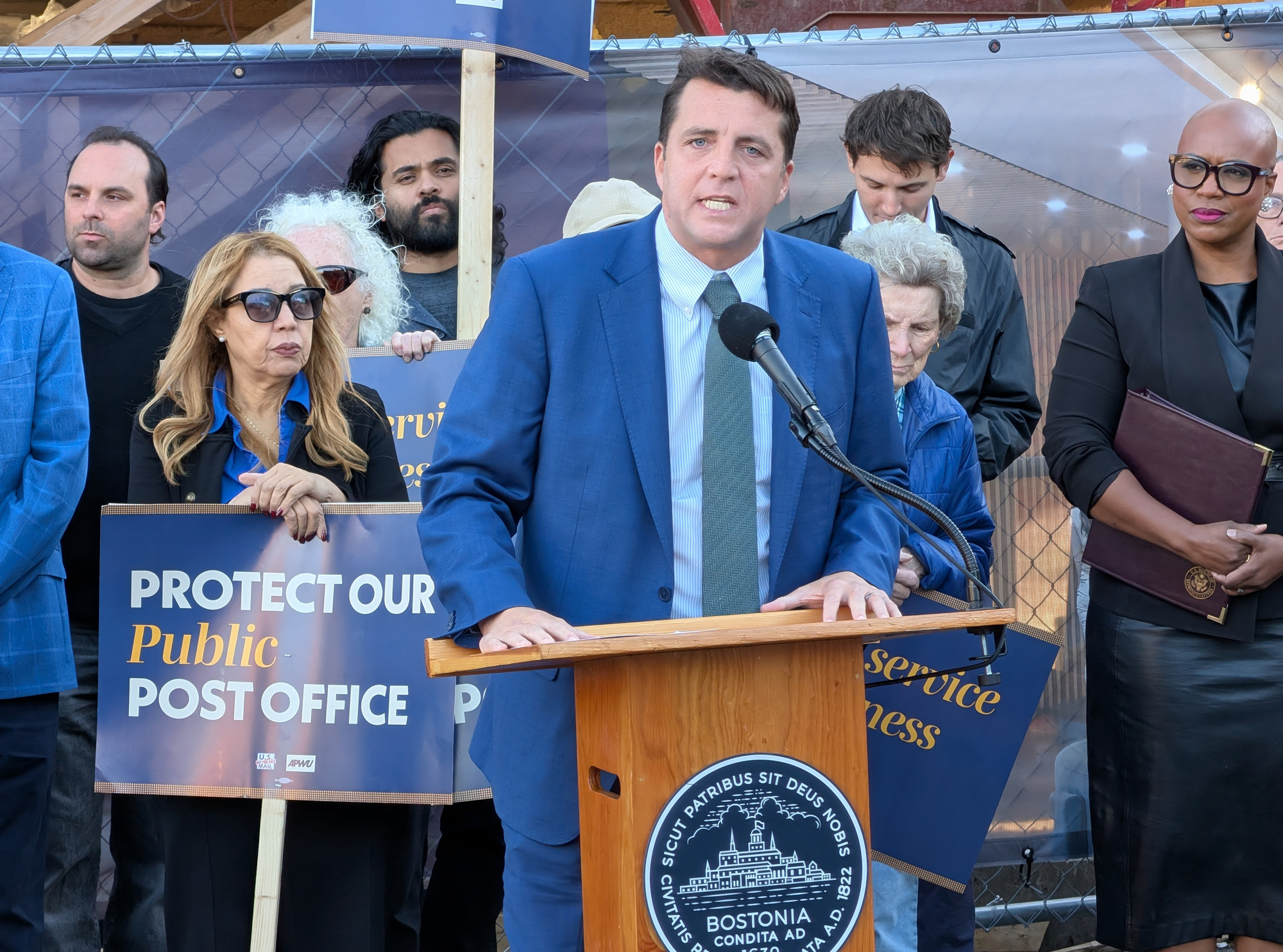
Above: City Councillor Brian Worrell spoke to reporters during a Monday press conference outside of the Roxbury branch of the Boston Public Library. Yawu Miller photo
Two people were killed and several others wounded in a flurry of night-time shootings in Roxbury and Dorchester during the late hours of Sat., July 4, and the early morning of Sun., July 5. The violence sparked a range of reactions from elected leaders, some of whom are calling for more police officers to reinforce the ranks, while others say more resources should go to other anti-violence workers.
The holiday weekend outbreak was preceded by a tactical deployment that has become a summertime ritual in Dorchester: The nighttime closure of several key roadways near Harambee and Franklin parks, which had become popular outdoor gathering spots for revelers. In 2020, Boston Police began closing certain streets— Circuit Drive, Talbot Avenue, and Old Road, for instance— as a tactic to prevent loud, late-night disturbances.
This year’s road closures started last Thursday night at 10 p.m. and will continue on weekends through September, according to a Boston Police memo shared with The Reporter.
And while the immediate Franklin Park and Franklin Field areas were relative crime-free last weekend, other parts of the city were marred by gunfire and its bloody aftermath.
Six people were shot and one killed on George Street near Clifford Park in Roxbury around 3 a.m. on Sunday as a large group watched an illicit fireworks display. Earlier, in Grove Hall, one person was killed and three others injured near 500 Blue Hill Ave., in the area of Castlegate Road. In addition to the two deaths, police were investigating shootings on Fayston Street, Horadan Way, and Draper Street.
The rash of gun violence rattled neighbors and led to calls for a response from different quarters of government. On Monday, Councillors Brian Worrell and Miniard Culpepper called a Nubian Square press conference that included Minister Randy Muhammad of the Nation of Islam. Together, they told reporters that while the city’s police department and Trauma Response Team are doing necessary work, more needs to be done to prevent violence before it happens.
“There’s a lot of money thrown for the police and different aspects of this work,” Muhammad said. “A lot of it comes after the fact. After someone has been shot, after someone has been stabbed, after someone has been murdered, but there’s very little to no funding or support for those organizations and people that are out there night and day, doing this work in a proactive way.”
The speakers at the Monday press conference highlighted the difference in approach between community advocates calling for violence prevention and those who are advocating for more police hires or overtime.
In May and June, a debate over public safety strategy made its way into City Hall, with councillors arguing for more funding for violence prevention.
“We think that city is safe, but we know we’re going to have some challenges this summer,” said Culpepper. “We prepare for the challenges. That’s why when we passed that budget, we made sure that youth [jobs] were fully funded this summer.”
The council in June amended Wu’s budget, restoring $11.8 million to youth jobs and community-based programs that were cut in her 2026-2027 plan.
In May, Wu announced her summer safety strategy, one that included teen-focused events held on Friday nights, enhanced trauma response after incidents of violence and more funding for summer jobs.
Steve Wilson, who heads the Ella J. Baker House in Dorchester, stressed the importance of including community members in the planning for anti-violence efforts.
“You can’t make decisions about a city without asking the people in the community,” he said. “And it’s getting old, and we have to stop doing that in the city of Boston.”
As violent crime rates have plummeted to less than half what they were 20 years ago, the city has pulled back from select anti-violence programs, including cuts in 2022 to its street workers program, which in past years employed teams of youth workers to intervene in disputes and offer teens alternatives to violence.
Many of the speakers at Culpepper and Worrell’s press conference referenced the work of groups that are continuing that approach to violence prevention, albeit without funding or support from the city. Muhammad cited the work of his group, 10,000 Fearless Peacemakers, which includes members of the Nation of Islam and other anti-violence activists. His mosque also operates a hotline (1 (833-4 NO SMOKE) through which members engage in conflict mediation.
Muhammad and others said police were necessary to help hold people accountable for crimes committed. “We work closely together,” Muhammad said of the police. “However, we have to work to prevent the crime. We’ve got to stop the next shooting.”
Larry Calderone, the president of the Boston Police Patrolmen’s Association, says police are overwhelmed and need more officers added to the ranks. BPD Commissioner Michael Cox has stopped short of such a recommendation.
Culpepper, asked if more police officers are needed, responded: “I leave that to Commissioner Cox.”
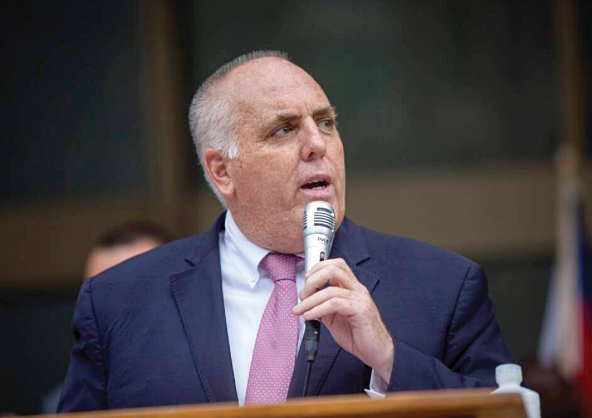
In a July 5 letter, Councillor Ed Flynn (above) wrote to Cox calling for a new public safety strategy that includes a major increase in police hiring. “Many people were shot last night in Boston,” he noted, and argued that “we need a new, comprehensive public safety plan that includes hiring hundreds of officers every year.”
He described BPD staffing as a citywide problem, writing: “Staffing levels are dangerously low. Shifts are not filled, impacting public safety in every Boston neighborhood.”
Wu, pressed on the question by reporters on Monday, said her administration had “added hundreds more officers to the force.”
“We have had great success recruiting and training and onboarding many of our officers,” Wu said. “Over the last few years since our administration started, we have had the largest ever of these classes graduate from the academy.
“Our officers and their families,” she said, “have signed up for a level of service that is not just putting their lives at risk, but a commitment of time during the summer, during holidays.”
On Monday, Worrell stressed the importance of community-based efforts at stemming violence, noting that activists engaged in that work were the impetus behind the Nubian Square press conference.
“They wanted to take back their neighborhood,” he said of the activists. “They wanted to take back the safety of their families, of their sons, and their children. And that’s why we’re standing here today. So enough is enough. It needs to be everyone at the table to make sure that the plans that we have for summer safety and a summer of peace are centered not only around the people of City Hall, but every community member here.”
Reporter editor Bill Forry, correspondent Yawu Miller, and Gage Vieno, a Reporter newsroom fellow, contributed to this report.
