
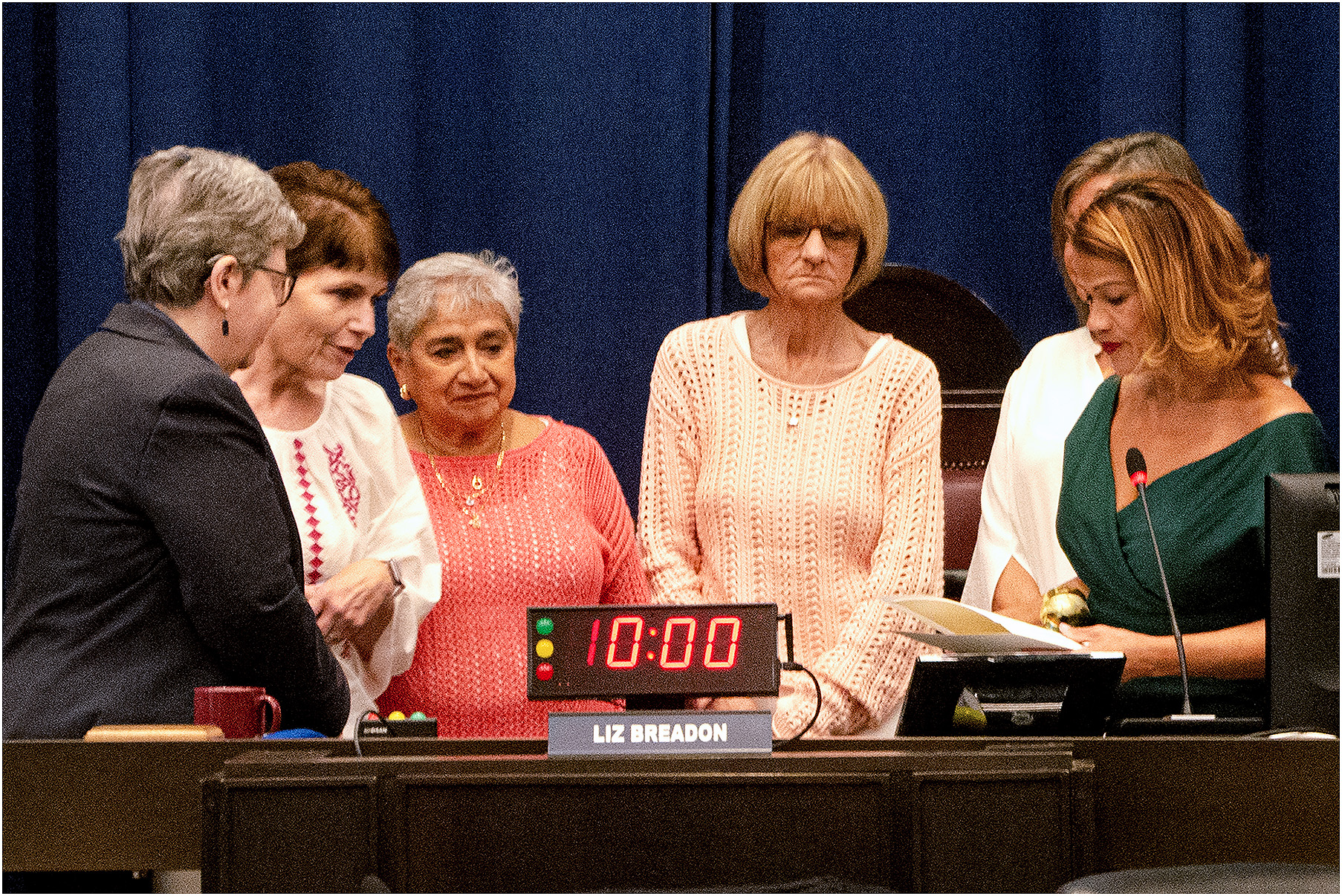
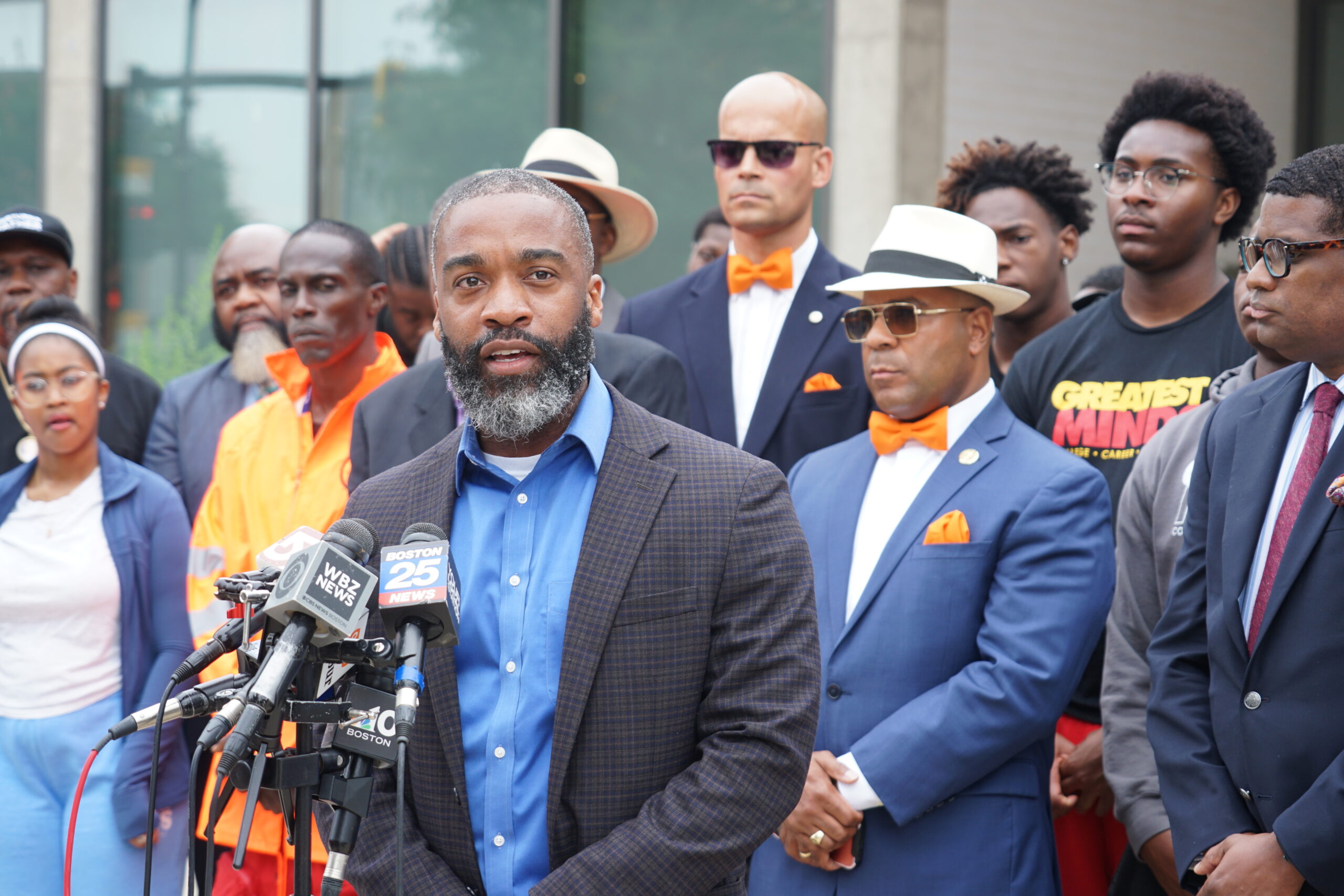
Above: BPS paraprofessionals at a June 3 council meeting, flanked by City Council President Liz Breadon, left, and Councillor Julia Mejia, right. Chris Lovett photo
To disentangle weeks of anguished complexity over the city budget for FY27, all it took was Boston’s outbreak of World Cup Soccer fever.
As District 7 (Roxbury) City Councillor Miniard Culpepper reminded his colleagues at a meeting on June 24, Boston’s prowess in pubs and beer had just been sorely tested by a bibulous influx of Scottish soccer fans, upsetting the familiar balance between supply and demand.
“When bars run out of beer. I mean, it’s not funny,” Culpepper mused. “I think it’s really sad that we are cutting paraprofessionals and teachers. Bars are running out of beer. The conversation about how we responsibly grow and diversify city revenue in a changing fiscal environment must begin now.”
At the same meeting, the council punctuated the conversation with the procedural stop of a motionless action. After five years of being equipped with additional budget powers granted by voters, the body could only manage limited changes, amid higher expectations for its clout and diminished forecasts for growth in tax revenue.
In the 2021 city election, voters approved a charter amendment that allowed the council to change budgets filed by the mayor, but without an increase in total spending. Any added spending had to be equaled by subtractions or “pulls” from other items. Previously, the council could only act on the budget in bulk, by approving without new spending, or rejecting—in the hope that the mayor would send it back with revisions.
Five years ago, Boston’s tax base was still surging, despite the pandemic, thanks to work in progress on new housing and commercial space. In FY26, which ended on June 30, the city reported that growth in tax revenue from new development had dropped from the previous year by one-third. For the first time in at least nine years, the new revenue figure was lower than the standard 2.5 percent annual levy increase.
Not foreseen when the charter change was advocated by the Better Budget Alliance (BBA) was how the growth would shrink, as well as how the mayor and the council would face increasing pressure to avoid spending cuts. Even less apparent was how councillors pinpointing budget “pulls” would get information from mayors whose spending plans might be contested.
At the council meeting on May 20, the previous chair of the Ways & Means Committee, District 4 (Dorchester/Mattapan) Councillor Brian Worrell, led an effort to reject the budget filed by the mayor in April. Worrell argued that the move could result in more concessions by the mayor’s administration, possibly based on more generous revenue projections. But Worrell’s motion gained only six votes, one less than needed for passage, and a near copy of the contentious vote for council presidency in January.
The current Ways & Means chair, District 6 (West Roxbury/Jamaica Plain) Councillor Ben Weber, maintained in a June 29 interview that, even after May 20, some of his colleagues wanted spending changes that would make rejection more likely.
“Whereas, in prior years, I thought we were all working together to try to make the package as good as possible,” he said, “this time, it did seem like, even after our rejection vote, that some people were trying to eliminate sources of funding or make it so impossible to work, so that rejection would be our only way forward.”
Weber tried to have a vote on the budget with amendments by his committee on June 3, but the move was tabled. At a working session two days earlier, additional changes had been suggested by the committee’s vice chair, District 3 (Dorchester) Councillor John FitzGerald. At the council meeting on June 10, his package of amendments—incorporating changes sought by some councillors who had previously voted for rejection–was merged with the package further revised under Weber.
Weber says that “almost all” of what the council approved on June 10 was in his original package, but he acknowledged the difference between a near-deadlock on May 20 and approval three weeks later by a numerically veto-proof count of 12-1. “It did seem like it made a difference,” he said. “Any way we could come together, that’s how we’re going to accomplish more as a body, so I was for it.”
A week later, Mayor Michelle Wu sent the council a letter agreeing with almost all of the changes approved on June 10. Not as lengthy as the culminating budget action two years ago, this year’s decisive meeting was marked by a two-hour disruption that temporarily converted the give-and-take of procedure in the council chamber into a non-violent show of force, staged by protesters and uniformed security.
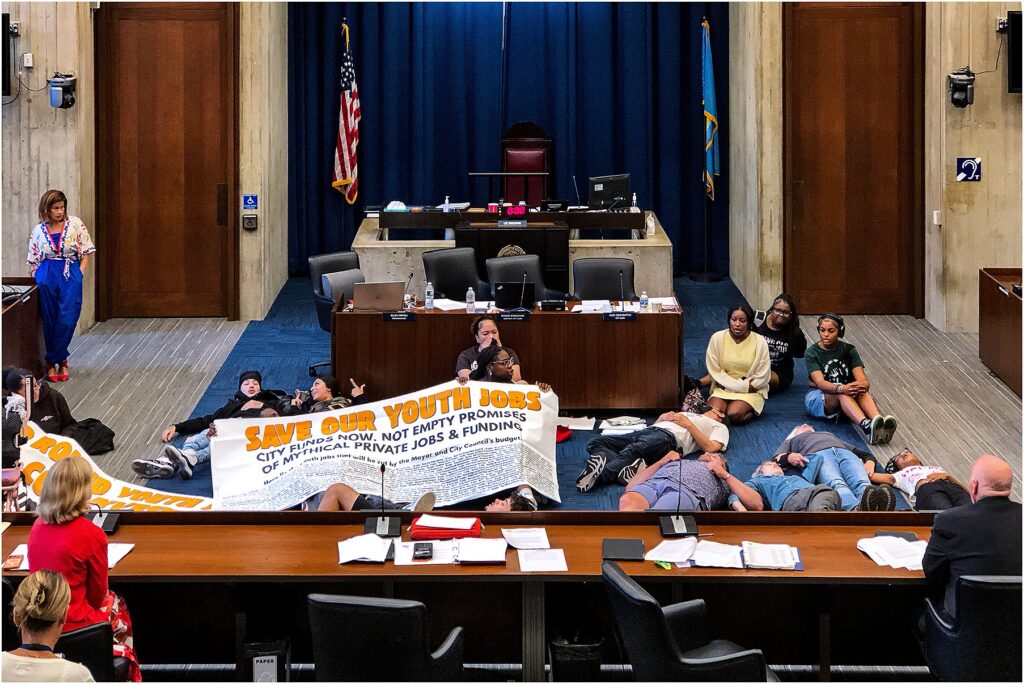
Protesters interrupted the proceedings at a June 10 council meeting. Several were arrested. Chris Lovett photo
Nine days after the meeting, former city councillor Larry DiCara said that his successors had been bullied—a view they did not express publicly. But, even after the protest, its most visible ally in the chamber, Councillor-At-Large Julia Mejia, insisted that the body could have done more to offset budget cuts, a view seconded later, near the end of the meeting, by Worrell.
“Time and time again,” said Worrell, “we hear the same message: ‘There’s no money, it’s going to get worse, do not ask for more, do not expect more, and don’t even imagine more.’ But, in one of the wealthiest cities in the country, with a $4.9 billion budget, nearly $2 billion in reserves, and a track record of collecting more than $200 million above projected revenue, I have to ask, who says there’s no money?”
The council’s amendments, as summarized by Weber on June 24, totaled $11.52 million, or slightly more than 0.2 percent of the $4.9 billion operating budget. At an earlier stage, he hailed the amount for being greater than similar amendments pushed by the council in recent years. On June 24, the council ended up following Weber’s recommendation of non-action, which allowed the changes on June 10 to take effect, along with the mayor’s one alteration.
“This budget restores cuts, maybe not at the level I would have liked to see them,” Culpepper said at the meeting, “but it does restore cuts that never should have been cut in the first place.”
Other councillors expressed frustration about cuts that were not reversed, especially in the Boston Public Schools (BPS) budget, and difficulties with getting accurate and up-to-date information on spending. One difficulty factored in a $1.4 million “pull” from “personnel services” in the Boston Transportation Dept. (BTD) that was advanced by FitzGerald only to be flagged by the mayor’s administration as potentially causing layoffs and reducing services.
As detailed by her letter, Wu only transposed the same “pull” amount to BTD’s contractual services. It was a small difference, but enough to put some councillors on the spot.
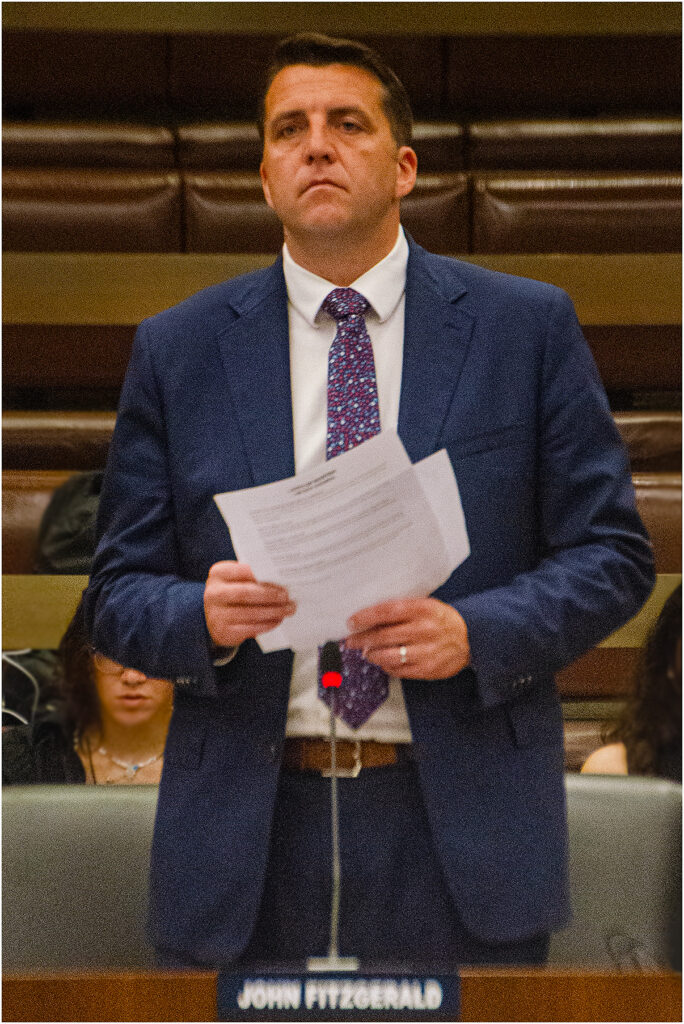
“As folks know,” FitzGerald (above) said at the June 24 meeting, “we work with the administration to figure out [budget changes], and this was a line item and a number that was given to us so that we could absorb this cut. So I was rather surprised last week when it came back with the modification, having thought we’d worked out an agreement with the administration, but I was told that there was an internal miscalculation and that it would result in layoffs.”
According to Weber, the council’s budget action requires “a lot of guesswork” because spending information for the previous fiscal year isn’t known in full until the deadline for passing the next year’s budget.
“Sometimes departments don’t get around to spending that money until the end of the fiscal year,” he explained, “which is why a lot of discussion has to take place between the City Council and these departments so we understand what the real impact would be from decreases of these line items. I don’t think we can get a good sense of that without speaking to the individual department heads.”
Even as early as the June 3 meeting, some councillors were calling for steps to change the flow of information and even leverage over spending. Near the end of the meeting, Mejia filed an order for the new budget powers to be reviewed and defined at a committee hearing.
“The process is flawed,” she said when introducing the order. “The 2021 charter amendment changed Boston’s budget process by establishing shared budget authority between the mayor and the City Council and granting the City Council the power to adopt, amend, or reject the budget. But, as we continue implementing those reforms, I believe it’s important to examine their intent and how they function in actual practice.”
That was followed by support from FitzGerald, one of the measure’s co-sponsors.
“I think one thing we’ve learned through this process in having these powers that we’ve gone through [during] the years is the process is flawed,” he said. “It is a good time, after five years, for looking at this like any business would do. You do a review of past practices and see where you can look to improve them. I don’t think we’re getting the result we want out of this, essentially.”
During the same meeting, Worrell filed an ordinance that would require the mayor’s administration to provide the body with quarterly reports on revenue, in addition to the current requirement for updates on spending. He said the measure would codify what had been the practice while he was the Ways & Means Committee’s chair.
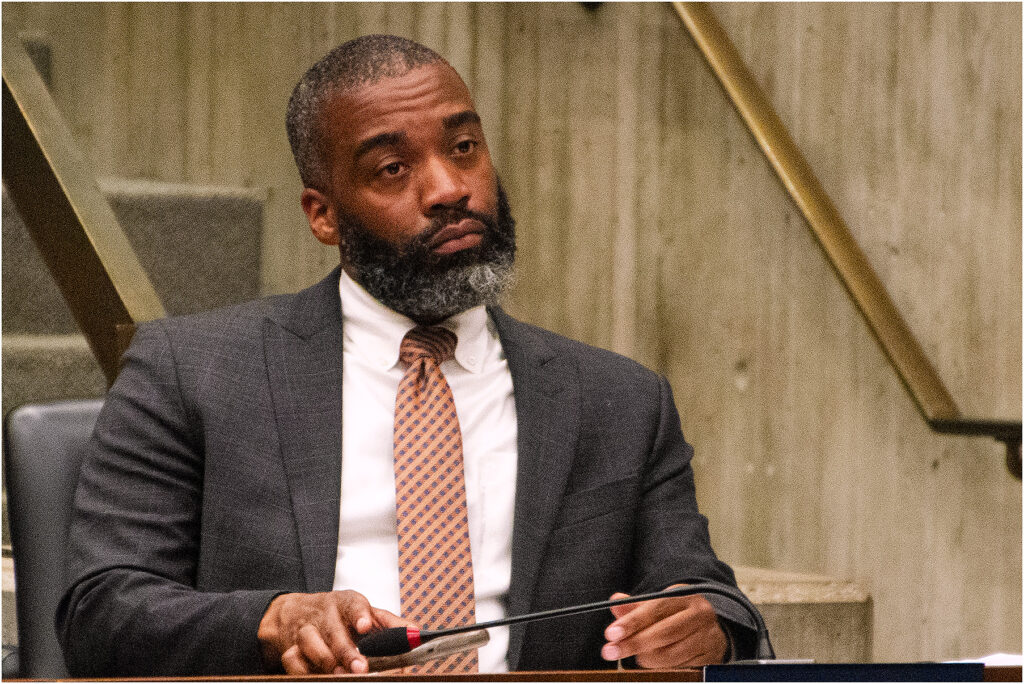
“If we are going to have budget conversations and advocate for the budget, I think this is best practice: that expenditures and revenue is part of the conversation, and the data around both expenditures and revenue is presented from the administration in a timely manner.” Worrell (above) argued, reminding councillors that revenue had been “consistently under-forecasted” for many years.
Unspent money in city budgets was among several concerns raised in a June 10 report from the Boston Finance Commission. “These funds are not generally acknowledged during discussions with departments in the following budget cycle,” the FinCom observed. “Unspent funds should be publicly reported, by department, and considered when creating a following year budget request.”
Before property tax increases were capped by passage of “Proposition 2½” in 1980, any desire by mayors and councillors to boost spending could be tempered by pushback from voters, as evidenced during the late 1970s. Four decades later, the charter amendment of 2021 created new incentives—for readjusting the balance of budget power in Boston’s “strong mayor” form of government.
“Sure, that’s democracy at work, but I think the council as a body, as an institution, is having trouble adjusting to the new set of rules,” DiCara surmised. “And by the way, I’m a really smart guy. I read the ‘Better Budget’ referendum a bunch of times. I didn’t know exactly what it meant, and I’m not so sure if a whole bunch of people do. It doesn’t mean they’re bad people. They’re not Supreme Court lawyers, but I’m not so sure that all the effort is worth the end result.”
The FinCom recommendations ranged from ideas for new revenue to possible savings through consolidation and independent audits of all city departments every five-to-seven years. “Auditing city functions can show where taxpayer dollars are having their greatest impact or where policies need to be revised,” the report suggested. “Audits should not be seen or used as a weapon but as a learning tool to manage municipal funds at optimum capacity.”
The first concern raised by the FinCom report was the decrease in tax revenue from commercial property—a problem in many cities. In Boston, the underlying shift in real estate values has increased the share of the tax burden for residential property owners, a tilt that could be tipped further by abatement requests and a pending legal challenge.
Over the past few years, as the FinCom highlighted, the slowdown in the city’s revenue growth has been accompanied by a smaller share of its revenue from “non-recurring” sources beyond the property tax base. “That’s not enough to pay our increasing obligations,” DiCara said, “either to employees with collective bargaining agreements, or to pensions or health insurance.”
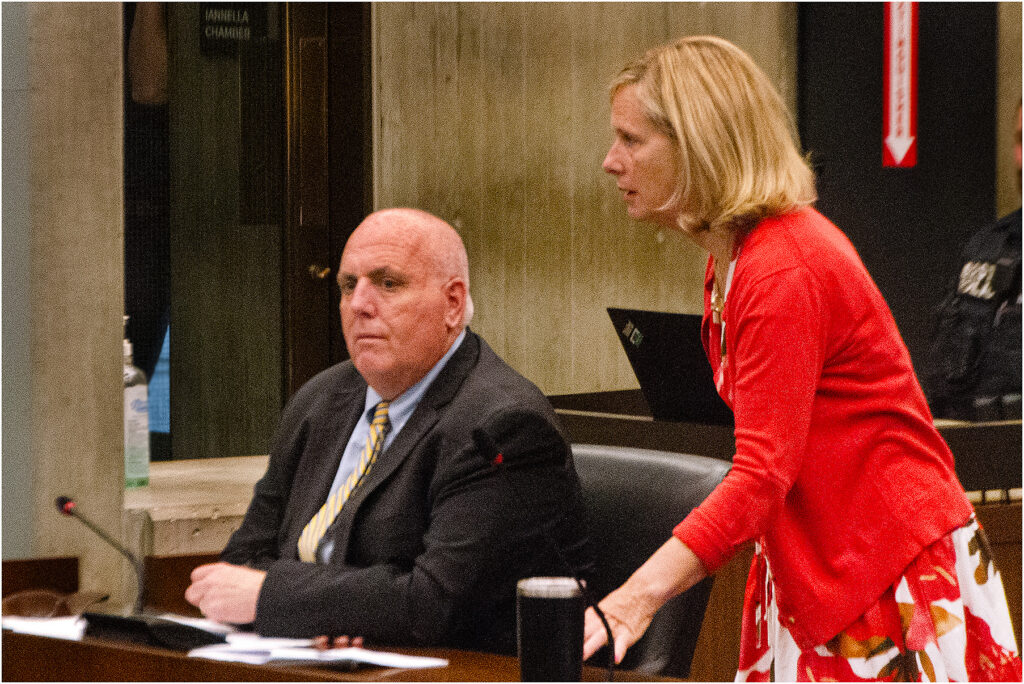
Councillors Flynn and Murphy during a June 23, 2026 budget discussion. Chris Lovett photo
Looking back on the budget process, Weber concluded, “I took away that we are entering sort of a different economic climate where, despite being able to raise revenue up to the sort of upper limits of what we’re allowed to do, it’s no longer keeping pace with increased costs, like for health insurance. And that, whereas in recent years it was more of what good things are we going to fund, now, it’s become more of what good things can we save in the budget process.”
The council has even less control over the BPS, whose FY27 budget trimmed as many as 400 positions for teachers and paraprofessionals—at a time of declining enrollment and school closings. Unlike with the city’s operating budget, itemized changes in BPS spending would have to be approved by the Boston School Committee, whose members are appointed by the mayor. But that did not rule out a show of support for paraprofessionals arranged by Mejia at the beginning of council’s meeting on June 3.
In the same 2021 election that approved the binding referendum on the council’s budget power, almost 79 percent of the voters also approved an advisory question that called for restoring an elected school committee. In a non-binding 1989 referendum, a narrow plurality of voters had favored the switch to an appointed committee that would be officialized in 1990 with support from the City Council and former mayor Ray Flynn.
Though Boston voters endorsed the switch in later ballot measures, the 2021 vote followed conspicuous blunders by committee appointees. One resigned in 2020 after making fun of Asian names during a high-profile meeting on exam school admissions policy. Two other members resigned in 2021, after revelations of text messages exchanged during the same meeting that disparaged white parents from West Roxbury.
Though an all-white committee elected at-large was found legally at fault for racial segregation in the BPS in 1974, the switch to district representation, starting in 1983, made the committee even more racially balanced. That did not prevent criticism, a few years later, faulting the committee for multiple BPS problems, including the dropout rate and shortcomings in special education. But the alternative of an appointed committee would also be denounced as disenfranchisement of the city’s increasingly diverse electorate.
The debate over BPS governance goes back more than a century, with calls for control to be more centralized or decentralized. An extensive 1944 report commissioned by the FinCom and headed by Dr. George D. Strayer called for abolishing the at-large elected school committee. In its place would be members nominated by a district body for appointment by the mayor, with more control over the schools consolidated in a top administrator.
The “Strayer Report” called the elected body a “proving ground for the politically ambitious,” with voters choosing from as many as 22 candidates. As emphasized in a banner front-page headline in The Boston Globe, the reformers summed up the school system as being “run by politics and riddled by favoritism.”
Six decades later, the BPS is relying even more on resources outside the city’s tax base—from other public funding to collaboration with the private, institutional, and philanthropic sectors. As a candidate for mayor in 2021, Wu favored a school committee that would be partly elected. But she later changed her position to favor sticking with an appointed committee, foreshadowing a similar repositioning late last year by New York City’s recently elected mayor, Zohran Mamdani.
When the City Council approved a home rule petition that called for replacing the appointed committee, Wu refused to sign her approval in February 2023. In her letter of explanation, she mentioned progress in the BPS under Superintendent Mary Skipper, but also partnerships with other sectors.
The move for reform in the 1944 report was denounced by its opponents as a power grab by a “lace curtain element” and the “intelligentsia.” One outspoken opponent was a member of the School Committee, Clement Norton, also known as a bookish confidant of the colorful former Boston mayor, John F. Fitzgerald. Norton acknowledged difficulties with getting information for decisions about the BPS budget. But, speaking four months after Allied forces had stormed the beaches at Normandy, he invoked fresh memories of wartime sacrifice—and alcohol deprivation.
“Only a fool would deny that the Boston system has many weaknesses,” Norton railed, according to the Globe. “Discussing only one phase of the report, the Strayer group would take from the people the right to elect members of the committee and would allow a ladies’ club and other groups to nominate them. Is this democracy? Is this what the boys fought for? Will an attempt be made to push through this legislation while the boys are away, like prohibition?”
