
Above: Residents attended an open house held at Kay’s Lounge on Blue Hill Avenue and hosted by Boston Transportation Department (BTD) officials, the MBTA, and other planners in July 2022. Seth Daniel photo
One oft-repeated complaint made about the stuck-in-neutral Blue Hill Avenue improvement project is that there hasn’t been enough public input into the $135 million plan. But that refrain from opponents doesn’t pass the sniff test.
From traditional public meetings with hundreds in attendance to one-on-one sidewalk encounters meant to engage regular bus riders, there has been a whole lot of outreach since 2022— much of it documented by MBTA and city of Boston reports and in the pages of The Reporter and other media outlets.
A review of news articles published in The Reporter chronicled 18 forums, open houses, and hearings that were focused on the transportation plan over the last four years. And that doesn’t include pop-up workshops and “street team” engagements that MBTA officials in particular have cited as a key part of their attempts to solicit input from commuters, including many bus-dependent riders who may not have made it to community meetings.
Is there a clear consensus in favor of center-running bus lanes along Blue Hill Avenue? Certainly not, based on a review of the various summaries and reports on the topic. But there’s also no clear evidence that a majority of people don’t want dedicated bus lanes.
It’s worth taking a few minutes to review the public record:
Two MBTA-authored reports— published in 2024 and 2025, respectively, and available online for scrutiny— summarize the T’s efforts and give an overview of the results.
The agency recorded roughly 2,000 interactions at pop-up events, open houses, workshops and other community gatherings in their first phase of engagement. They collected 331 completed surveys, 223 comments or votes on open-house maps, and 114 youth-workshop responses, according to a report summary. The next round of engagement, held later in 2023, included another 675 responses from people who answered surveys or offered feedback at pop-up meetings.
Taken together, the reports indicate broad agreement from respondents that the three-mile Blue Hill corridor from Grove Hall to Mattapan needs safer crossings, more reliable bus service, additional trees, and better enforcement of traffic and parking rules.
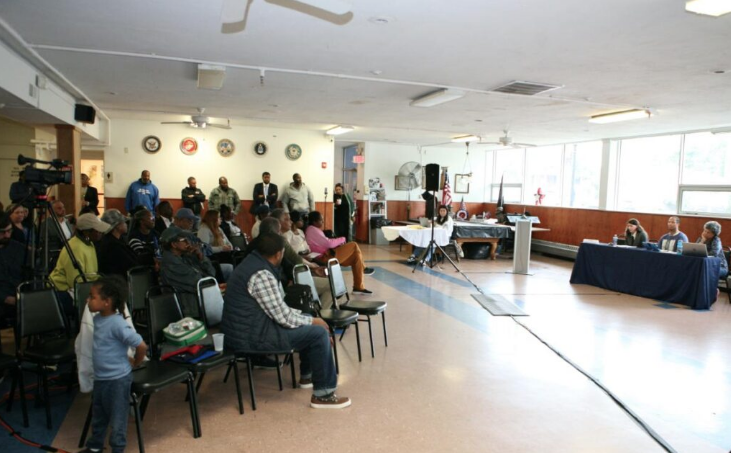
It was standing room only for a City Council hearing about the Blue Hill Avenue project that was held in June 2025 in the Carter Post in Mattapan Square. Story here. Seth Daniel photo
They also reveal significant anxiety—particularly among drivers, business owners, seniors and people living near the avenue—about traffic congestion, lost parking, and safety for those who would need to cross the road to access center-running bus platforms.
Neither of the MBTA reports resolves the key question: Does a majority of people in the neighborhood support the center-running bus-lane plan? But comments clearly show a strong interest in major physical improvements with general agreement that the draft design— which includes center-running lanes— would improve commute times, pedestrian safety, and a larger tree canopy.
Another report that surfaced in April 2026 through reporting by the online platform Streetsblog Mass brought new insight on responses gathered by the city of Boston in a winter 2025 survey that asked more pointedly about the center-running bus issue.
Conducted digitally with roughly 1,600 residents, it claims that 60 percent of respondent citywide said they “strongly” or “somewhat supported” the overall project, compared with 15 percent who opposed it. Another quarter had no opinion or said they lacked enough information.
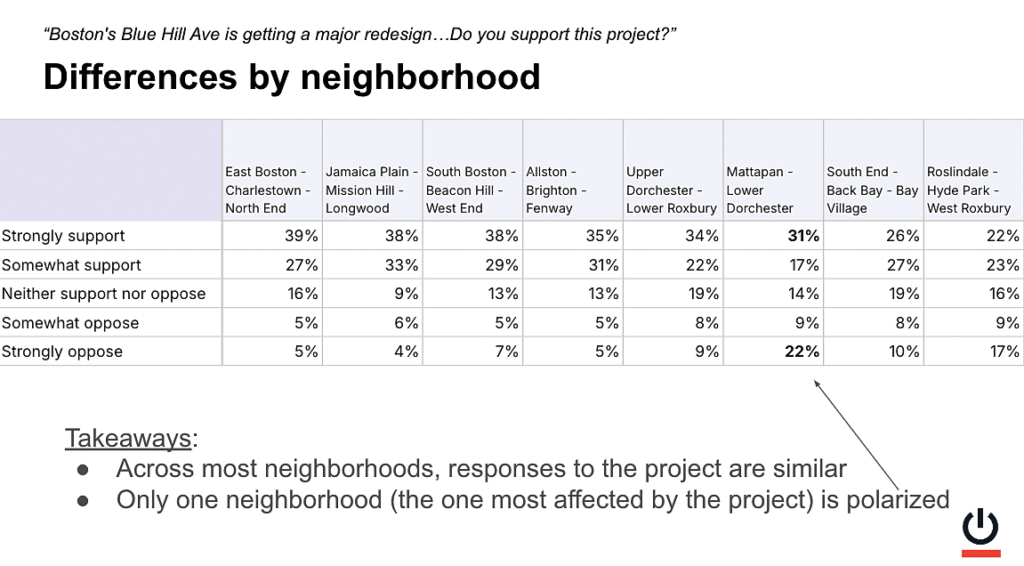
A chart included in a 2026 summary generated by the city of Boston based on a survey conducted in 2024 and 2025 shows a breakdown of support for the Blue Hill Avenue center-running bus project by neighborhood groupings. City of Boston graphic
Support was lower—and opposition higher—among respondents from neighborhoods near Blue Hill Avenue. Still, supporters outnumbered opponents there by 48 percent to 31 percent by the city’s count.
More recently, much of the discussion about the Blue Hill Avenue project has been framed by those who oppose it most stridently, with some of the most die-hard opponents having called on the Trump regime to pull funding to the state to achieve their goal of scuttling the project.
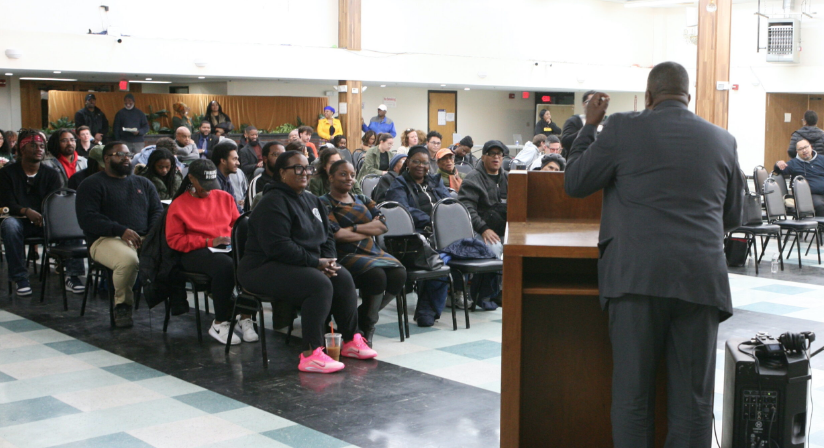
The last big forum (above) on March 26 was convened in Dorchester by Councillors Brian Worrell and Miniard Culpepper, who have become the most outspoken elected foes of the Wu-Healey administration concept. But even at that public meeting at the Reed Auditorium in Grove Hall— which was mainly dominated by opponents— there were voices who rose in strong support, including several young people who say they desperately want the faster commute times promised by the dedicated lanes.
And yet, as of this writing, it’s fair to say that the project— despite the years of discussion and debate— is now in a state of suspended animation, no closer to a final design than it was two years ago. Mayor Wu, the chief champion of the project, left a window open to revising it dramatically in her latest extensive public comments during a May interview on the DotLife podcast.
“Nothing is set in stone. Nothing is final in terms of the design,” Wu said. “We want to hold on to every dollar that can improve communities’ lives, but we also wouldn’t take federal money just because it’s there if it’s not a design that works for our community.”
