


By Gage Vieno
Reporter Fellow
Artificial intelligence has made it easier than ever for scammers to impersonate loved ones, government officials, and trusted businesses, Suffolk County District Attorney Kevin Hayden warned residents on Tuesday during a fraud prevention workshop in Dorchester.
Hayden joined representatives from the Boston Police Department, Boston Housing Authority, Metro Credit Union, Hebrew SeniorLife, Central Boston Elder Services, and other community organizations for the latest presentation of the Suffolk County Fraud Fighters initiative, a multi-agency effort his office launched in 2023 to educate residents about increasingly sophisticated scams.
The workshop, held at the Keystone Apartments on Hallet Street, focused on helping older adults and residents recognize warning signs of fraud while emphasizing that people of all ages have become targets.
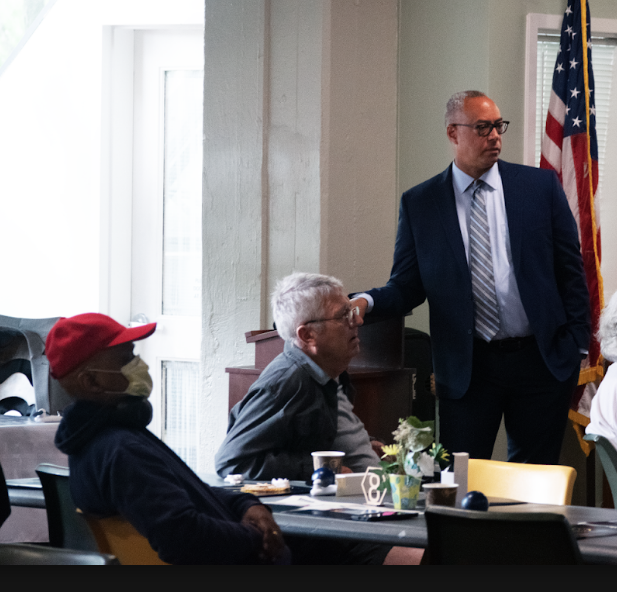
DA Kevin Hayden in the Sawtelle Room at Keystone Apartments on July 21, 2026. Gage Vieno photo
“We’re not giving you this information to try and scare you,” Hayden told attendees. “We want to arm you with reality.”
Presenters explained that scammers are now using AI tools to clone voices, create convincing fake videos, and build realistic online identities in just minutes. One demonstration showed how an audio recording of a person’s voice could be copied and used to create a fake emergency call asking family members for money.
“It is not just professionals,” Hayden said of the scammers utilizing this technology. “Anybody can do it.”
The presentation featured real-world examples of fraud, including romance scams, cryptocurrency investment schemes, fake government calls, and text-message scams that begin with seemingly innocent messages sent to random phone numbers.
One case highlighted during the workshop involved a retired individual who lost more than $1 million after developing an online relationship with someone posing as a young Boston woman. Organizers explained that the scammer used AI-generated audio and fabricated identities to gain the victim’s trust before persuading him to invest in fraudulent cryptocurrency opportunities.
The example underscored one of the workshop’s central messages: scammers often rely on emotional manipulation rather than technical expertise.
Rather than engaging with suspicious texts or social media messages, presenters repeatedly urged residents to immediately block and delete them.
“Take your card out, turn it around, and dial the 1-800 number of your bank because you know that’s a legit number.” said Hayden, regarding residents who might be pressured to give out bank information.
Organizers also demonstrated how scammers impersonate family members using AI voice-cloning technology. In one example, a grandmother received what sounded like a phone call from her grandson claiming he had been arrested and urgently needed money. The workshop advised residents to independently contact relatives before responding to any emergency request.
Hayden said the speed and accessibility of AI have changed the landscape of fraud, making awareness one of the public’s strongest defenses.
The presentation also warned residents about fake bank alerts, bogus technical support calls, gift card payment requests, and fraudulent text messages claiming to be from delivery companies or government agencies such as the RMV.
Representatives from Metro Credit Union explained that legitimate banks will never ask customers to click unfamiliar links in text messages and encouraged anyone with concerns to call the phone number printed on the back of their debit or credit card instead.
While many attendees were older adults, presenters emphasized that scams are no longer confined to seniors. According to statistics shared during the workshop, adults ages 18 to 25 experienced the highest number of reported scam incidents in 2025.
Hayden stressed that residents should not feel embarrassed if they become targets.
Instead, he encouraged people to pause before acting, verify unexpected requests through trusted contacts, and remember that scammers succeed by creating panic and urgency.
The Fraud Fighters initiative plans to continue bringing similar educational workshops to neighborhoods across Suffolk County as technology—and the scams that exploit it—continue to evolve.
