
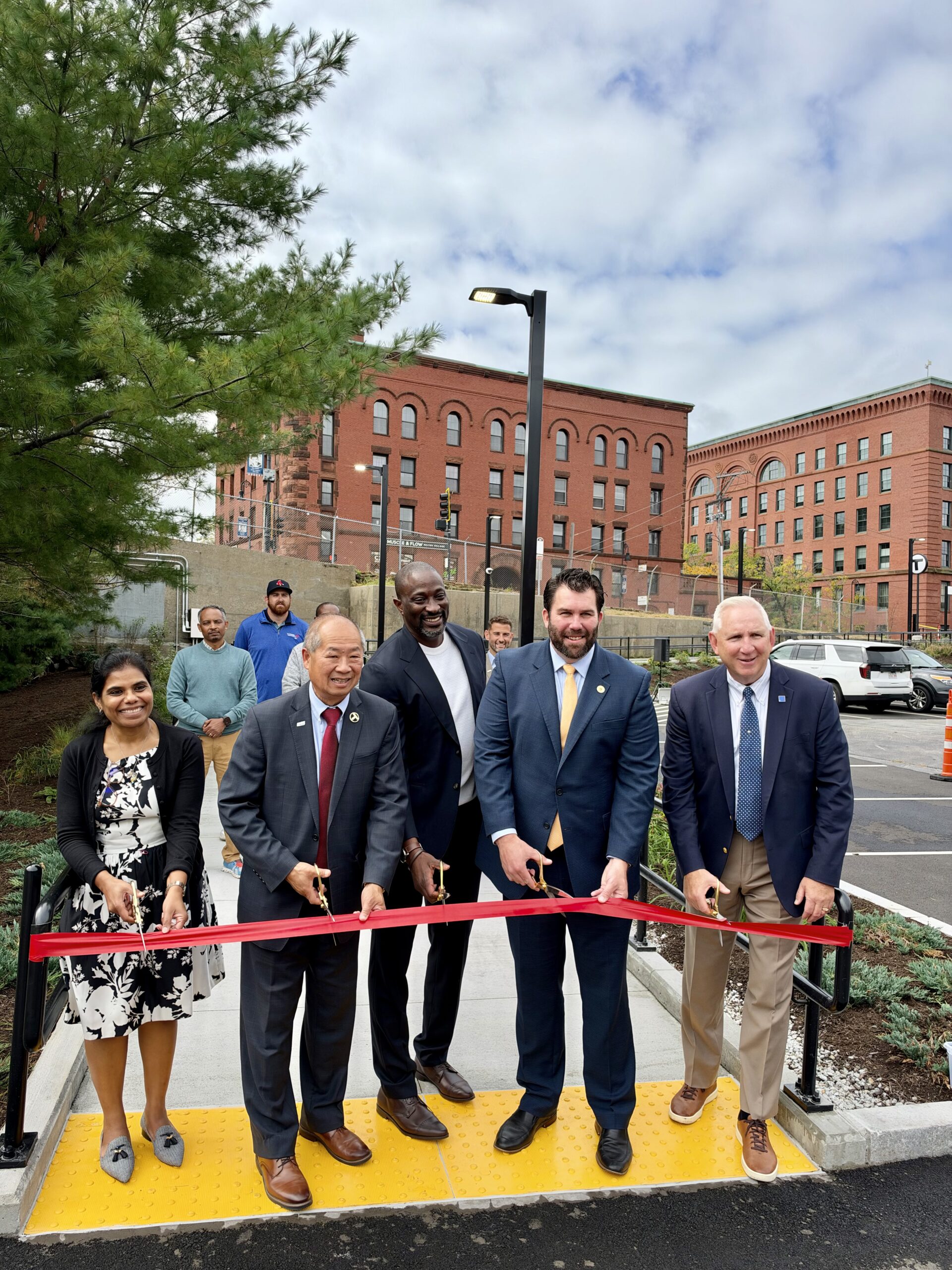
Above: Sen. Nick Collins chats with Hong Zhong, Nicholas You, Zachary Liu and Brian Lau at the Boston Asian Youth Essential Service agency on Harrison Avenue in Chinatown. Yawu Miller photo
Under a baking hot sun last Saturday, Latoya Gayle gathered at Sharon’s Park on Columbia Road with union members, city workers, and Mayor Michelle Wu to kick off a canvassing event.
“At this moment, we have so much coming at us, we can’t have our state senator being another obstacle,” Wu told the gathering of several dozen volunteers.
For Wu, that obstacle is incumbent state Sen. Nick Collins, who has represented the First Suffolk district since 2018 and whom the mayor blames for blocking her efforts to shift more of the city’s taxes from residential properties to commercial properties.
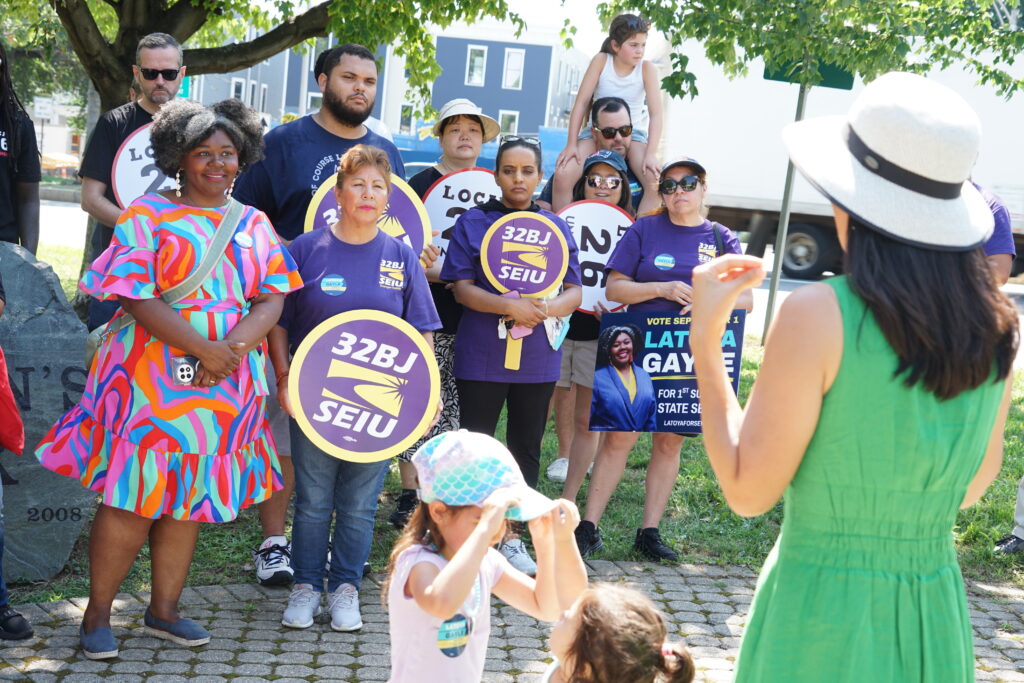
Mayor Michelle Wu addresses Latoya Gayle and members of SEIU 32BJ and Unite Here Local 26 as they gather for a canvassing event at Sharon’s Park in Dorchester. Yawu Miller photo
In this election season, she’s putting her mayoral muscle behind Gayle, who is challenging Collins, and Daniel Lander, who is running against Sen. William Brownsberger, lending campaign staff to the two candidates and staking them with significant political capital.
In Collins, Wu has taken on a formidable incumbent. First elected to the House in 2010, he has drawn on his roots as a city kid from South Boston and amassed substantial support while securing state funding for the First Suffolk’s many nonprofits, community development projects and services in a district that includes the Mass. and Cass area, much of the South End, Chinatown, South Boston, and parts of Dorchester and Mattapan.
“I’d say the top issues are roughly the same everywhere in the district,” Collins said in an interview. “Issues around affordability on housing, public safety, and public health, access to ob opportunities through job training education. We stepped in for funding for programs in Chinatown.
“We’ve been delivering services to the youth, to seniors, public health response to the issues surrounding to organizations. We’re proud supporters of the Tufts Medical Center. We got the state to put $54 million behind the reconstruction of the Quincy School and similarly to the Carter School.”
The senator boasts endorsements from labor unions including SEIU 1199, SEIU 509, AFSCME Local 1526, the International Brotherhood of Electrical Workers and Boston Firefighters Local 718.
For her part, Gayle has been endorsed by SEIU32BJ, Unite Here Local 26, The Mass Teachers Association, and AFSCME Council 93, among others.
Christopher “Tiger” Stockbridge, who joined Gayle at the Saturday canvassing event, cited Collins’s stance against Wu’s proposed tax shift in his support for Gayle’s candidacy.
“We need partners in government, not politics,” he said. “We deserve a senator who’s going to stand with us and put people ahead of politics.”
The tax-shift standoff between Wu and the state Senate is central to the race between Collins and Gayle, with Wu’s backing of the long-shot challengers to Collins and Brownsberger widely seen as political retribution.
For him, Collins said, commercial property tax rates were never the problem.
“Our job in the Senate is to work independently on our constituents’ behalf and get to the bottom of things,” he said. “The reason that people’s taxes were going up was because the city was over-assessing homes in middle class Boston, including parts of the South End, Dorchester, Mattapan, Roxbury, Hyde Park, South Boston, while Beacon Hill and Back Bay, were getting a tax cut.”

Sen. Collins spoke to the Columbia-Savin Hill Civic group in the spring. Seth Daniel photo
As for the overall rates, Collins said, the city’s businesses generate more than their share of the city’s revenue.
His point is backed by an April report from the Lincoln Institute of Land Policy, which found that Boston had the 49th lowest residential property tax rate among 53 major American cities. It also had the highest difference in commercial and residential rates, with businesses paying more than five times the rate at which residential properties pay.
Gayle, however, says the tax rate issue is gaining traction with voters.
“I knocked on the door yesterday of a woman who’s a senior who had told me, ‘I’m voting for you because I’m single, I’m a senior, and I’m struggling to pay my property tax bills,’” she said. “And that was all she needed.”
The union endorsements have helped both Gayle and Collins with door-knocking in the district. Both campaigns say they’ve hit doors of likely voters in every precinct.

Gayle walked in the Dorchester Day Parade last June. Yawu Miller photo
“We’re getting amazing responses on doors,” Gayle said on Saturday. “In so many ways, it almost feels like it’s an open seat because so many doors we knock on have no idea who the incumbent senator is.”
Gayle said voters’ top concerns are mainly cost-related issues, like rent control. Collins said he’s hearin constituents’ concerns around affordability, public safety, and the fallout from the Mass. and Cass area,
which he says impacts every section of the district.
On the latter issue, he cites funding he secured from the state to help the city’s public safety and public health response to the issues surrounding people struggling with addiction.
“The state subsidizes that effort significantly, not just through the Public Health Commission, but through the nonprofits like the Gavin Foundation, like Pine Street Inn, like Victory Programs and other programs that are both contractual and legislatively appropriated from the state.”
With 16 years in the State House under his belt, Collins rattles off a list of legislative accomplishments he says have delivered for the district: expanded liquor licenses for the city, $20 million a year for the city’s libraries and community centers, funding for youth programs and job training.
“I think we’ve demonstrated the ability to get things done through partnerships with local organizations,” he said. “We don’t get our ideas from sitting in the ivory tower and writing manuscripts and pontificating. We get it from being at community meetings — up to 50 a month — being in the community during the weekends and nights to hear what’s going on, to hear what the challenges are and how we can empower people.”
Collins’s ability to deliver for the district has earned him the respect of many of his legislative colleagues.
He has received endorsements from current representatives, including Dan Hunt, Brandy Fluker-Reid, John Moran, Chynah Tyler, and Christopher Worrell as well as former Rep. Marie St. Fleur and his predecessor in the First Suffolk, former Sen. Linda Dorcena Forry (who is co-publisher of The Reporter).
Worrell, who worked as an aide for Collins before running for office, said his interests often align with Collins’s.
“As a state rep now, our collaboration on bills and earmarks has been incredible,” he said. “He’s a great partner on the Senate side. We’ve gotten millions of dollars for organizations in the community.”
The campaigns are competing for votes in what many fear could be a low-turnout primary. Voters have already received mail-in ballots, with early voting beginning Sat., Aug. 22. The primary will take place on Sept. 1, three days before the Labor Day weekend starts.
