
‘We’re celebrating our music, culture, and food’
When Yadires Nova-Salcedo was the eight-year-old princess of Boston’s first-ever Dominican Festival in 1985, a gathering of a few hundred took place in Mozart Park in Jamaica Plain, a .75-acre playground on Centre Street that was the center of Dominican life in Boston at that time.
Overshadowed by Puerto Ricans and other Latino groups, Dominicans made up just 13 percent of the city’s Latino community.
Last Sunday, the 41st annual Dominican Festival parade went past Mozart Park on its way to the Playstead in Franklin Park, where it drew thousands of spectators for the traditional merengue and bachata of the island nation, as well as the reggaeton that has become a staple of the contemporary Dominican music scene.
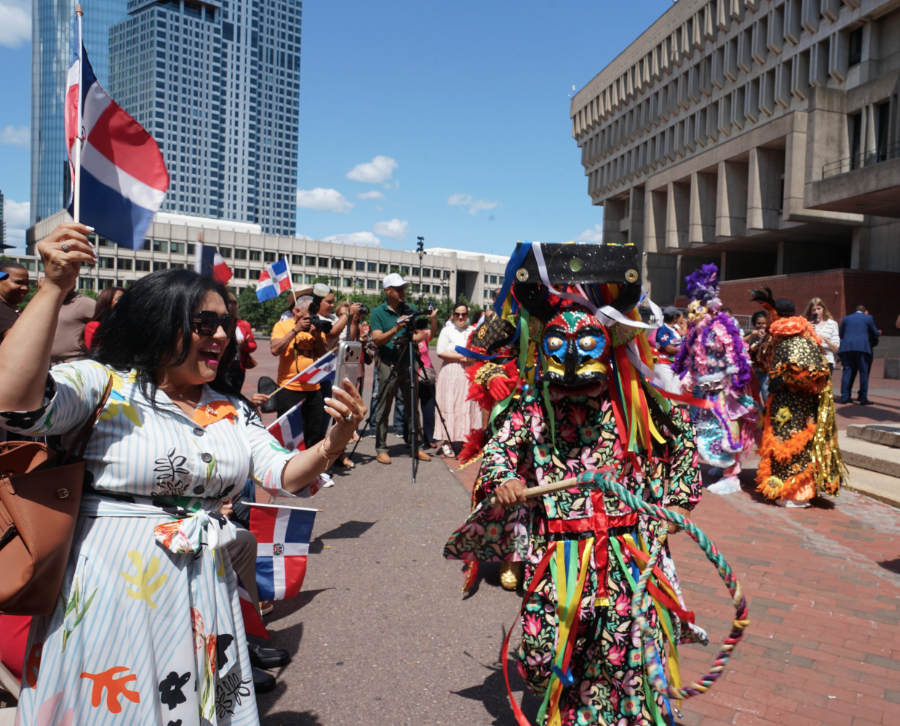
Yadires Nova-Salcedo watched Dominican dancers during a Dominican flag raising on City Hall Plaza last week. Yawu Miller photo
“We’ve grown tremendously in all sectors,” Nova-Salcedo told The Reporter on Sunday. According to the Boston Foundation’s Boston Indicators Project, the Greater Boston Dominican community increased in numbers from 18,332 in 1990 to 78,319 by 2017.
Over some 24 years, she served as host and producer of WBZ-TV 4’s Centro news segment and witnessed the growth of the Dominican community and the broader Latino community.
“I used to go crazy trying to find a Latino who was a teacher or lawyer to bring on the show,” she said. “Now there are Latinos in every profession.”
That includes three Dominican Boston city councilors, Julia Mejia, Enrique Pepén, and Henry Santana, as well as Dominican business owners, corporate executives and journalists. Nova-Salcedo’s son Angel covers sports for WCVB in Boston. Her daughter Angelina is a reporter with an NBC affiliate in Atlanta.
As the community has grown in numbers and stature, the Dominican Festival’s parade has become an important stop for politicians, with Mayor Michelle Wu, District Attorney Kevin Hayden, and state Sen. Nick Collins among those marching in last Sunday’s parade.
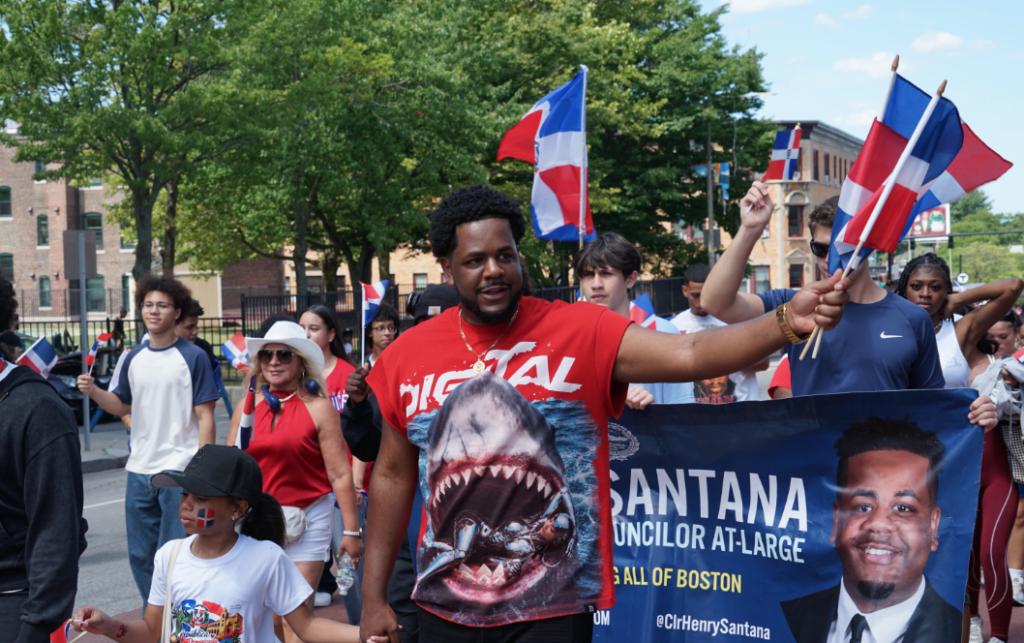
Councillor Santana and his contingent in Sunday’s parade in Jamaica Plain. Yawu Miller photo
“It’s one of the largest Dominican events in New England,” said Santana, an at-large member who was re-elected to his second term on the city council last fall.
Minivans and hatchbacks with massive speaker arrays pumped out merengue and reggaeton at sound levels that rattled onlookers’ fillings. Horseback riders demonstrated their skill as their mounts headed up Columbus Avenue with intricate paso fino footwork. Dancers in colorful, traditional Dominican costumes entertained onlookers. In the headline event, Grammy-nominated merengue star Toño Rosario sang at the Playstead to thousands of fans.
“You see all aspects of Dominican life represented here,” Santana said. “We’re celebrating our music, culture, and food.”
Today, 41 years after Nova-Salcedo’s princess appearance, Boston’s Dominican community has shifted from Jamaica Plain to points south and east, with many living in Roxbury, Dorchester, Mattapan, and Hyde Park.
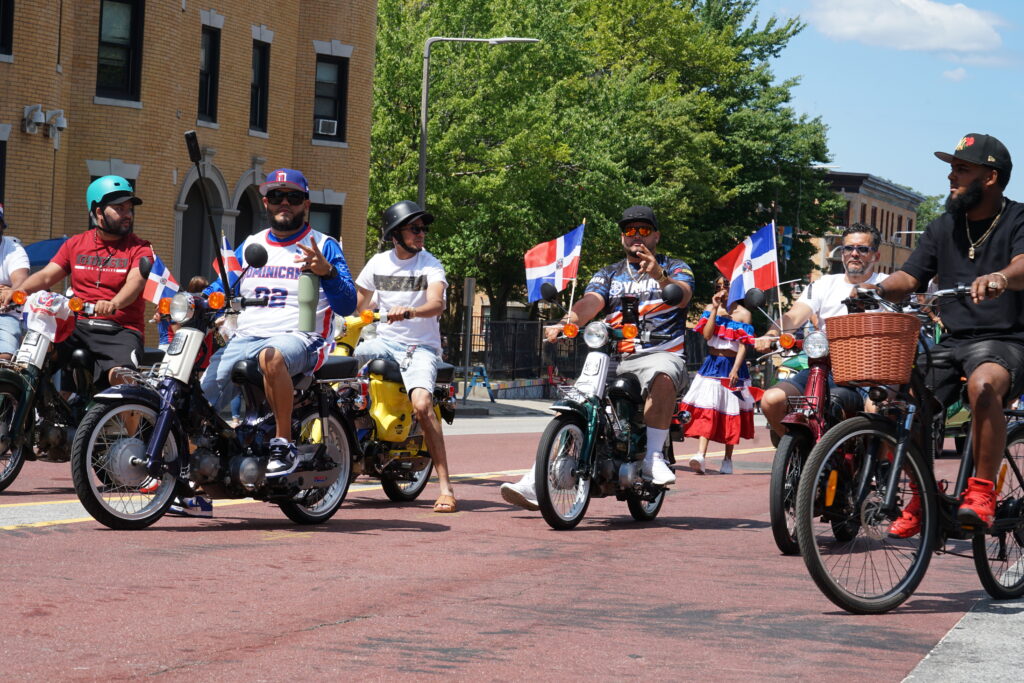
A scene from Sunday’s parade. Yawu Miller photo
“It’s changed a lot,” said Santana, who was born in the town of Bani in 1995 and came to Boston with his family in 1998. “We have a growing community, but we’ve been gentrified in so many ways.”
Nova-Salcedo, also from Bani, now serves as the Dominican government’s liaison for Dominican Culture in New England. “We teach children about our music, how to dance,” she said. “They learn the national anthem.”
Her ministry also teaches about the history and culture of the Dominican Republic, the significance of its flag, and what it means to be Dominican.
“Parents have too much to do,” she said. “They have too many jobs. They don’t have time to teach their children about the Dominican Republic.”
And, of course, she participates in the parade and festival. In 2015, she served as the grand marshal of the parade, and the festival remains one of her favorite events.
“To know that I was part of the very first one is amazing,” she said.
