

Copyright © 2026 Boston Neighborhood News, Inc. This content may not be re-published or re-used without written permission.
When three candidates running in the primary for the First Suffolk District’s state Senate seat gathered on Aug. 20 for a virtual forum organized by the Ward 13 Democratic Committee, the most contentious differences were between the incumbent, Nick Collins, and a figure not on the ballot—Boston Mayor Michelle Wu.
The exchange took place twelve days before the election date and two days before the start of early voting.
The district includes South Boston, Chinatown, most of Dorchester, and parts of the South End and Roxbury. Within Dorchester’s Ward 13, the district extends over seven precincts, from the Fairmount/Indigo rail line west of Uphams Corner, through Jones Hill and Savin Hill, to the Columbia Point Peninsula.
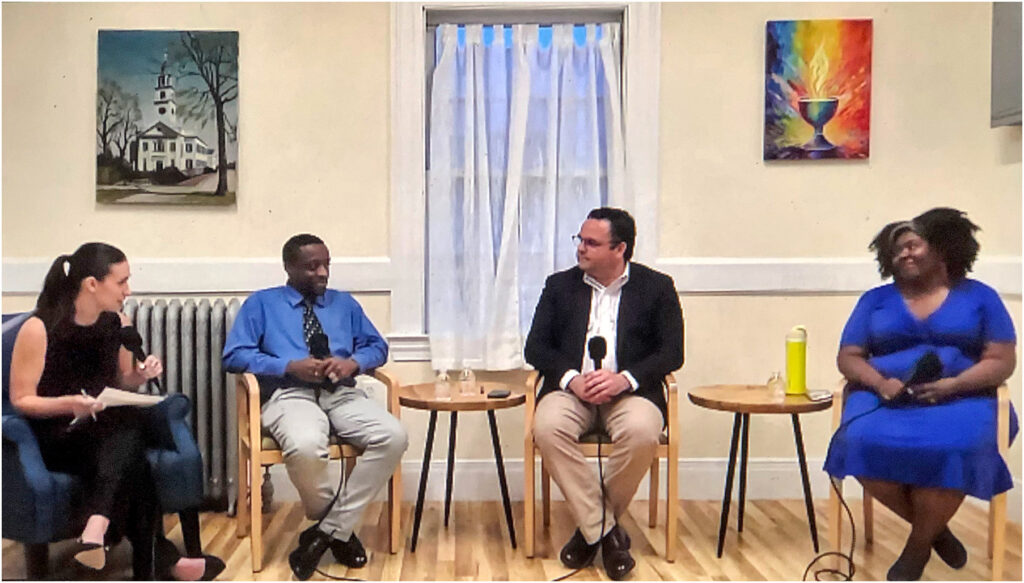
From left: Moderator Eve Zuckoff of WBUR, Juwan Skeens, Senator Nick Collins, and Latoya Gayle. Screenshot. Watch the entire forum here.
The event also took place two days after an update on a legal challenge to the Wu administration’s tax assessments on commercial property. Filed by owners appealing the city’s denials of tax abatements, the suit is being represented by the Pioneer New England Legal Foundation.
At a media briefing August 18, the foundation’s president, Frank J. Bailey, reported that the city had disclosed 150 properties affected by what he characterized as “retaliatory assessment increases.” He said he was told that the practice had since discontinued, but he estimated that appeals to the state’s Appellate Tax Board could take years to resolve.
In response, the Wu administration issued a statement saying: “The City’s Assessing Department accurately values over 180,000 properties each year, and our valuations continue to comply with the law and are certified annually by the state Department of Revenue.”
Even before the lawsuit was filed, Wu had clashed over the commercial property tax burden with Collins and Will Brownsberger, a Senate colleague whose district includes other parts of Boston. Both are also facing primary challengers backed by Wu.
The senators opposed a home rule petition sent to the State House by Wu and the City Council in 2024 that would have temporarily slowed a shift of the property tax burden from the commercial class to the residential class caused by a growing rift in property value trends, with commercial in overall decline and residential still increasing.
When introducing the petition, Wu cited a similar adjustment advanced twenty years earlier by former mayor Thomas Menino, during a similar trend in values. According to a 2004 report by the Boston Municipal Research Bureau (BMRB), the adjustment reduced the tax bill for an “average homeowner” that would have otherwise increased by 41.4 percent. After the measure had been adopted, the increase was 12 percent.
Triggered by a national economic downturn, Menino’s tax adjustment was designed to phase out in five years, and commercial property values in Boston, in line with the national economy, started to rebound as early as 2005.
In 2024, the BMRB summed up the adjustment as a “temporary solution,” though cautioning that Wu’s measure would have been applied to a more permanent “structural” challenge in demand for commercial real estate.
At last week’s forum, Collins criticized Wu’s model, the earlier tax adjustment advanced by Menino, as “a proposal that failed 20 years ago, that was a smokescreen for what we learned was the overassessment of middle-class homes in Boston that drove up people’s taxes.” Collins added that Menino, in the end, “abandoned it and moved towards new growth.”
In response to the Collins position, a city spokesperson said, “It hurts all of Boston to have a senator who is nowhere to be found when we need action from the state Senate during legislative session, then pops up in an election year to troll the mayor and City workers. This isn’t the first time Senator Collins has made false, insulting accusations about hardworking City workers after blocking tax relief that would have saved Boston homeowners more than $150 million in property taxes by now.”
In recent weeks, Collins has been highlighting another kind of property tax relief that would be more closely targeted to financially vulnerable homeowners, with a higher ceiling on income eligibility. The measure has been approved by the state Senate, but it still awaits action in the House of Representatives. Similar relief has also been approved in a city order, though neither measure specifies a new source of relief beyond city revenue.
Collins also blamed the higher tax burden for many Boston homeowners on regressive assessments that favored high-end properties. In 2025 report, the Lincoln Institute of Land Policy (LILP) generated an analytical tool to detect regressive assessments, in response to nationwide “findings of widespread vertical inequity.”
After applying LILP’s “vertical equity app” locally, the Boston Policy Institute (BPI) concluded last year that “all four classes of property suffer from regressive assessments whereby the owners of lower-valued homes in Boston are paying property taxes on a higher percentage of their home’s value than the owners of higher-valued homes are paying.”
The BPI noted that regressive assessments are frequently offset in Boston by an exemption for owner-occupants, which provides the highest percentage of tax reduction for owners of properties with lower values. As another source of relief for some owner-occupants, the LILP has recommended the “homestead exemption.”
Also flagging the imbalance in assessments was an analysis by the Small Property Owners Association (SPOA), a group representing “independent landlords and family-scale housing providers.” In a recent Boston Globe Op-Ed article, a SPOA director, Chris Lehman, cited a more recent LILP study reporting that Boston homeowners “have one of the lowest property tax rates of any major city in America.”
Though a low rate applied to rising values can strain some household incomes, Lehman observed that tax bills for homes with comparable values in the suburbs were about 60 percent higher.
“Those numbers make it difficult to argue that Boston homeowners are overtaxed or that shifting even more of the city’s tax burden onto commercial property is necessary,” he wrote. “They also make Wu’s decision to wield the issue as a political weapon against Brownsberger and Collins particularly difficult to defend.”
Not mentioned by The Globe was that Lehman was a Collins campaign contributor, as well as a co-founder of Groma, a Boston-based real estate and technology company. Also donating $500 to the campaign was the company’s other co-founder, Seth Priebatsch.
According to the media and data company Thesis Driven, Groma uses a proprietary Alternative Intelligence (AI) platform for acquiring, upgrading, and operating “small urban buildings” such as three-deckers, with ownership by a real estate investment trust. Due to greater cost efficiencies and standardization, the Groma model aims to make scattered-site properties more appealing to investors.
One of the “representative outcomes” reported by Thesis Driven last year was a six-unit building in Dorchester where rents, since acquisition, increased by about 20 percent. As of October 2025, the company’s initial model, the Groma Boston Growth Fund I, had acquired 39 buildings in Greater Boston, with 136 units.
The model led to a real estate trust with more than 100 properties and about 550 units in Greater Boston. As Thesis Driven explained, “Investors purchase shares in the trust rather than direct property interests, gaining exposure to hundreds of small buildings through a single, diversified platform.”
Shares with limited quarterly redemptions can be had by accredited investors putting up at least $1,000, and the company is even considering a way for residents of its buildings to convert part of their rent into ownership in the trust. The model is described as “participatory housing investment,” with shares “in the same long-term value creation.”
But a longtime Ward 13 resident, Cara Gillis, recently deplored the increasing share of homes in her neighborhood that were absentee-owned.
In a June 23 op-ed published by The Reporter, she wrote, “Spaces are carved into additional bedrooms to maximize rental income. Rents are so high that multiple roommates are often required to afford a unit, resulting in what was once three cars per property becoming six, nine, or more. The street was never designed to accommodate that level of density. Tenants come and go. Gardens disappear. Maintenance becomes the minimum necessary to protect an investment. Neighbors often don’t even know who owns the property next door, let alone whom to call when a problem arises.”
A posting of the commentary on social media prompted negative comments about new multi-unit developments approved by Wu. And Lehman himself blamed Wu for a host of problems in a post last October in “Pirate Wire,” a web newsletter founded by a venture capitalist commentator Mike Solana. According to The Atlantic, Solana had previously worked as chief marketing officer for Founders Fund, which is led by the politically influential venture capital mogul Peter Thiel.
The post in Pirate Wires targeted Wu on multiple fronts, from crime and exam school admissions policy to set-asides on affordable housing and construction jobs for Boston residents. Capped by a graphic picturing Wu against a flaming orange background crisscrossed with yellow crime-scene tape, Lehman’s commentary, titled “Is Boston Cooked?” cited the persistent problems with open-air drug use long associated with “Mass-and-Cass,” as well as Wu’s “commercial tax hike strategy.”
Lehman also faulted Wu policies, especially on higher set-asides for affordable housing, as a throwback to politics of redistribution and favoritism toward the politically dominant Irish-American population under Boston’s 20thcentury four-time mayor James Michael Curley. In a 2002 research paper, Harvard economists Edward L. Glaeser and Andrei Shleifer called it the “Curley effect.”
In “Pirate Wires,” Lehman ventured an update under Wu: “Less housing is built, and the housing that is built is more likely to be set aside for low-income residents. This raises costs for market-rate residents, limits the number of new market-rate residents who can move to Boston, and shifts the city’s population towards the low-income residents who have disproportionately voted for Wu – a page from Curley’s book.”
At the Ward 13 forum, the Senate challenger backed by Wu, Latoya Gayle, reaffirmed her support of the proposed temporary shift in property tax rates. She pointed out that the state had recently allowed a shift in rates for classes of property in Watertown. This capped the share of the levy on residential properties at 50 percent, a figure that, as Collins emphasized, was higher than the current level for residential property in Boston.
When asked about problems associated with open-air drug use, Gayle and second-time challenger Juwan Skeens spoke about access to treatment and enlisting support from other communities. After Gayle’s call for a “humane response” to struggles with addiction, Collins summarized emergency medical and recovery efforts supported by the state, but he also urged more “truth-telling” about criminal activity.
“Right now, it’s viewed in this way that is not truth-telling,” he said. “The centerpiece of what continues to allow that to perpetuate is human trafficking and prostitution, and a lot more people know about that than like to admit it. And I think when we start there, we’re going to see some changes.”
All three candidates expressed support for a version of a real estate transfer levy to raise new money for affordable housing. They all agreed on pending legislation that would allow communities to adopt rent control—a move opposed by SPOA. But Collins noted his opposition to a more restrictive rent control ballot measure that was struck down by the Massachusetts Supreme Judicial Court.
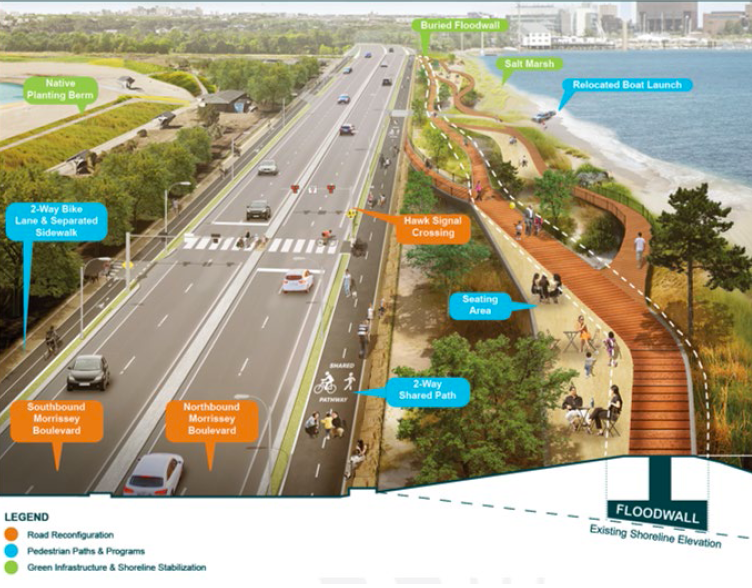
A rendering from the Morrissey Commission report.
Toward the end of the forum, the moderator, WBUR reporter Eve Zuckoff, asked for thoughts on efforts to increase climate resiliency for Morrissey Boulevard in the face of more frequent shutdowns prompted by rising sea levels. Collins had authored legislation for plans to be developed by a special commission, but he also brought up an issue on which the mayor has been accused of going too far — or not far enough.
“One item that I don’t think we need is to shrink the amount of lanes on Morrissey Boulevard to accommodate bike lanes,” he said. “We have a significant amount of area in and along the coastline. I’m very proud of the work we did to extend the Neponset Greenway, and I know some people here with a big hand in that in Ward 13, and being able to have safe cycling tracks is critical.”
Then Zuckoff turned to Gayle. “Should there be bicycle lanes on Morrissey Boulevard?” Gayle wondered.
“Why not?”
Copyright © 2026 Boston Neighborhood News, Inc. This content may not be re-published or re-used without written permission.
