


Copyright © 2026 Boston Neighborhood News, Inc. This content may not be re-published or re-used without written permission.
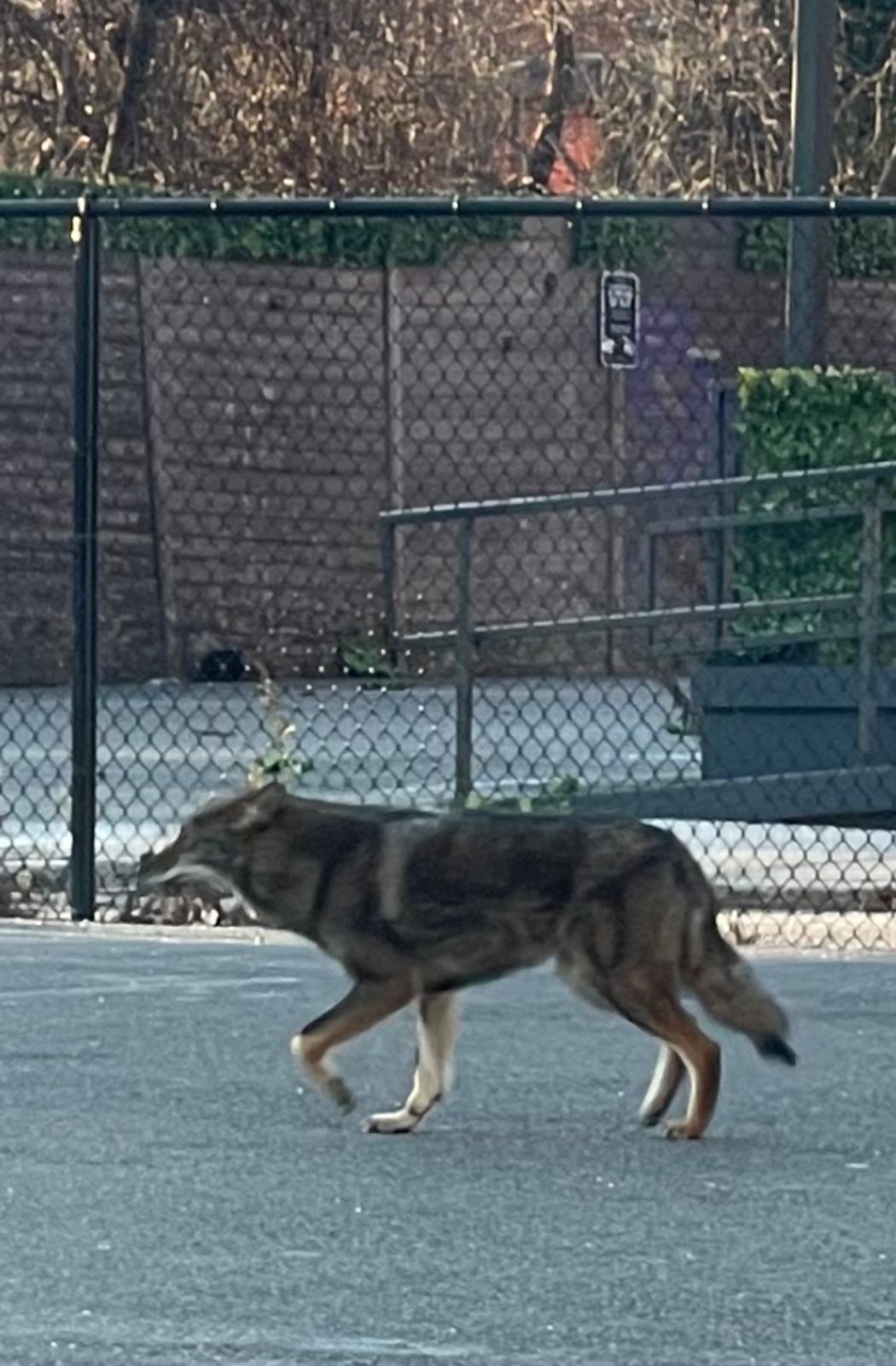
Photo: A coyote ran through a parking lot area near the Neponset River in Lower Mills earlier this year, one of the increasingly common sightings of the animals in the Lower Mills and Cedar Grove areas. Courtesy photo
A large airhorn sits at the ready inside Bobby MacEachern’s work truck at Cedar Grove Cemetery. It’s not meant to wake up the dead; it’s used to drive away the ever-increasing numbers of coyotes who congregate in the cemetery, around the edges of Dorchester and Mattapan, and, sometimes, in the central, most densely populated areas of the neighborhoods.
Coyotes, like turkeys and deer, have increasingly found a home in the city, and MacEachern said they’ve had to adapt.
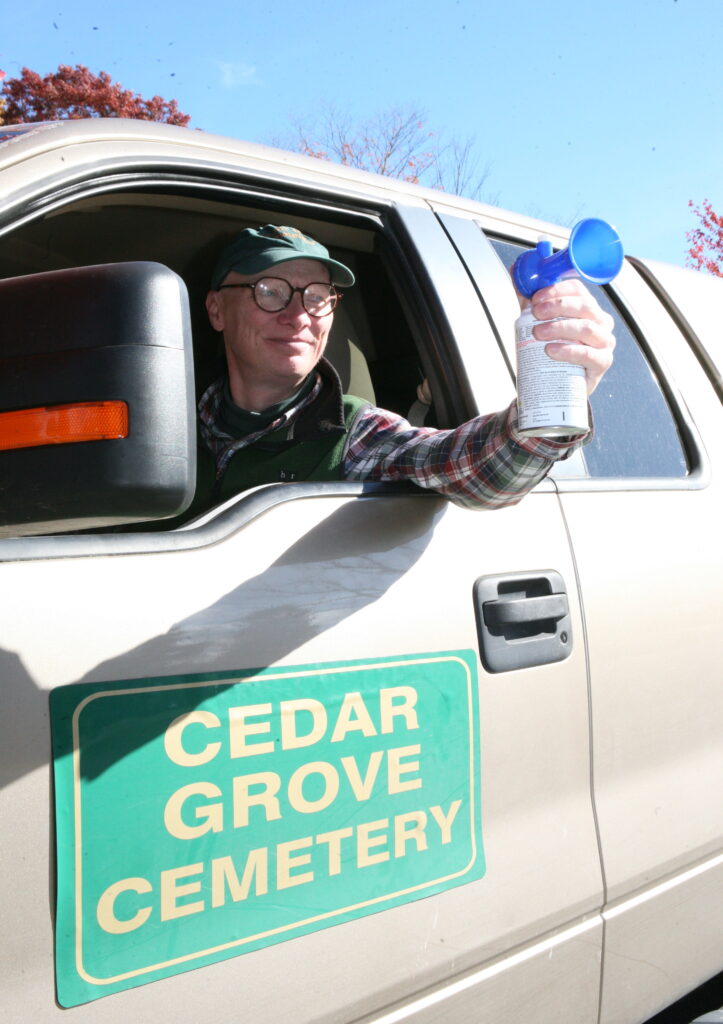
Bobby MacEachern, office executive at Cedar Grove Cemetery, shows off one of the airhorns that he and his staff use to drive away coyotes that increasingly congregate in the cemetery during the daylight hours when people are there. Seth Daniel photo
“Our first rule of thumb is to keep our distance,’ he said last week, “and we use the air horns to scare them away without having to make contact with them.”
Cedar Grove and many other parts of the neighborhood are fertile ground for a new study of the Eastern Coyote that was launched last month by a team of students and researchers at Amherst College led by Dr. Thea Kristensen, a lab instructor in the school’s Biology Department.
The group had already conducted an onsite study of the Eastern Coyote at the Quabbin Reservoir in central Massachusetts, and also launched a website designed to collect public-reported sightings statewide for mapping coyote populations and potential study sites.
With coyotes increasingly living alongside humans in urban environments like Dorchester and Mattapan, the team is just as anxious to get reports from cities as they are from more suburban or rural areas.
“The MassCoyotes project is one we really intend to engage with the community in the process and answer some questions about coyotes in our state,” said Kristensen. “Volunteers let us know where they see coyotes in particular. We love individual sightings and if folks have access to Ring Doorbell footage or a trail camera across their yard, that would be fantastic. In the end, we really want to help people and learn how they can co-exist with this species of coyote.”
She added: “It would be particularly exciting to contrast the coyotes living in Dorchester and the ones we study in the Quabbin and note differences in their behavior,” she said.
Kristensen told The Reporter that her student researchers only recently pivoted to MassCoyotes after a very successful seven-year project studying Black Bears dubbed “MassBears.” In partnership with the US Geological Survey, they gathered information on bears for a study published in September’s Scientific Reports.
The Eastern Coyote is just as misunderstood as the bear, she said, and she hopes this new project will provide a window into the lives of coyotes, helping the team better understand their behavior, activity patterns, and interactions with one another and their environment.
The sighting map will also help the team understand where in the state coyote habitats overlap with populations of people.
At Cedar Grove Cemetery, MacEachern said, they have “two resident families of coyotes” that keep dens in the cemetery.
“When I was a kid, we didn’t have wild turkeys or bunnies or as many coyotes,” he said. “Now with the bunnies around, it’s a food source for the coyotes. We have now put air horns in all of our vehicles. If staff see a coyote during the day when people are here, they use the air horn to drive them out of the cemetery and also to warn people there is a loose coyote.”
Other measures include always keeping dumpsters closed and frequently emptying rubbish barrels.
He noted that people not only come for quiet peace with loved ones interred at the cemetery, but also for exercise or to walk their dogs through the paths. He said he advises all of the above to take caution and always have pets on a leash.
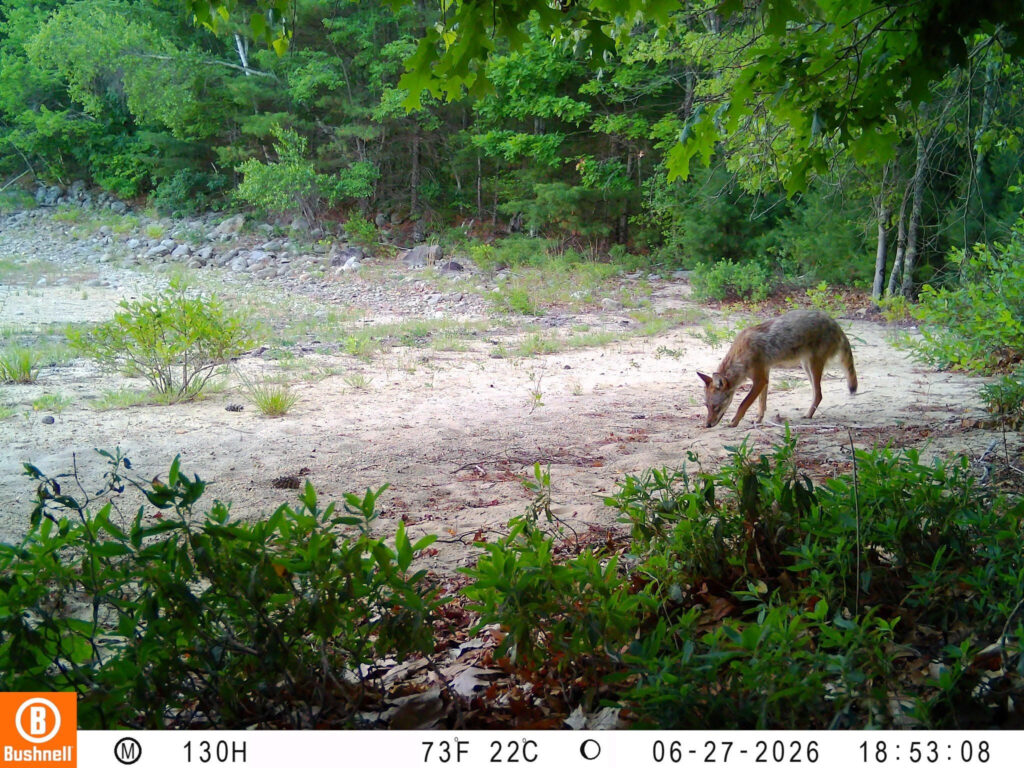
A coyote at the Quabbin Reservoir came out of hiding last summer during the onsite study by Amherst College. Students use trail cameras in the day and at night to capture the movements of the coyotes there. Courtesy photo
“These coyotes will come out of the blue and grab a dog, unfortunately,” he said. “You can’t trap them or kill them, and you don’t know how long they’ll be around. For the most part, we try to educate people and tell them how to deal with them. They are everywhere now.”
Such interactions are why Kristensen and her team launched MassCoyotes. She said there are two varieties of coyotes, the Western Coyote and the Eastern Coyote. The latter is usually a little bit larger than the western coyote and is a cross between a wolf and dog. They are typically bigger than a dog and often observed to be much faster runners. Their numbers Coyotes have been on the increase for some time after the populations were decimated in the Colonial era from overhunting of their food sources.
“Once the hunting pretty much stopped, we started seeing the species come back,” she said. “They are now able to live in a variety of different habitats. You see them in the Quabbin where it’s very, very rural and you also see them all the way into Boston in very urban areas. They are a very interesting species in that they can exist in a variety of these habitats and that’s why we want to map them and learn more about them.”
Said student researcher Faye Riebe, a sophomore: “Starting MassCoyotes is awesome for the group. Expanding our main area of focus beyond bears will give us a super well-rounded view of Massachusetts wildlife biology and ecology, and being able to do this alongside the community is great.”
Kristensen said the coyotes occupy a new frontier for study with the public, particularly since they are as interesting to researchers as to residents.
“I think they are fascinating, and I’m very interested in finding out how they relate to each other, with our original question being how they function as a family,” she said.
“A lot of folks haven’t thought about that to a great extent yet. I’m also fascinated with how we can better co-exist with them and connect with them where appropriate.”
Anyone who would like to log in a coyote sighting can do so by visiting https://masscoyotes.wordpress.amherst.edu/ . The Google Form asks several detailed questions about the sighting, including exact location, and allows one to upload photos for videos within the form.
Tips on coexisting with coyotes
Simply hearing or seeing a coyote in your neighborhood is not a cause for concern. However, you should take a few important steps to meet the moment.
• Remove or secure all human-associated food sources, including bird feeders, unsecured trash, open compost, outdoor pet food, fallen fruit from trees, and overripe garden vegetables. Never intentionally feed wildlife.
• Directly supervise and leash pets whenever they are outside. It’s the presence of the person on the end of the leash that prevents attacks.
• Hazing is a technique used to deter an animal from an area or change its behavior. You can haze a coyote by waving your arms or clapping while walking toward the coyote, making loud noises by yelling or using an air horn, spraying a hose, or throwing small objects, like tennis balls, in the animal’s direction.
Courtesy of MassWildlife
Copyright © 2026 Boston Neighborhood News, Inc. This content may not be re-published or re-used without written permission.
