
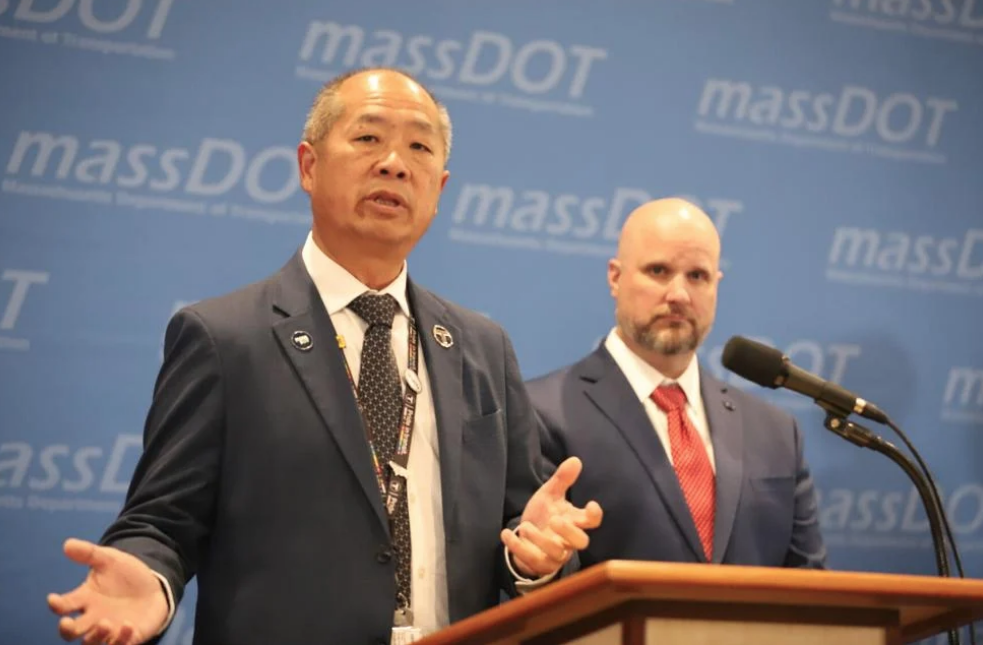
Above: Marvin Martin of the Four Corners Action Coalition spoke during a rally calling for a new station on the Fairmount Line at Four Corners. The rally— in August 2000— was held on a bridge that carries Washington Street over the Fairmount right-of-way. A station was opened near this site in 2013. Bill Forry photo
How is it that the Fairmount Line has become somewhat of a non-factor in the ongoing discussion about transit equity in Boston’s neighborhoods?
For three decades, this newspaper has chronicled a sustained movement by activists in Mattapan, Hyde Park, Roxbury, and Dorchester to galvanize support for new stations, cleaner and faster service, and full accessibility to a rail line that for many years blew through our communities without stopping.
The grassroots push to convert the Fairmount commuter line into an “Indigo” line that functions more like a rapid-transit corridor akin to the Red or Orange lines was born from the work of residents from groups like the Four Corners Action Coalition. It gained real traction in the 2000s and yielded breakthrough wins in the form of new stations at Newmarket, Four Corners, Talbot Avenue, and – most recently – Blue Hill Avenue.
These were not minor achievements. All together, the state poured roughly $175 million into new stations, upgrades to bridges and other stops, and new equipment.
Most recently, advocates and lawmakers successfully lobbied MBTA brass to electrify the Fairmount, a huge changeover that will allow for new rolling stock and more frequency on the line. It will cut travel times in half on weekdays and make the line a far more viable option for tens of thousands of commuters in our community.
It will also cost an additional $54 million to electrify the Fairmount and about $30 million per year to lease and operate the new battery-powered propulsion vehicles – BEMS – that will replace the current diesel locomotives.
In August 2024, Gov. Healey went to Morton Street station to celebrate the decision as “a big, big deal… long talked about by neighbors and we’re finally doing it.”
The governor said she hoped the T and its partner, Keolis, would beat a 2028 deadline, adding: “We’re going to do everything we can, pedal to the metal, to deliver this.”
Then last month, The Reporter published a story detailing an MBTA board decision that is expected to delay delivery and deployment of the electrified fleet until 2030. That’s disappointing, for sure. The MBTA says it’s still committed to delivering the new fleet and speeds, but this setback has raised anxieties about the outcome and the commitment.
That reaction makes it all the more maddening that the ongoing Fairmount upgrade is so rarely factored into the current heated debate about transit improvements in this part of the city.
When two city councillors— Miniard Culpepper and Brian Worrell— floated a concept to build a new Orange line subway spur into Mattapan from Ruggles Station last month, the Fairmount Line was less than an afterthought. It wasn’t even included on their poorly executed map depicting the current MBTA system.
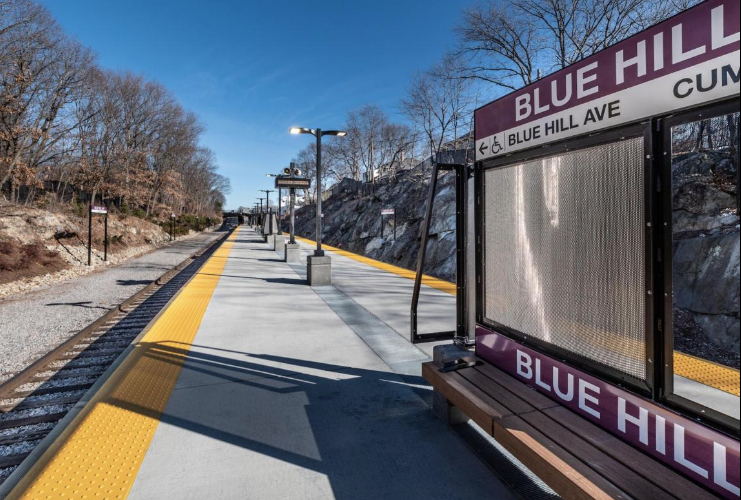
The Blue Hill Avenue station on the Fairmount Line opened in 2019. Reporter file photo
That’s absurd. The Fairmount Line is a very real rail corridor that runs through the same communities that are at the center of the debate over Blue Hill Avenue.
Is it a solution to all that ails us on the transit front? Far from it. But, to act like it’s not a critical part of the solution is an insult to neighbors whose many years of work have teed up a very tangible win, but one whose finishing touches continue to elude us.
It would be great to see a solid chunk of today’s political energy that is being poured into far-off subway concepts and bus-lane protests used instead on the Fairmount Line, which is — to borrow a football reference— in the “red zone.”
There should be an active and vocal Fairmount/Indigo caucus — composed of state, city, and federal leaders— all pushing for regular updates and deliverables on the electrification timeline and the promised new vehicles. Imagine how effective that same group could be in steering the MBTA and Keolis toward standardizing costs to city riders, who currently pay different fees based on nonsensical “zones.”
The people along the Fairmount corridor have already waited long enough. Let’s get focused on finishing that job. Electrify the line. Keep the timeline on track. Add frequency. Improve station access. Market it like it matters.
And stop leaving it out of the conversation.
