
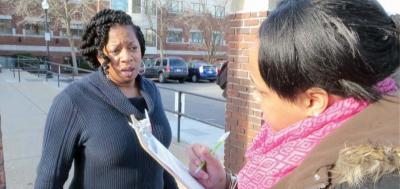
 Codman Academy students canvassed neighbors about their traffic-related concerns. Meggie Quackenbush photo
Dorchester’s Codman Square is getting a city-sponsored traffic study to address concerns over pedestrian safety in the neighborhood, thanks to the efforts of a group of tenth-grade students at Codman Academy.
Boston Transportation Department staff announced the study this week after meeting with Codman Academy students and faculty on June 8 to view a presentation on traffic from tenth-graders. The students conducted the study as part of their physics class in an effort to draw larger attention to their concerns over Epping Street, a one-way road that runs adjacent to the academy where a student was hit by a car last year.
“The study is important for the safety of not only Codman students and staff, but anyone in Codman Square. I got involved because I was a victim—it just interests me to want to help others,” said Jahdejha Henderson, a 15-year-old who was struck by a passing motorist while trying to cross the street to school.
She said she feels lucky to have survived her accident, but is concerned that other students might not have the same outcome.
Henderson and her classmates feel their study is especially pertinent because of Codman Academy’s new K-12 program, which will involve an expansion of its lower school into the Lithgow Building on Washington Street, across the street from the academy’s current Epping Street facility.
“Because of the little kids coming in, with the school opening across the street, we wanted to make sure there’s no more accidents on that street,” said Brianna Hollins, 16, who also participated in the project.
As part of the study, students undertook speed and traffic counts along streets in the area surrounding the academy. They found that traffic on Epping Street is much higher than expected, with many drivers speeding down the road in order to avoid a busy intersection in Codman Square.
Maggie Sachs-Mahmood, a physics teacher who helped lead the student’s traffic study, said some of their findings were alarming, including inadequate driver visibility at intersections near the school and poorly marked crosswalks. Most pressing for the students is their conclusion that Epping Street should ultimately be closed.
Yet some in the community are concerned that shutting the street down will backup traffic and eliminate coveted parking spaces in an already overly-congested area, Sachs-Mahmood said. Students and faculty at the academy, however, feel that the benefits of closing the street will far outweigh any negative effects.
“For safety’s sake, we think at least we need to start collecting more information via a study funded by the BTD in order to convince others that it’s not going to mess up their lives completely,” said Sachs-Mahmood.
“Hopefully through this study, our community can learn a great deal about the possibilities for improving the safety and overall experience of people moving through this space,” she said.
The students said they felt strong support from those who attended the meeting last week, including representatives from the Boston Police Department and from WalkBoston, a pedestrian advocacy organization that worked with the academy on its study.
“The Codman Area is very dynamic and WalkBoston is very pleased with the city’s commitment to making the area more walker friendly,” said Dorothea Haas of WalkBoston.
Boston Police Captain John Danilecki said police will step up enforcement and ticketing on Epping Street, and will work with the academy to hire crossing guards to improve safety at intersections near the school.
“The students did a remarkable job bringing this issue to our attention and showing that we need to make a change,” said Danilecki.
Vineet Gupta, director of planning at BTD, said the new city-funded traffic study will be the first step in Mayor Marty Walsh’s recently-announced Vision Zero Boston, a multi-city initiative that works to prevent traffic fatalities and injuries. He said the department will begin accepting requests for proposals for the study in the next couple of months. In the interim, BTD plans to collaborate with Boston Public Works to promote safety at Epping Street by repainting crosswalks and reducing crossing distances, Gupta said.
“BTD Commissioner Gina Fiandaca has made this one of her highest priorities,” said Gupta. “We at the city are very keen and committed to making improvements to the area.”
While students and faculty are pleased that smaller improvements will be made before the beginning of the next school year, they still think that a “huge change” needs to happen to make the streets around the academy more welcoming, Sachs-Mahmood said.
“My students are quite happy with the outcome of their hard work so far,” she said. “They are happy to hear that the BTD is interested in putting real reforms in place right away, but that the BTD agrees that more work needs to be done to study and reform this space.”
