
As the Boston Planning and Development Agency continues to guide and propel new construction starts across the city, Mayor Michelle Wu offered some new insights last week on how she might seek to introduce some reforms at the powerful agency, which has been a target of her critiques throughout her political career.
Specifically, Wu is moving ahead with legislative efforts that would eliminate certain powers— such as eminent domain takings— that were used by BPDA’s predecessor agencies to raze the South End and West End neighborhoods in the 1950s and early 1960s, displacing thousands of Boston families.
Wu is also in the process of hiring a cabinet-level chief of planning who will be tasked in part with a broad dismantling of its authority. And she filed an order with the City Council at the end of February to sunset – legislation that sets dates when a department or agency’s authority expires – the BPDA’s powers, calling the move “part of a broader effort to move past the tool’s legacy of displacement and neighborhood destruction.”
Fourteen urban renewal plans are active in Boston, and the city is seeking the immediate sunsetting of five that are in areas of Roxbury, as well as parts of downtown Boston. The other nine, to be sunset by law at the end of this year, include the Fenway area, and areas of Charlestown, Faneuil Hall, Government Center, and the South End, among others.
At a recent roundtable with neighborhood newspapers, the mayor was pressed on her plans for removing the BPDA’s urban renewal authority. Wu said the focus of urban renewal has largely been on downtown areas that are now built out. She declined to comment on the appropriateness of past multiple extensions of urban renewal powers.
“We are one of the few cities in the country that still carries forward a legacy that has been tied to displacement, the removal of communities in the past,” she told reporters.
According to Wu, if Boston is to reach its goals on housing affordability, access to transportation, and climate change resiliency, the city’s communities must be engaged. She noted that urban renewal’s approach represented a tilt of power toward internal decision makers in a moment of urgency, when blight was more widespread across the city.
“The maps don’t tie to the places where we see the greatest potential of equitable growth,” she said, referring to the areas that are the focus of the sunset legislation she is proposing.
Pressed to describe the areas of greatest potential for that growth, Wu said she meant swaths of land such as Widett Circle off the Southeast Expressway approaching downtown, the Allston neighborhood area near the Turnpike, and parts of Hyde Park and East Boston. Widett, which abuts Dorchester, was pitched as the location of a stadium for the Boston 2024 Olympics, an effort that collapsed due to lack of public support in 2015.
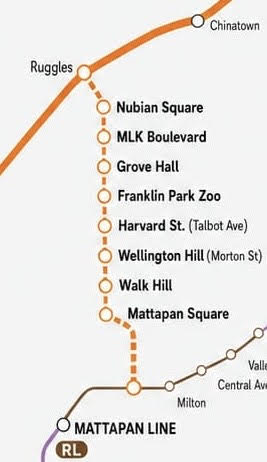
The urban renewal districts focus on downtown, parts of Charlestown and Roxbury, but don’t cover Mattapan, Hyde Park, and East Boston, Wu said.
The roundtable, held virtually on a recent Monday afternoon, also touched on housing production goals and the expected influx of biotech company employees in the coming years as developers seek to build lab space to meet market demand. Many of the jobs come with high salaries, raising fears that current residents will continue to get priced out of the city’s housing.
Asked about her elected predecessor’s housing goals — as mayor, Marty Walsh pushed for the city to have nearly 70,000 new units by 2030 — Wu said her administration is broadening the types of goals she hopes to deliver on. “At the same time, it’s not enough to just pick a number and build this many units of new housing,” she added, saying it must all be connected to other goals, such as climate change resiliency, and deployment of federal funds into specific projects that cover affordable homes for artists and seniors.
“We need to build the equitable, sustainable holistic communities that each of our neighborhoods deserve,” she said.
Pressed on whether this approach is a matter of too little, too late, Wu said, “In some ways we are already way late on the investments in affordability and infrastructure that are needed. We are doing our best to catch up and use this moment of federal funding and pandemic recovery to try to address, and redress, the past harms and delays. But we are definitely behind.”
The city has an affordable housing requirement for developers, but it applies to proposals with at least ten units, spurring some to put forward nine-unit proposals. Wu acknowledged discussing lowering the threshold further as a way to close such “loopholes.”
She said that city officials have to be supportive of several types of housing, and Boston is still waiting to see how the pandemic, and international instability brought about by Russia’s invasion of Ukraine, will affect the local market.
The mayor said her administration is putting together a group of community leaders, developers, academics, and others to dig into the volatile issue of rent control — which she has also referred to as rent stabilization — and offer specific solutions to the housing crisis.
