
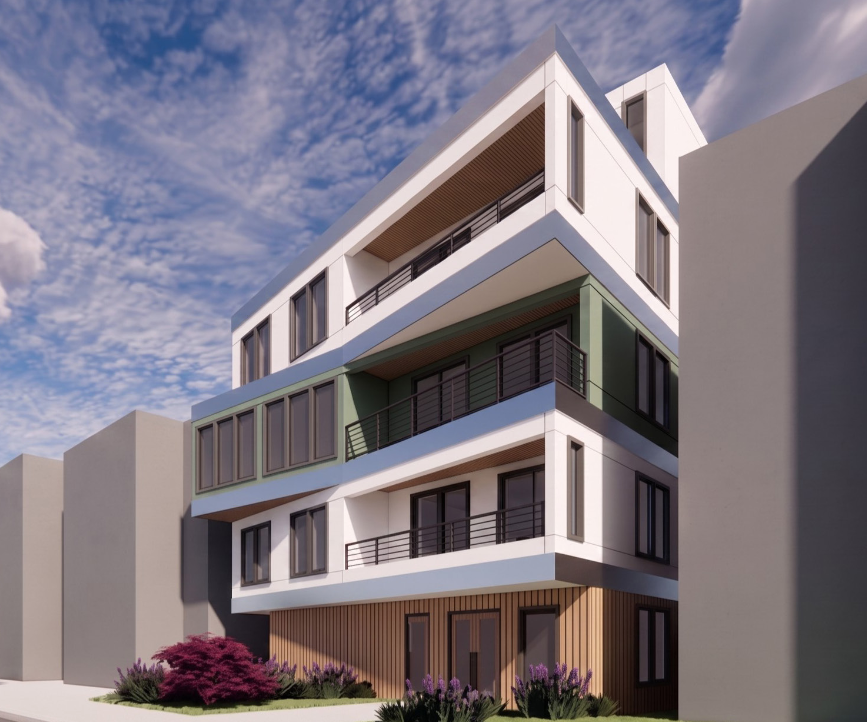
The city’s Office of Housing has released a Request for Proposals (RFP) on a series of 18 city-owned sites that have been packaged into 10 development opportunities along Blue Hill Avenue in Grove Hall.
The release at the end of April is the second grouping of vacant, buildable sites along the avenue to be released in the larger Blue Hill Avenue Action Plan. City officials said last month that the sites will be key elements toward the goal of preventing long-time residents and businesses from being pushed off the corridor as things ideally improve.
In 2021, the city released several sites located between Franklin Field and Morton Street that were dispersed to smaller development teams for affordable housing and affordable commercial spaces.
“We’re really excited to be continuing on and offering this second group, building on what we learned the first time around and the response we got back while also being mindful of the nuances of the neighborhood these groups of parcels are in,” said Jessica Boatright, deputy director of the Neighborhood Housing Division.
Added Project Manager Julio Pilier: “The community is as excited as we are to see these parcels put out for development and bring in projects that will create benefits for the community. These sites have been empty for a long time. Some have been put out as recently as 2016, but those projects didn’t move forward. We are excited to have them out again and to work with this community as we move forward on this process.”
Empty lots along Blue Hill Avenue have long been endemic to the environment. In many instances, they are the remnants of the 1970s, when the neighborhood was in disarray and buildings were being burned down or else neglected to the point where they had to be demolished. Attempts to develop them were made in the 2000s, but nothing significant emerged.
This time, with the full momentum of the Blue Hill Avenue Action Plan – and last year’s successful process farther down the Avenue – there is a great deal of optimism.
According to the AtlasScope historical map, two of the larger packages – one just south of Lawrence Street in Grove Hall and the other at the corner of Blue Hill and Intervale, the lots were undeveloped until the late 1890s – mostly serving as the home to the groves of fruit trees that gave the neighborhood its name. In 1895 the land on Lawrence was open and owned by a William Phipps. That lot was developed with wooden buildings by John and Mary Sheran in 1897.
The Intervale Street site was first built on by William Carp, who constructed brick commercial buildings there. It is uncertain exactly when those lots became vacant, but most assume that it happened in the 1960s and 1970s.
Eleven of the lots are in Grove Hall, while the other seven are farther up on the Roxbury line – between Quincy, Moreland, and Winthrop Streets. This group of lots, Pilier said, is the most diverse in size and potential of all the city’s Blue Hill Avenue lots.
“In the first group, they were mostly the same size,” he said. “We have here small sites and larger sites…One has 11,000 square feet, so there is opportunity to do something larger there. I think there’s room for a lot of variety and different types of projects in this package. We’re excited to see what developers will come up with.”
Once again, the city hopes to attract smaller development teams that are just starting out or have only a few projects under their belt. That was what happened last year with the previous round of lots, and by asking respondents to focus on one opportunity instead of many, officials hope to get homed-in projects from several smaller teams.
Housing will be a focus, Boatright and Pilier said, but the community also has other desires that were expressed in community meetings leading up to the RFP release.
“We’re really encouraging mixed-use developments like in the first group,” Pilier said. “People in the community want to see diverse types of businesses that eventually occupy these spaces and they want things that contribute jobs and things like restaurants to the neighborhood. In some sense, people want to see opportunities for community spaces like a dance center or museums.”
Another community priority is affordable commercial space for businesses now in jeopardy of being pushed off the corridor by rising rents.
The timeline for the RFPs includes a response deadline of July 26. After a review for qualifications, responses will be presented to the community at meetings in August or September. Boatright and Pilier said they hope to designate developers by the fall.
Boatright said there is one more grouping of lots to come, but that only includes two lots near Franklin Park that would be more difficult to develop. The lots released in this latestvround were “more straightforward,” she said. It was also a case of responding to the moment “while there is great deal of excitement for these opportunities.”
